






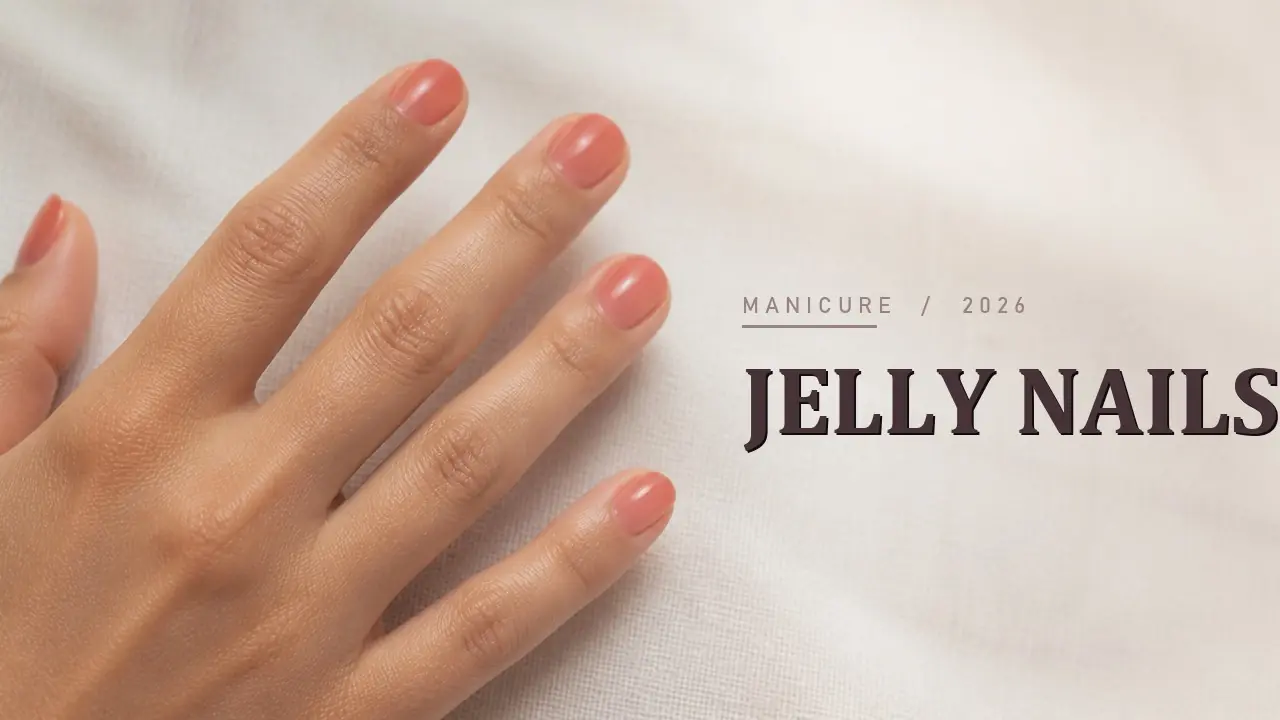
The jelly manicure is the defining nail look of May 2026 and the manicure that most home nail enthusiasts have been searching for the easiest way
Published · Updated

What is a jelly manicure and why it is trending in 2026
A jelly manicure is a nail polish technique that uses sheer, translucent colour built up in light layers to create a glossy, dimensional finish reminiscent of jelly or stained glass. Unlike a traditional opaque manicure, where each coat fully covers the nail, a jelly manicure stays deliberately see-through, allowing natural nail colour and light to pass through the polish and giving depth without darkness.
The trend gained popularity in 2026 for three reasons. First, it suits the broader nail movement toward “luminous naturals”, finishes that enhance rather than mask the nail underneath. Second, the sheer finish reads as light and breezy across both seasons, allowing it to transition beautifully from spring to summer. Third, it works at home with the polish many people already own; the technique is much more important than the specific product. Anyone who can paint a basic single-colour manicure can master a jelly manicure on their second or third attempt.
The look pairs naturally with the broader 2026 nail aesthetic that includes glazed doughnut nails for a pearlescent pearl finish, aura nail art for soft gradient centers, and the cleaner manicure styles favouring subtle accents over heavy embellishment. The jelly manicure sits in this family as the most accessible and the most transitional.
Jelly manicure vs gel manicure vs glazed donut nails
Confusion across these three looks is common because they share the glossy finish but differ in finish, application, and longevity.
A gel manicure uses gel polish cured under a UV or LED lamp, producing a high-gloss finish that lasts two to three weeks without chipping. A jelly manicure is a finish style rather than a product type; it can be done with regular polish or with gel polish. The defining feature of a jelly manicure is translucency, not the polish formula. A gel jelly manicure exists; so does a regular-polish jelly manicure.
A glazed doughnut nail is a specific finish that combines a sheer pearly base with a chrome powder topcoat, producing a pearlescent shimmer. It is more opaque than a gel manicure and uses chrome rather than translucent colour for the visual effect. The two looks overlap in popularity in 2026 but are distinct techniques.
A jelly manicure focuses on colour depth through translucency. A glazed doughnut focuses on iridescent surface shimmer. Gel manicure focuses on extended wear. You can combine any two of the three (a gel jelly manicure with chrome accent nails is one popular 2026 variation), but the techniques and goals are separable.
What you need for a jelly manicure at home
The starting kit is short. A nail file (180 grit for shaping and 240 for smoothing), a buffer block, a cuticle pusher, a base coat, a sheer or translucent colour polish, an optional white or pale opaque polish for layering opacity control, a high-gloss top coat, a cuticle oil, and a soft cloth for cleanup. You do not need a gel lamp, chrome powder, or speciality tools.
The single most important product is the top coat. A high-gloss, non-yellowing top coat is what creates the wet, jelly-like finish that defines the look. A matte or dull top coat will erase the jelly effect even if every previous step is perfect. Spend on the topcoat; save on the colour.
For colour, sheer-formulated polishes (look for descriptions like “sheer”, “jelly”, “milky”, “tinted”, or “wash”) provide the easiest path to the jelly effect. Opaque polishes can be diluted with a tiny amount of clear top coat to create a sheer version, but the consistency is harder to control than buying a sheer formula in the first place.
How to do a jelly manicure: 7-step tutorial
The seven steps below produce a clean jelly manicure that lasts five to seven days with regular polish. Skipping any step compromises either the finish or the wear time.
Step 1: Prep and shape
File the nails into an oval or rounded-square shape, as these shapes best show the jelly finish by maximising the flat surface area. Gently push back cuticles with a wooden or metal cuticle pusher. Lightly buff the surface of the nail with a buffer block to remove any residual oils that prevent polish adhesion. Wipe the nails with a clean cloth or a polish-remover swipe.
Step 2: Base coat
Apply one thin coat of a clear base coat. The base coat does two jobs: it protects the natural nail from colour staining and gives the sheer colour something to grip. Skipping the base coat is the most common cause of polish chipping within two days. Let it dry for one minute.
Step 3: First color wash
Apply the first coat of sheer colour in a thin, even layer from the base of the nail to the tip. Do not try to achieve full colour with this coat; it should look almost watery. Let it dry for two minutes. The thin layer is essential because thick layers cure unevenly and lose the translucent jelly effect.
Step 4: Sheer color layering
Apply a second thin coat of the same sheer colour over the first layer. The colour depth builds gradually. Most jelly manicures look best at two or three sheer coats rather than four or more; over-layering crosses into opaque territory and loses the jelly look. Let dry for two minutes after each coat.
Step 5: Optional jelly accent
This step is optional but adds the dimensional depth that distinguishes a gel manicure from a plain sheer manicure. On one or two accent nails, add a small amount of a contrasting sheer colour (a deeper rose over a pale pink base or a soft coral over a milky nude). Apply it with a thin brush in a horizontal stroke across the tip or centre of the nail. It is not a collision of colours but an intentional layer of jelly that is the accent.
Step 6: Glossy top coat
Apply a generous coat of high-gloss top coat to all nails. This is where the jelly effect comes alive. The top coat seals the colour and gives a wet, glassy finish. Use slightly more product than you would with a normal manicure. Let it dry for five minutes.
Step 7: Cuticle oil finish
Once the top coat is dry to the touch, brush a small amount of cuticle oil around each nail and onto the cuticle area. Cuticle oil hydrates the surrounding skin and adds a final layer of shine that complements the jelly finish. It also helps the manicure look polished and “finished” rather than DIY. For ongoing nail health that supports any manicure, our guide to stronger, healthier nails covers daily habits that extend the wear time of any home manicure.
Best jelly manicure colors for May 2026
The jelly manicure colours trending in May 2026 are grouped into three families. Each suits different skin tones and outfit palettes.
Coral and peach jellies
Sheer corals and warm peaches are the standout colours for the spring-to-summer transition. They read as fresh, sunlit, and vacation-ready without being too summery for May. Best on warm-toned skin and outfits in cream, soft denim, and warm pastels. The coral jelly manicure was the most-photographed nail look on Pinterest in early May 2026.
Milky pink and nude jellies
Milky pinks and translucent nudes are the safest everyday jelly choice. They flatter every skin tone and work with every outfit. The 2026 versions lean slightly cooler than the standard pink-nude of past years, with a touch of mauve or blue undertone that keeps the look modern rather than soft and delicate.
Sheer berry and rose
For those who want more colour presence without crossing into bold territory, sheer berry and translucent rose are the next step up. The depth reads as more polished and slightly more sophisticated than the pale pinks while staying within the jelly-like translucent finish. These shades are particularly flattering on cool-toned skin and pair well with denim and white.
Jelly manicures on short vs long nails
Short nails take to a jelly manicure beautifully. The smaller surface area means the translucent colour reads as a clean, deliberate finish, rather than as an underapplied opaque polish. Short oval or short squoval shapes look most current with the 2026 jelly trend.
Long nails (almond, stiletto, and coffin) can also wear a jelly manicure but require more attention to the layering. The larger nail surface tends to show coverage unevenness more, so each thin coat must be applied with extra care. The payoff is dramatic: a long jelly nail catches light beautifully along its length.
Square nails (flat tip, sharp corners) are the least flattering shape for a jelly manicure because the sharp geometry contrasts with the soft fluid look of the jelly finish. If you prefer square shapes, soften slightly to a squoval (square-oval) to bridge the difference.
Common mistakes that kill the jelly effect
Five recurring mistakes account for most failed home jelly manicures.
First, applying coats too thickly. Thick coats of sheer polish cure unevenly, trap air bubbles, and lose the translucent jelly look. Thin coats, even if it requires three or four to build the depth, are non-negotiable.
Second, using the wrong polish. Fully opaque polish cannot produce a jelly finish, no matter how thin the application. Look for “sheer”, “jelly”, “milky”, or “wash” descriptors on the bottle.
Third, either skip the top coat or use a matte top coat. The high-gloss top coat is what makes the jelly effect look wet and glassy. Matte or low-gloss top coats erase the entire effect.
Fourth, applying over poorly prepped nails. Oily nail surfaces cause sheer polish to streak and bead. The buffer-block step and the cleanup wipe are quick but essential.
Fifth, rushing dry time. Sheer polish needs more dry time between coats than opaque polish because the thin layers stay slightly tacky longer. Build in a full two minutes between coats. Smudging at the top coat stage ruins all the previous work.
How long jelly manicures last and how to extend them
A home jelly manicure with regular polish lasts five to seven days before noticeable chipping. A gel jelly manicure lasts two to three weeks. The wear time can be extended in either case by reapplying a thin top coat every two or three days, which both reinforces the glossy finish and seals fresh polish over any tiny edge wear.
Daily cuticle oil application extends wear time meaningfully. Dry cuticles and dehydrated nails are more prone to lifting at the polish edge. A few drops of oil massaged into the cuticles each night keeps the surrounding skin pliable and the polish base intact.
Avoid harsh detergents, hot water immersion, and abrasive scrubbing for the first 12 hours after application. Wear gloves for dishwashing and cleaning. These small habits routinely extend a jelly manicure from five days to a full week.
For a broader context of nail-colour trends in 2026, our overview of celebrity nail trends shaping 2026 manicure styles shows how the jelly look fits into the wider conversation.
Frequently asked questions
What is the difference between a jelly manicure and a regular manicure?
A jelly manicure uses sheer, translucent polish in thin layers to create a glossy, dimensional finish that allows light to pass through the colour. A regular manicure uses opaque polish that fully covers the natural nail. The defining feature of a jelly manicure is the see-through quality of the colour, not the polish formula itself; both regular polish and gel polish can be applied in a jelly style.
Can I do a jelly manicure without gel polish?
Yes, and most home jelly manicures use regular polish. The technique (thin sheer layers and a high-gloss top coat) produces the jelly effect regardless of whether the polish is regular or gel. The trade-off is wear time: regular-polish jelly manicures last five to seven days; gel jelly manicures last two to three weeks.
How many coats does a jelly manicure need?
Two to three thin coats of sheer colour, plus a base coat underneath and a high-gloss top coat over. Four or more coats tend to lose the jelly translucency and start to look opaque. The exact number depends on how sheer the chosen polish is; very sheer formulas may need three coats, while medium-sheer formulas usually look right at two.
What colours work best for jelly manicures?
Sheer corals, milky pinks, translucent nudes, sheer berries, and rose tints are the most photographed jelly manicure colours for May 2026. Cool-toned skin tends to favour pinks and berries, while warm-toned skin tends to favour corals and peaches. Translucent nudes flatter every skin tone and are the safest everyday choice.
How long does a jelly manicure last?
A regular-polish jelly manicure lasts five to seven days before chipping. A gel jelly manicure lasts two to three weeks. Daily cuticle oil application and a refreshing top coat every two to three days can extend the manicure by a few days. Avoiding hot water, harsh detergents, and abrasive scrubbing in the first 12 hours after application also extends wear meaningfully.
Will a jelly manicure work on short nails?
Yes, and short nails are arguably the best canvas for the trend. The smaller nail surface reads as deliberately translucent rather than underapplied opaque. Short oval or short squoval shapes are the most current pairings with the 2026 jelly aesthetic. Square nails with sharp corners are the least flattering shape because the geometry contrasts with the soft fluid look of the jelly finish.
Related Articles
- Glazed Donut Nails: The Pearlescent 2026 Manicure Everyone Wants
- Aura Nail Art: How to Create the Viral Blurred Gradient at Home
- Water Marble Nail Art: A Step-by-Step Tutorial for Stunning Designs
About The Author

COMMENTS