




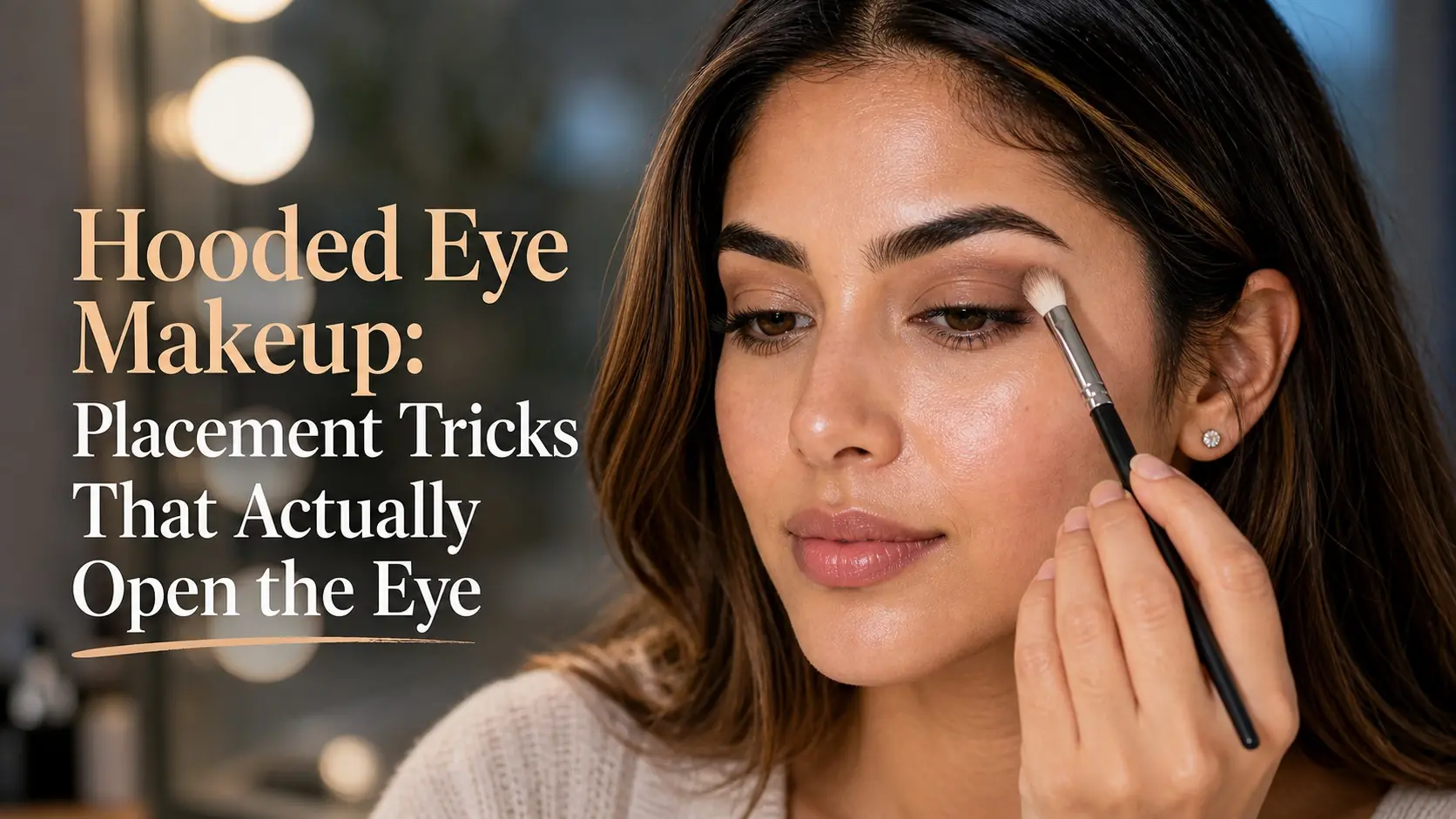
Hooded Eye Makeup: If you have ever followed a makeup tutorial step by step, recreated the exact looks shown on screen, and still ended up with eyes t
Hooded Eye Makeup: If you have ever followed a makeup tutorial step by step, recreated the exact looks shown on screen, and still ended up with eyes that look heavy, closed, or smaller than when you started, you are not doing anything wrong. The tutorial was simply never designed for your eye shape. Hooded eye makeup is its own discipline, with its own rules, its own placement logic, and its own vocabulary of techniques that differ fundamentally from what works on deep-set, almond, or round eyes. Once you understand why standard advice fails and what the alternative approach looks like, every product in your collection becomes significantly more useful. This guide covers everything: the anatomy of hooded eyes, the core placement rules, eyeshadow mapping, liner strategies, lash tips, brow shaping, no-shadow looks, three complete tutorials at different intensity levels, and answers to the most common questions asked by people with this eye shape. Whether you are brand new to makeup or have been struggling with this for years, the information here gives you a reliable foundation to work from.
Published · Updated
The anatomy at play involves the brow bone, the orbital rim, and the distribution of soft tissue between those two structures. In a non-hooded eye, the crease sits visibly below the brow bone, and the mobile lid is clearly defined and visible when the eye is open. In a hooded eye, the excess skin creates a secondary fold that either sits at or below the crease line, effectively hiding whatever you applied to the lid the moment you open your eye.
This is the core problem with standard tutorials: they are filmed and photographed with eyes open but designed for an eye shape where the lid stays visible in that open position. When a tutorial instructs you to place a transition shade “just above the crease”, it assumes the crease is visible when you look forward. On hooded eyes, that shade disappears completely the moment the eyes open. The only way to see it would be to look down, which is not the goal.
Standard tutorials also frequently recommend tight, precise liner along the entire upper lash line, including the inner corner. On a hooded eye, a thick, complete liner stripe can visually shrink the eye by compressing the visible strip of lid space. Smudging and transferring onto the browbone is another common result, because the skin above the lash line presses against the browbone area throughout the day.
Understanding these structural realities is not discouraging. It is clarifying. Once you know the rules of the playing field, you can work with them rather than against them.
The Four Core Rules of Hooded Eye Makeup
Every technique in this guide flows from four foundational principles. Internalising these rules makes it easier to adapt any tutorial or trend to your specific eye shape.
Rule One: Place Everything Higher Than You Think
Because the hood conceals the lid when your eyes are open, shading and definition need to be placed above where they would go on a standard eye. When you apply eyeshadow with your eyes closed, you need to visualise where it will land when you open them. The standard instruction to blend “into the crease” becomes “blend above the crease, onto the brow bone” for hooded eyes. Placing colour at the actual crease line often means it simply vanishes.
A useful technique is to apply shadow with your eyes open rather than shut. Look straight into a mirror and apply the transition shade where you want it to appear visually, even if that means going into what looks like browbone territory with your eyes shut. This counterintuitive approach produces dramatically more visible results.
Rule Two: Keep the Lid Light and the Perimeter Dark
Depth and darkness compress visually. Applying a dark shade across the entire lid on a hooded eye reinforces the heaviness that already exists. Instead, keep the centre of the lid relatively light or even bright, and concentrate darker shades at the outer corner and outer crease area. This creates the illusion of lifting the eye outward and upward rather than dragging it down.
This principle holds even in dramatic looks. Even when working with smoky eyes or bold colours, the lightest point should be somewhere on the lid itself, with depth built at the perimeter. The contrast between the lighter centre and darker edges creates the dimensional effect that makes eyes appear more open and lifted.
Rule Three: Extend Outward and Upward at the Outer Corner
The outer corner is the most powerful tool in hooded eye makeup. Extending shadow, liner, or both upward and outward at the outer corner creates a visual lift that counteracts the downward pull of the hood. A cat-eye flick, a winged liner, or simply blending the darkest shade in an upward diagonal at the outer corner all serve this purpose.
The direction of this extension matters enormously. Straight horizontal extension makes eyes look wider but does nothing for the heaviness created by the hood. An upward angle, following the lower lash line extended toward the tail of the brow, creates the lifting illusion that most hooded-eye wearers are after.
Rule Four: Check Your Work with Eyes Open
This sounds obvious but is consistently skipped. Because standard makeup instruction teaches you to blend and assess with eyes closed or partially closed, many people finish an entire look without checking what it actually looks like from the front. For hooded eyes, the difference between eyes closed and eyes open can be extreme.
Develop the habit of stepping back and looking at your full face, both eyes open, from a normal viewing distance, at every stage of application. If a shade has disappeared, move it higher. If liner looks thick and closing, thin it at the inner corner. Constant open-eye assessment is the single habit change that makes the biggest difference for hooded-eye makeup results.
Eyeshadow Placement Map: Cut Crease Versus Diffused Techniques
Eyeshadow technique for hooded eyes generally falls into two main camps: the cut crease approach and the diffused blend approach. Both are valid. Choosing between them depends on your preference for precision, the look you are going for, and how much of your hood is visible when your eyes are open.
The Cut Crease for Hooded Eyes
A traditional cut crease uses concealer or a matte flesh-toned base to carve a clean line above the crease, creating a sharp boundary between the lid colour and the crease colour. On hooded eyes, this technique is modified to account for the fact that the crease itself may not be visible.
For a hooded cut crease, you map the line above where your crease actually sits, sometimes a full centimetre above it, using the open-eye position to determine the correct placement. Apply a matte medium-brown or taupe shade as a transition colour across the entire area from lash line to brow bone with your eyes open, focusing on the upper half of that area. Then, using a flat brush and a slightly lighter matte shade or a skin-toned concealer, press a clean line along the lower edge of that transition shade with eyes open. This creates the illusion of a visible crease where one is otherwise hidden.
The cut crease technique requires practice and a steady hand but produces the most dramatic lid-opening result. The sharp line between lid and crease colour visually defines the eye in a way that mimics the natural crease depth of a non-hooded eye.
The Diffused Blend for Hooded Eyes
The diffused blend is softer, more forgiving, and better suited for everyday wear. Rather than a sharp line, you build up shading in a gradual gradient from the lash line upward, making sure the deepest point is at the outer corner and the transition is blended well above where the crease sits.
Start with a matte transition shade in light brown, taupe, or whatever neutral suits your skin tone, and apply it across the upper crease area using a windscreen-wiper motion with a fluffy brush. Then add your deeper shade at the outer third of the eye, blending upward and outward in a diagonal. The key is extending that deeper colour up enough that it remains visible when your eyes are open. Finish with a light, reflective shade on the centre of the lid to draw the eye forward.
The diffused blend is faster, works with a wider range of eye shapes and hood severities, and is the better starting point if you are still learning what placement heights work for your specific eyes.
Shimmer and Glitter Placement
Shimmer and glitter reflect light and visually expand whatever area they cover. On hooded eyes, placing shimmer in the centre of the lid or at the inner corner creates a brightening, opening effect. Avoid placing shimmer in the outer corner or along the lower lash line exclusively, as this can emphasise heaviness rather than counter it.
A small point of shimmer at the inner corner tear duct area is one of the most effective tricks for immediately making hooded eyes appear more awake and open. It takes seconds to apply and works with virtually any other shadow look.
Liner Styles That Work (and Those That Close the Eye)
Eyeliner is where hooded eye makeup most dramatically diverges from general makeup advice. Certain liner styles that are universally recommended in mainstream tutorials will consistently close and shrink hooded eyes. Knowing which styles to use and which to avoid saves enormous frustration.
Liner Styles That Open Hooded Eyes
A tightline is one of the most effective liner techniques for hooded eyes. Tightlining means applying liner between the lashes at the waterline on the upper lid, filling in the gaps between lash roots without drawing a visible line on the skin. This darkens and thickens the appearance of the lash line without taking up any visible lid real estate. The effect is that lashes look fuller and the eye looks more defined without any visual narrowing.
A floating liner is another powerful tool. Rather than drawing liner along the lash line and letting it extend out, a floating liner is placed above the crease, in the open-eye position, as a graphic or subtle line that appears to float on the browbone area. This technique, popular in editorial and avant-garde makeup, is actually extraordinarily practical for hooded eyes because it creates definition that remains visible when eyes are open.
A thin upper lid liner that skips the inner corner is another workhorse technique. If you start your liner from the middle of the lash line and extend it outward with a flick at the outer corner, you avoid the inner corner compression that makes hooded eyes look smaller while still creating the appearance of definition and an upward lift.
Cat-eye and winged liner, when placed correctly, are among the most flattering styles for hooded eyes. The key is angling the wing correctly. Follow the angle of your lower lash line extended outward and upward. The wing should point toward the tail of your brow, not straight outward. And the wing needs to be long enough to extend past the hood so that it remains visible when eyes are open. A short wing disappears under the fold; a longer one stays visible and creates the lifting effect.
Liner Styles That Close Hooded Eyes
A thick, complete liner from inner to outer corner on the upper lid is one of the most common hooded-eye makeup mistakes. It compresses the already-limited visible lid space, makes eyes appear smaller, and is prone to transferring onto the brow bone area, creating a smudged, drooping appearance by midday.
Waterline liner on the lower waterline is often recommended for definition but can close hooded eyes by visually reducing the whites of the eyes and making the entire eye area appear smaller and heavier. If you want to line the waterline, use a nude or flesh-coloured liner rather than dark shades. Nude waterline liner makes the eye appear larger and more open while still providing a finished look.
Thick lower lash line liner is another issue. Heavily lining the lower lash line brings visual weight to the lower portion of the eye, making the upper heaviness from the hood even more pronounced. If you use lower liner, keep it thin, smudged, and concentrated at the outer corner only.
Managing Transfer and Smudging
Liner transfer onto the brow bone is a persistent challenge for hooded eyes. The skin above the lash line physically presses against the brow bone area, picking up product throughout the day. Combating this requires both product selection and layering technique.
Use a long-wear, waterproof gel or liquid liner rather than pencil liner, which is more prone to smudging. Set any liner with a matching eyeshadow pressed over the top using a fine brush. This not only locks the liner in place but also gives it a slightly softer edge that blends into the shadow more naturally. Priming the entire eye area, including the brow bone, with an eyeshadow primer before doing any colour work dramatically reduces transfer.
Lash Placement Tips for Hooded Eyes
False lashes and mascara application both require adjustment for hooded eyes. The goal is always to maximise the visibility of the lash line from a straightforward perspective rather than optimising for the close-up, eyes-closed view.
Mascara Strategy
For mascara, concentrate the most product and the most curl at the outer corner of the lashes rather than applying evenly from inner to outer. Heavily curled, voluminous outer lashes create the same upward-lifting visual effect as a winged liner, drawing the eye upward and outward at the corners. Inner corner lashes can be more lightly coated or left with just a light coat of a lengthening formula rather than a volumising one.
Curl lashes before applying mascara, and hold the curler in place for a full ten seconds at the root. A heated lash curler can produce a more lasting curl that holds better throughout the day. After applying mascara, check in the mirror with both eyes open to confirm the curl is visible at the outer corners. If lashes are falling back into the hood, another pass with the curler after the first coat of mascara sets can help lock the curl in place.
False Lash Selection and Placement
For false lashes, choose styles that are longer and more dramatic at the outer corner. Half lashes worn only on the outer two-thirds of the eye are often more flattering than full-band lashes for hooded eyes because they concentrate volume and length where it creates the most lift without adding heaviness to the inner corner where the hood is usually most prominent.
When placing full-band lashes, start placement further from the inner corner than you typically would on a non-hooded eye. Beginning the lash band at the point where your iris starts on the inner side, rather than right at the tear duct, avoids adding visual weight to the inner corner. Press the outer corner of the lash band slightly upward, following the angle of the lifted liner wing, rather than following the natural curve of your lash line if that curve turns downward.
Individual lash clusters placed at the outer corner are another effective option. Three to five clusters of three or four lashes each, placed at the outer corner and angled upward, create a dramatic lifted effect that works beautifully with hooded eyes. The placement is more controlled than full-band lashes, making it easier to ensure the lashes remain visible above the hood when the eyes are open.
Brow Shaping for Hooded Eyes
Brows have a significant effect on how hooded eyes read. The relationship between the brow position, the brow arch, and the hood below it can visually lift or further weigh down the eye area. Brow shaping and grooming are worth taking seriously as a component of hooded eye makeup, not an afterthought.
Arch Placement and Lift
A higher arch in the brow creates visual space between the brow and the lash line, which is precisely what a hooded eye needs. If your brows grow relatively flat or your arch sits toward the centre rather than the outer third of the brow, consider adjusting the arch through shaping.
The ideal arch point for hooded eyes is generally above the outer edge of the iris, sometimes extending toward the outer third of the brow. Removing a small amount of hair from below the outer portion of the brow and filling in or defining the arch with brow powder or pencil above that same point creates a lifted appearance.
Brow Thickness and Density
Very thick, heavy brows can add visual weight to an already compressed eye area. This does not mean thin brows are better, as extremely thin brows create their own set of proportion issues. The goal is a brow that appears groomed, defined at the arch, and appropriately proportioned to your face. A medium thickness with a clean lower edge tends to work well for most hooded eyes because it creates structure without heaviness.
Makeup Products for Brow Lifting
Applying a small amount of matte highlighter or concealer just below the arch of the brow, then blending upward, lifts and opens the space between the brow and the eye. This technique is sometimes called a brow bone highlight and is one of the simplest, most universally flattering additions to a hooded eye makeup routine. Even a swipe of a skin-toned concealer blended just under the arch adds visible lift to the entire eye area.
No-Eyeshadow Looks for Hooded Eyes
Not every day calls for eyeshadow, and plenty of effective hooded eye makeup looks use liner, mascara, and brow work alone. The no-shadow approach can be clean, modern, and professional while still making a visible impact.
The Tight-Liner and Mascara Look
Tightlining the upper waterline to fill in the root area and then applying two coats of a volumising, curling mascara with extra concentration at the outer corners creates a polished, defined look that works in any setting. Add a nude or white liner to the lower waterline and a sweep of brow gel to groom the brows, and the look is complete in under five minutes. The key detail that keeps this from looking bare is the quality of the mascara application, particularly the curl.
The Graphic Liner Look
A floating liner, placed above the crease with eyes open, is a bold, fashion-forward look that requires no eyeshadow and works extremely well on hooded eyes. Draw a clean, thin line of black or coloured liner across the upper crease area, extending it outward in a flick. Because it is placed above the hood rather than on the lid, this line remains fully visible throughout the day. Pair it with bare skin and bold lips for an editorial look that photographs beautifully.
The Bronzed Lash Look
Using a bronze or copper mascara and a sweep of bronzer on the upper cheekbones, with a tight-lined upper waterline and groomed brows, creates a warm, glowing look that enhances hooded eyes without any shadow. The bronze mascara catches the light and creates the visual warmth of an eyeshadow look without requiring precise blending or placement.
Step-by-Step Tutorials for Hooded Eyes
Tutorial One: Natural Everyday Look
This look takes approximately ten to fifteen minutes and works for any setting from work to casual outings. The goal is defined, awake-looking eyes that appear naturally polished.
Begin by applying an eyeshadow primer across the entire lid and up to the browbone. Allow it to set for thirty seconds. Using a fluffy blending brush, apply a light matte taupe or warm brown shade across the entire crease area with eyes open, focusing placement slightly above where your crease sits so the colour remains visible when your eyes are open. This shade serves as a transition and adds subtle dimension without any obvious colour.
Load a small flat brush with a slightly deeper matt brown and apply it to the outer corner of the eye, blending upward in a soft diagonal toward the tail of the brow. Make sure to check with both eyes open that this deeper shade extends high enough to be visible above the hood.
Apply a light, satin or matte cream shade across the lid centre using your finger or a flat brush. This lightens the centre of the lid and creates contrast with the outer corner depth.
Tightline the upper waterline using a black or dark brown waterproof gel liner pencil. Apply nude liner to the lower waterline. Apply two coats of a curling mascara, holding the wand at the outer corner for a few extra seconds to build volume there.
Groom the brows with a clear or tinted brow gel. Apply a small amount of matte concealer or highlighter just below the arch and blend upward. The look is complete.
Tutorial Two: Polished Work or Evening Look
This look adds more definition and a subtle shimmer element, taking the natural everyday base and elevating it for more put-together occasions.
Start with primed lids as above. Apply the taupe transition shade with eyes open, making sure it extends well above the crease. Add a medium matte brown at the outer corner, blending in an upward diagonal. This time, take the outer corner shade a little higher and a little further toward the outer edge than in the natural look.
Using a thin, precise brush, apply a deeper matte brown or a muted charcoal at the very outer corner, pressing it into the lash line area and blending the edges upward to create a graduated depth at the outer corner. This deeper shade anchors the look and adds a smokier quality.
Apply a champagne or warm gold shimmer shade to the centre of the lid using your fingertip, pressing it in to maximise reflectivity. Tap a small point of the same shimmer at the inner corner.
Using a thin angled brush and a waterproof gel liner or a liquid liner, draw a thin line along the upper lash line, beginning from the centre of the eye and extending outward, lifting into a subtle wing at the outer corner. The wing should point toward the tail of the brow. Make sure the wing extends past the outer corner of the hood so it remains visible with eyes open.
Apply nude liner to the lower waterline. Using a thin brush, apply the deeper brown or charcoal shadow along the outer third of the lower lash line and blend it slightly. Curl lashes and apply two to three coats of volumising mascara. For additional impact, apply a few individual lash clusters at the outer corners before mascara.
Set the under-brow area with matte concealer blended up toward the arch. Fill in brows with a fine brow pencil, emphasising the arch. The look is fully polished and wearable for long days or evenings out.
Tutorial Three: Dramatic Evening Look
This look creates a high-impact, lifted smoky eye designed for photographs, events, and nights when you want maximum visual presence.
Prime lids thoroughly. Apply a deep matte brown or soft black across the entire crease area and well above it with a fluffy brush, using open eyes throughout to ensure placement stays visible. This is your diffused base for the smoky effect.
Using a flat brush, press a true black or deepest charcoal matte shade into the outer corner and outer crease, blending the edges with a clean fluffy brush but keeping the outer corner quite deep and concentrated. Carry this deep shade higher at the outer corner than anywhere else, creating an upward wedge of darkness that lifts the eye visually.
To create the cut-crease effect, dip a flat concealer brush in a matte flesh-toned concealer or a dense matte skin-tone shadow and carefully press a clean line across the lower edge of all your blended shadow, with your eyes open, following the arch of your visible eyelid above the hood. Blend the edges of this line gently with a small brush to soften without losing the definition.
Apply a deep metallic or smoky shimmer across the lid centre, pressing it firmly with your fingertip. The shimmer in the centre against the matt dark perimeter creates the dimensional effect that defines a truly impactful smoky eye.
Apply a small amount of the black shade to the inner corner to deepen it slightly, then place a point of bright shimmer or a light shimmer directly over it at the tear duct. This contrast between the dark inner corner and the bright highlight creates an interesting depth that works beautifully in photographs.
Line the upper lash line with a waterproof gel liner, starting from the inner corner and creating a defined line that extends into a dramatic wing at the outer corner. The wing should be longer than in the previous tutorials, extending well past the hood to remain visible when eyes are open. Set the liner with matching shadow using a thin brush.
Apply black kohl to the lower waterline and immediately smudge the lower lash line with a shadow or soft pencil, extending the smudge outward at the outer corner. Apply a line of individual lash clusters across the outer two-thirds of the upper lash line, then apply full-coverage volumising mascara to blend the false and natural lashes together.
The complete look is intense, fully lifted, and works exceptionally well on hooded eyes because every element of it has been placed with the open-eye position in mind.
Sweat-Proof and Long-Wear Tips for Hooded Eyes
Hooded eyes have a particular challenge with wear because the skin fold creates friction and heat against the product on the lid throughout the day. Transfer to the brow bone area is the most common result, creating the appearance of smudging or fading by midday even when products are applied carefully.
Primer Is Non-Negotiable
An eyeshadow primer is the single most effective tool for extending the wear of hooded eye makeup. Apply it across the entire lid area and extend it up to the brow bone, because that area will pick up transferred product throughout the day. Let the primer set completely before applying any shadow or liner on top. A primer with a slight stickiness, sometimes described as ‘tacky’ in finish, grips pigment more effectively than smooth, moisturising formulas.
Setting Spray and Powder
After completing the shadow application, lightly misting a long-wear setting spray over closed eyes and allowing it to dry before moving to liner locks the shadow in place. Alternatively, pressing a translucent setting powder over the brow bone area, where transfer tends to land, absorbs oil and creates a surface that picked-up product is more likely to fall off of rather than sticking to and smudging.
Product Formula Matters
Pressed powder shadows generally outlast loose pigments and cream shadows on hooded eyes. Cream eyeshadow, while beautiful in texture, tends to crease and transfer significantly more on hooded eyes than pressed formulas, particularly in warm or humid conditions. If you love cream textures, use a cream shade only as a base layer under powder shadow rather than wearing it alone.
Waterproof formulas for liner and mascara are strongly recommended. Even if you do not encounter water or sweat specifically, the oils produced by the skin throughout the day can break down non-waterproof formulas and cause smearing at the lash line and along the brow bone.
Touch-Up Strategy
Carry a small angled brush and a pressed shadow compact for touch-ups. If transfer occurs at the brow bone, use a clean fingertip or cotton swab to gently remove the transferred product, then press a small amount of setting powder over the area. Avoid rubbing, which pushes the transferred product further into the skin and makes it harder to remove cleanly. A targeted touch-up of the outer corner liner and wing, which experiences the most friction throughout the day, can refresh the entire look without requiring full reapplication.
Frequently Asked Questions About Hooded Eye Makeup
Can I wear a cut crease if I have very severe hooding?
Yes, but the placement needs to be significantly higher than on a mild hood. If your hood covers nearly the entire lid when your eyes are open, your cut crease line will need to sit quite high on the browbone area to remain visible. The technique is exactly the same, but the position of the clean line is higher. Some people with very pronounced hooding prefer the diffused blend approach because it requires less precision and still produces effective results. Both work; the cut crease just requires more accurate placement calibration for severe hoods.
Why does my eyeliner always end up on my brow bone by the end of the day?
This is the transfer issue caused by the skin fold pressing against the surface below the brow throughout the day. The solutions are priming the entire lid and brow bone area before applying any products; using waterproof gel or liquid liner rather than pencil liner; setting liner with a pressed shadow on top; and applying a layer of translucent setting powder to the brow bone before makeup to create a barrier against transfer. All of these together will significantly reduce or eliminate the transfer problem.
Is a smoky eye possible on hooded eyes?
Absolutely, and hooded eyes can wear a smoky eye particularly well because the structural depth created by the hood adds to the sultry, atmospheric quality of the look. The key adjustments are placing all shading above where it would go on a standard eye, keeping the centre of the lid lighter than the perimeter, and extending the outer corner darkness upward in a lifted diagonal. The result is a smoky eye that looks intentionally dramatic rather than heavy or drooping.
Should I avoid wearing eyeshadow on the lower lash line?
Not necessarily, but lower lash line shadow should be used selectively on hooded eyes. Keep it to the outer third of the lower lash line, use it in a smudged or diffused application rather than a precise line, and make sure it is the same colour family as your upper lid shadow. Connecting the outer corner of the upper lid shadow to a small smudge of shadow at the outer corner of the lower lash line can actually enhance the lifted effect. Avoid lining the entire lower lash line, especially in a dark shade, as this creates visual enclosure that makes eyes appear smaller.
Do coloured liners work on hooded eyes?
Coloured liners, particularly in the floating liner position above the crease, work beautifully on hooded eyes. Because the floating liner is placed above the hood, it remains visible without any of the transfer issues that affect regular liner application. Bright, opaque colours in blue, green, violet, or coral on the upper browbone area as a floating graphic liner are a bold, effective choice that is highly distinctive and works practically because of the placement above the hood.
How do I find my correct shadow placement height?
Stand in front of a mirror at a normal viewing distance. Open both eyes naturally and look straight ahead. Place a clean brush or a pencil horizontally at the level of your visible lash line. The space above that point and below your brow is your working canvas for shadow that will remain visible. Begin by placing your transition shade about one-third of the way up from the visible lash line and work from there. Adjust based on what you see in the mirror with eyes fully open. Over time, you will develop an intuitive sense of your specific placement zone.
What primers work best for preventing creasing and transfer?
Primers with a tacky, grippy finish tend to outperform smooth or moisturising formulas for hooded eye wearers. Look for primers described as waterproof or long-wear, and check that they are fragrance-free if you have sensitive skin. Applying primer up to the brow bone, not just the lid, addresses the brow-bone transfer issue that standard lid primers do not account for. If you find that primer alone is not enough, pressing a thin layer of translucent setting powder over the primer before applying shadow adds another layer of grip and wear resistance.
Are there any makeup trends I should avoid with hooded eyes?
The graphic liner trends that place thick, opaque liner along the entire upper lash line in a full, connected stroke from inner to outer corner can be challenging. So can looks that place heavy shimmer or glitter only at the outer corner, which adds weight without lift. Downward-sweeping liner styles, where the liner follows the lower lash line angle past the outer corner and curves downward, also reinforce drooping rather than lift. None of these are strictly off-limits, but they require more calibration to work on hooded eyes than they do on other shapes. Any trend can be adapted with the right placement adjustments.
Do I need different brushes for hooded eyes?
The same brush shapes used in standard eyeshadow work are useful for hooded eyes, but a few specific shapes become especially important. A thin, precise flat brush for applying shadow in tight spaces and for cut-crease work is essential. A small, tapered blending brush that can work in confined areas gives more control over high-placement blending than a large fluffy brush. A fine-tipped liner brush is important for creating precise wings and extending liner correctly. Beyond these, the standard set of a large fluffy blending brush, a flat shader brush, and a clean spoolie covers most needs.
Building Your Hooded Eye Makeup Routine
Developing a reliable routine for hooded eyes is ultimately about experimentation and refinement. The principles and techniques in this guide provide the framework, but your specific eyes, your specific hood shape and severity, your skin tone, and your personal preferences all influence what works best for you.
Start with the natural, everyday tutorial and practise it until the placement feels automatic. Notice which areas disappear when you open your eyes and adjust accordingly. Once the everyday look is consistent and reproducible, add the polished look elements. Build toward the dramatic look once placement has become instinctive.
Keep notes or photographs of what works. Because hooded eye placement can be counterintuitive, it is genuinely useful to document what specific brush movements, placement heights, and product combinations produce the results you want on your eyes. A few photographs taken over several practice sessions can become an invaluable reference point.
The most common experience for people who internalise hooded eye makeup principles is that the entire experience of makeup becomes more rewarding. Looks that previously seemed beyond reach, from polished cut creases to dramatic smoky eyes, become achievable once the placement logic is clear. The eye shape that once felt like a limitation becomes one that wears bold, lifted, dimensional looks with remarkable effectiveness.
With consistent application of the rules and techniques here, hooded eyes can achieve every level of makeup drama with results that remain visible, lifted, and intentional throughout the day. The key is always placement: higher than intuition suggests, lighter at the centre, deeper at the perimeter, and always, always checked with eyes fully open.
RELATED ARTICLES:
Blue Eyeshadow Makes a Comeback: How to Wear 2026’s Coolest Eye Color Trend
Master the Art of Floating Eyeliner: Stunning Floating Eyeliner Techniques You Need to Try Now!
Homemade Hair Recipes: 20+ DIY Treatments for Every Hair Type
Skincare-infused makeup: Why your 2026 foundation should double as a serum
The Biggest Makeup Trends to Watch Out For in 2026
About The Author

COMMENTS