








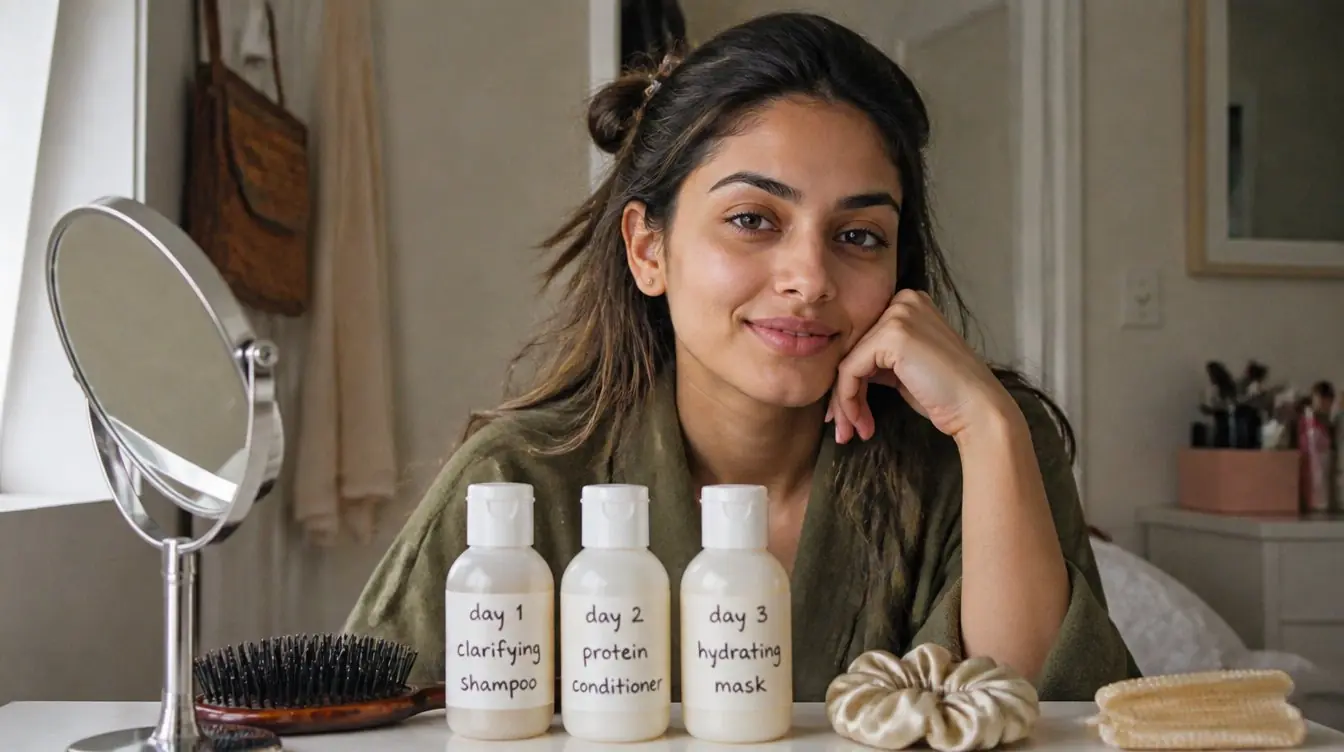
Discover the hair cycling routine that balances moisture, protein, and scalp health by rotating shampoos and treatments. Learn how to build your own cycle for your hair type.
A hair cycling routine is the 2026 hair trend that finally answers a question stylists have whispered for years: most hair gets stuck because the same products are used every wash, every week, for months. A hair cycling routine rotates cleansing, treating, and conditioning steps across the week so each one does its job without overlap or buildup. This guide walks through a hair cycling routine with the exact weekly schedule, the product types to rotate, and the visible changes to expect in the first month.
Published · Updated
What is a hair cycling routine, and why does it matter?
A hair cycling routine is a deliberate, repeating schedule in which you alternate between different types of cleansers, conditioners, and treatments throughout the week or month. Instead of reaching for the same shampoo bottle every wash day, you map out which products your hair receives and in what order, based on your hair’s current condition, scalp behaviour, and seasonal needs.
The concept borrows from the world of skincare, where rotating active ingredients, exfoliants, and moisturisers have long been recognised as superior to applying the same formula every single day. The same logic applies to hair. Your scalp produces sebum at a rate influenced by genetics, hormones, and environment. Your strands face different levels of stress depending on heat styling, chemical processing, sun exposure, and mechanical manipulation. No single product can address all of these variables simultaneously, and trying to force one formula to do everything often leads to buildup, dryness, or imbalance.
Hair cycling matters because it respects the complexity of your hair’s needs. Moisture and protein, for example, must remain in a careful balance. Too much moisture without adequate protein leads to limp, overly soft strands prone to breakage. When there is too much protein and not enough moisture, hair becomes brittle and stiff, snapping under tension. By rotating products that deliver each element in turn, you maintain equilibrium rather than swinging from one extreme to the other.
Beyond the strand itself, a well-structured hair cycling routine benefits the scalp. Clarifying formulas remove buildup of minerals, silicones, and excess sebum on a scheduled basis, preventing clogged follicles. Scalp treatments can be applied at the right intervals, rather than daily, to avoid irritation. Nourishing masks can be timed after clarifying washes when the hair is most receptive to absorbing ingredients.
How Hair Cycling Differs from Regular Hair Care
In conventional hair care, most people pick a shampoo and conditioner they like and use them consistently for weeks or months. Hair cycling replaces this static approach with a dynamic one. The routine changes from wash to wash, guided by a plan rather than habit. This shift requires a bit more attention at first but quickly becomes second nature and delivers noticeably more consistent results over time.
The Science Behind Rotating Shampoos for Hair Balance
Rotating shampoos is one of the foundational pillars of any hair cycling routine, and the science behind it is straightforward. Different shampoo formulas are designed for different tasks: cleansing buildup, adding moisture, fortifying protein, soothing the scalp, or balancing pH. When you cycle through these types, your scalp and strands benefit from each function in sequence rather than receiving only one repeatedly.
Clarifying shampoos contain surfactants powerful enough to dissolve mineral deposits, silicone residue, and excess sebum that gentle shampoos cannot fully remove. Used exclusively, clarifying shampoos strip too much natural oil and disrupt the scalp’s moisture barrier. But used once every one to four weeks, depending on your water hardness and styling habits, they reset the scalp and strands to a clean baseline that allows subsequent treatments to penetrate more effectively.
Moisturising shampoos use gentler surfactants alongside humectants and emollients that help hair retain water. These are typically used most frequently in a cycling schedule because most hair types benefit from regular hydration. However, relying on moisturising formulas alone can lead to product buildup over time, which is why the clarifying step matters so much in the overall cycle.
Protein shampoos contain hydrolysed proteins such as keratin, silk, wheat, or rice that temporarily bond to gaps and damage in the hair’s cuticle and cortex. These strengthen strands and reduce breakage. Overuse of protein, however, causes hair to feel brittle and firm, which is why protein shampoos appear in a cycling schedule at intervals rather than every wash. The cycle keeps protein use purposeful rather than chronic.
Understanding Surfactant Load and Scalp Health
Every shampoo has a surfactant load, meaning the type and concentration of cleansing agents it contains. Rotating between high-surfactant clarifying washes and lower-surfactant gentle washes prevents the scalp from becoming either perpetually stripped or perpetually coated with residue. This balance directly supports healthy sebum production and a well-functioning scalp microbiome, the community of microorganisms that live on the scalp and contribute to scalp health. Disrupting this community too often leads to sensitivity, while neglecting cleansing leads to follicle congestion. Cycling keeps both extremes in check.
Building Your Hair Cycling Routine Step by Step
Creating a personalised hair cycling routine starts with an honest assessment of your hair’s current state, your wash frequency, and your lifestyle. There is no universal template because hair types, scalp conditions, and goals vary enormously. The following framework gives you a starting point that you can adjust as you observe your hair’s responses.
Begin by identifying your wash frequency. If you wash your hair twice a week, you have two wash-day slots per cycle. Washing three times a week gives you three slots. Your cycle can repeat weekly, biweekly, or monthly depending on your hair’s needs and how many product types you want to incorporate.
Next, identify the categories of products you need to cycle through. Most people benefit from including at least one clarifying shampoo, one moisturising or balancing shampoo, one deep conditioning treatment, and one protein treatment in their cycle. Those with high-porosity hair may need more frequent protein. Those with fine hair may need lighter conditioning. Those with dry scalps may need scalp-specific treatments integrated into the schedule.
Once you have your product categories, assign them to your wash-day slots. A simple starting schedule for someone who washes twice weekly might look like this: the first wash of the week uses a moisturising shampoo followed by a standard conditioner, while the second wash uses a clarifying shampoo followed by a deep conditioning mask. Every third or fourth week, one of those wash days incorporates a protein treatment instead of or alongside a moisture treatment.
Frequency Guidelines for Each Product Type
Clarifying shampoos work best when used every two to four weeks for most hair types or once a week for those who use heavy styling products, live in hard-water areas, or have oily scalps. Deep conditioning treatments are generally beneficial once a week or every two weeks for dry or damaged hair and once or twice a month for hair in good condition. Protein treatments are typically applied every four to six weeks for healthy hair and every two to three weeks for chemically processed or heat-damaged hair. These are starting points, not rigid rules, and your hair’s response will tell you when to adjust. The cycle should feel like a guide, not a constraint.
Hair Cycling for Different Hair Types
One of the remarkable strengths of the hair cycling approach is its adaptability. Because you are building a custom rotation rather than following a single formula, you can tailor the cycle to address the specific needs of your hair type without compromising on effectiveness.
Fine hair tends to weigh down easily and is prone to becoming limp after heavy conditioning. A hair cycling routine for fine hair leans more heavily on lightweight, volumising, or balancing shampoos and uses deep conditioners as mid-shaft to ends treatments only, never applied to the scalp. Protein treatments can be beneficial for fine hair every four to six weeks, adding temporary structural support. Clarifying washes are especially important for fine hair because buildup accumulates quickly and further reduces volume and lift.
Thick or coarse hair has a different challenge: the cuticle tends to be more resistant to moisture absorption, and dryness is a persistent concern. For this hair type, the cycle should lean toward more frequent deep conditioning treatments and moisturising shampoos. Clarifying washes are still necessary but may be spaced further apart unless the hair is heavily styled. Protein treatments should be used thoughtfully because coarse hair can shift toward stiffness quickly if protein is overused relative to moisture in the cycle.
Curly and wavy hair types have complex porosity and curl pattern considerations. These hair types often benefit from co-washing, using a cleansing conditioner instead of a shampoo on some wash days, while reserving true shampoo for designated clarifying days in the cycle. Moisture is the cornerstone of curly hair care, so the cycle should include generous deep conditioning steps, with protein used strategically in response to elasticity loss or breakage signals rather than on a fixed schedule.
Cycling for Chemically Processed Hair
Colour-treated, relaxed, permed, or keratin-treated hair requires particular care in structuring a hair-cycling routine. Chemical processes alter the hair’s porosity and structural integrity, making it more vulnerable to both moisture loss and protein overload. For processed hair, the cycle should include colour-safe or sulphate-free cleansers as the primary shampoo, clarifying shampoos specifically formulated for colour-treated hair used no more than once a month, and a more frequent protein-moisture balance check throughout the cycle. Watching how your hair responds in terms of elasticity and softness after each type of treatment will guide your adjustments so the cycle remains protective rather than damaging.
The Role of Deep Conditioning in Your Hair Cycling Schedule
Deep conditioning is one of the most powerful tools in a hair care routine, and scheduling it correctly amplifies its benefits significantly. A deep conditioner is a concentrated treatment designed to be left on the hair for an extended period, typically ten minutes to an hour or more under heat, allowing its ingredients to penetrate beyond the cuticle into the cortex of the hair shaft, where real restoration occurs.
The timing of your deep conditioning step within the cycle matters significantly. Applying a deep conditioner immediately after a clarifying shampoo is particularly effective because the clarifying wash removes the surface buildup that would otherwise block ingredient absorption. The freshly cleaned hair is like a sponge ready to receive moisture and nutrients, and the deep conditioner takes full advantage of that receptivity.
There are two categories of deep conditioners to consider cycling between: moisture-based and protein-based. Moisture deep conditioners use humectants, emollients, and occlusives to restore softness, flexibility, and shine to hair that has been depleted. Protein deep conditioners use hydrolysed proteins and amino acids to temporarily fill in damage, strengthen the cuticle, and reduce porosity. Alternating between these two types within your cycle keeps the moisture-protein balance stable and prevents either type of imbalance from taking hold over time.
Heat vs. No Heat for Deep Conditioning
Applying gentle heat during deep conditioning, through a hooded dryer, a heat cap, or even the natural warmth created under a plastic cap, opens the hair cuticle and allows deeper penetration of conditioning ingredients. This is especially helpful for high-porosity or heavily damaged hair that has difficulty retaining what it absorbs. For low-porosity hair, which naturally resists moisture absorption due to a tightly sealed cuticle, heat is almost essential to getting deep conditioners to actually work. If heat is inaccessible or practical, simply extending the time the conditioner sits on the hair improves results. Most deep conditioning should last at least twenty to thirty minutes, at minimum, for meaningful benefit, with or without added heat.
Scalp Treatments Within a Hair Cycling Routine
A complete hair cycling routine addresses not just the hair shaft but also the scalp, which is the foundation from which all healthy hair grows. Neglecting the scalp in a hair care cycle is a significant oversight because scalp health directly determines the quality, strength, and growth rate of every strand that emerges from it.
Scalp treatments come in several categories, each suited to different concerns. Exfoliating scalp scrubs or chemical exfoliants remove dead skin cells, flakes, and product buildup from the scalp surface, improving circulation and allowing follicles to breathe freely. These are typically used once every two to four weeks and should follow or coincide with a clarifying shampoo in the cycle, not be layered on top of a dirty scalp already coated in residue and sebum.
Scalp serums and oils can be cycled in as pre-wash treatments, applied the night before or an hour before washing, to nourish the scalp without weighing down the hair during styling. These treatments are particularly helpful for dry or flaky scalps and for stimulating circulation around the follicles. Massaging a nourishing oil into the scalp before a clarifying wash allows the clarifying shampoo to remove any excess oil while still leaving the scalp balanced rather than stripped bare and uncomfortable.
For those dealing with dandruff, seborrhoeic dermatitis, or scalp psoriasis, medicated scalp treatments should be incorporated into the cycle according to the guidance of a dermatologist or trichologist. These treatments are not meant for daily use in most cases, and cycling them alongside your regular hair care schedule allows you to manage the condition without disrupting your overall routine or causing additional irritation from overuse.
Recognizing Scalp Signals in Your Cycle
Your scalp communicates its needs clearly if you pay attention to what it is telling you. Persistent itchiness after several weeks of gentle washing suggests it is time for a clarifying step or scalp exfoliation to remove accumulated debris. Increased flaking may indicate dryness from over-cleansing or a need for scalp hydration through a pre-wash oil treatment. Excessive oiliness between washes may signal that your conditioning products are too heavy for the scalp zone or that a clarifying wash is overdue. Adjusting your cycle in response to these signals is the key to making hair cycling a truly responsive and effective long-term practice.
Protein and Moisture Balance in Hair Cycling
The protein-moisture balance is the central axis around which any effective hair cycling routine revolves. Hair is primarily composed of a protein called keratin, but the structure of keratin relies on adequate moisture to remain flexible and functional. When the balance tips too far in either direction, the hair suffers in predictable and recognisable ways.
Signs of moisture overload include hair that feels mushy when wet, has excessive elasticity or stretch before snapping, lacks definition in any style, and feels limp or heavy even after drying. This condition, sometimes called hygral fatigue, occurs when hair absorbs so much water that the repeated swelling and contracting of the hair shaft weakens its structure progressively. The solution within a hair-cycling routine is to introduce more protein treatments and lighter, more balanced conditioning products while reducing the frequency of heavy moisture treatments temporarily.
Signs of protein overload include hair that feels stiff, brittle, or rough, snaps easily without much stretch when tested, and feels like straw or dried grass to the touch. This condition occurs when protein deposits on the hair surface exceed what the hair can balance with moisture. The solution is to scale back protein treatments in the cycle, focus on moisture-rich products for the next several wash days, and add a clarifying wash to remove protein buildup if it has accumulated in layers on the hair shaft.
The hair porosity test can help you understand how your hair naturally leans in terms of its ability to absorb and retain moisture. Low-porosity hair resists both moisture and protein absorption, so both should be applied with care and ideally with heat to encourage the cuticle to open. High-porosity hair absorbs everything quickly but loses it just as fast, so heavier conditioners and more frequent deep treatments are beneficial, along with protein to temporarily patch gaps in the cuticle and slow moisture loss.
Testing and Adjusting Your Balance
A simple stretch test can guide your protein-moisture decisions within your cycle and should be performed regularly to track your hair’s condition. Take a single wet strand and gently pull it lengthwise. Healthy hair should stretch a small amount and then return to its natural state without breaking. If it stretches far and does not spring back to its original length, moisture is adequate, but protein may be needed in the next cycle step. If it snaps immediately with little to no stretch, protein is already high, and the focus should shift to moisture for the next several wash days. Run this test periodically, particularly after introducing a new product into your cycle, to ensure the balance remains correct and your cycle adjustments are having the intended effect.
Seasonal Adjustments to Your Hair Cycling Routine
Hair cycling is not a set-it-and-forget-it system. Like the seasons themselves, your hair’s needs shift throughout the year, and a smart hair cycling routine accounts for those changes proactively rather than waiting until damage is visible.
In winter, cold air outside and dry heated air indoors create a dual dehydrating environment for both scalp and strands. The cycle should lean toward more frequent deep moisture treatments, heavier conditioners at the ends, and potentially a scalp oil treatment before clarifying washes to prevent the scalp from becoming uncomfortably dry and flaky. Protein use may actually decrease slightly in winter for some hair types because the hair is already stressed by the environment and does not need additional stiffening from heavy protein applications during this season.
In summer, increased humidity can be a friend to curly and wavy hair types by providing ambient moisture from the surrounding air. However, it also encourages scalp sweating, faster sebum production, and more frequent product buildup due to heavier styling. The cycle in summer may shift toward more frequent clarifying washes and lighter conditioning formulas. UV exposure from the sun can degrade the hair’s protein structure over time, so a moderate increase in protein treatments during summer can help offset that environmental damage for those who spend significant time outdoors.
Spring and autumn are transition seasons in which the scalp and hair are adjusting to shifting temperatures and humidity levels. These are good times to reassess your cycle and make gradual adjustments rather than waiting until the full impact of the new season is visible in your hair’s condition. A proactive seasonal adjustment is always less disruptive than a reactive repair cycle after the damage has accumulated.
Travel and Environmental Adjustments
Travel disrupts hair care routines significantly because water quality, humidity, and access to your usual products all change when you leave home. Hard water, which contains high concentrations of calcium and magnesium, causes substantial mineral buildup on the hair and scalp that ordinary cleansers cannot fully remove. When travelling to a hard water area, scheduling a clarifying wash upon return is a smart and non-negotiable addition to your cycle. Humidity extremes in tropical destinations or arid deserts also call for temporary adjustments to the moisture balance of your cycle to compensate for the environmental conditions. Keeping a small clarifying shampoo and a concentrated deep conditioner in your travel kit allows you to maintain the essentials of your cycle even while away from home and your usual hair care setup.
Common Mistakes to Avoid When Starting Hair Cycling
Many people approach hair cycling with enthusiasm and then become frustrated when the results do not appear as quickly as expected. Understanding the most common mistakes helps you avoid setbacks and get meaningful results faster.
The first and most common mistake is changing too many products at once. When you swap out multiple products simultaneously, you lose the ability to understand which change is driving the result you observe, whether that result is positive or negative. Introduce one new product type or one new rotation schedule at a time, observe for two to four weeks, and then make the next adjustment once you understand how your hair has responded.
The second common mistake is using a clarifying shampoo too frequently out of enthusiasm for the reset feeling it provides. Clarifying too often strips the scalp and hair of natural oils faster than the sebaceous glands can replenish them, leading to an overcompensation response in which the scalp produces more oil than usual to defend itself. Stick to the recommended interval of every two to four weeks for most hair types unless a specific condition calls for more frequent clarifying under professional guidance.
The third mistake is skipping the deep conditioning step after clarifying. Clarifying shampoos leave the hair clean but temporarily more porous and in need of conditioning to restore the cuticle’s smooth state. Failing to follow with a deep conditioner leaves the hair exposed and prone to dryness and breakage in the days following the clarifying wash, which defeats one of the key purposes of including clarifying in the cycle.
The fourth mistake is ignoring the scalp while focusing entirely on the length of the hair. The condition of your scalp directly influences the health and growth of your hair from the very root. A cycling routine that addresses scalp health will always outperform one that treats the scalp as an afterthought or a secondary concern to the visible length of the strands.
When to Seek Professional Guidance
Hair cycling is a self-directed practice suitable for most people to manage at home with careful observation and gradual adjustments. However, persistent scalp conditions such as seborrhoeic dermatitis, psoriasis, folliculitis, or significant hair loss are medical concerns that benefit from the guidance of a dermatologist or trichologist. A professional can help you design a cycling routine that works alongside any medical treatments you may need and can identify whether hair loss or scalp issues have an underlying cause that a product rotation alone cannot address. Seeking professional input early prevents small scalp concerns from becoming larger problems that are harder to manage and reverse.
Hair Cycling Routine Sample Schedules for Common Hair Types
To make the concept more concrete and immediately actionable, here are sample hair cycling routine schedules for three common hair scenarios. These are starting templates intended to be adjusted based on individual response and observation over the first several weeks.
For fine, straight hair with an oily scalp and a tendency toward buildup, washing three times a week is common. A suitable starting cycle might assign a clarifying shampoo followed by a lightweight conditioner applied only to ends every week on the first wash day of that week. On the second wash day, a balancing or volumising shampoo followed by a standard conditioner is used from mid-shaft to ends. The third wash day uses the same balancing shampoo with no conditioner if the hair feels well-hydrated, or a lightweight leave-in spritz only at the ends. Every three to four weeks, one wash day incorporates a lightweight protein treatment followed by a moisture conditioner to maintain strand integrity.
For medium-density, wavy, or loosely curly hair with normal to low porosity, washing twice a week works well for most people in this category. The first wash of the week might use a gentle sulphate-free shampoo with a standard conditioner, followed every two weeks by a deep moisture mask left on for at least twenty minutes. The second wash of the week could alternate between a co-wash on one week and a clarifying shampoo followed by a deep conditioner the next week to keep the cycle balanced. Protein treatments are added once a month on the clarifying wash day for a thorough reset and rebalancing session that addresses any cumulative moisture surplus.
For thick, coily, or high-porosity hair that tends toward chronic dryness, weekly or biweekly washing is common to preserve natural oils and reduce mechanical manipulation of fragile strands. A starting cycle might use a moisturising or co-wash cleanser most weeks, followed always by a deep conditioner applied under a heat cap for maximum penetration. Once a month, a clarifying shampoo precedes the deep conditioning session to remove buildup before the treatment is applied. Every two to three weeks, a protein deep conditioner is used instead of a moisture deep conditioner to maintain strength and reduce the breakage that high-porosity hair is particularly prone to experiencing.
Tracking and Refining Your Cycle Over Time
Keeping a simple hair journal is one of the most effective tools for refining your hair cycling routine and accelerating the learning curve. After each wash day, note what you used, how your hair felt during and after the wash, and any changes you observed in texture, manageability, scalp comfort, curl definition, or frizz levels. Over time, clear patterns emerge that tell you which parts of your cycle are working and which need adjustment to better serve your hair. Hair also changes with age, hormonal shifts, dietary changes, stress levels, and medication, so a periodic reassessment of the cycle, at least every two to three months, keeps your routine aligned with your hair’s current state rather than the state it was in when you first started the cycle.
Long-Term Benefits of a Consistent Hair Cycling Routine
The benefits of hair cycling become most apparent and compelling over the long term. In the first few weeks, you may notice improved scalp comfort and cleaner-feeling hair between wash days as clarifying steps remove accumulated buildup that had been dulling your hair and weighing it down. Within one to two months, the protein-moisture balance often stabilises, leading to hair that feels more consistently soft, strong, and manageable rather than alternating unpredictably between dry and limp from week to week.
Over several months, many people notice measurably reduced breakage and improved hair retention throughout the length. This is one of the most meaningful long-term benefits because it means the hair you grow is making it to visible length rather than snapping off mid-shaft or at the ends. Hair that is consistently balanced in protein and moisture is more elastic, more resilient under the tension of styling, brushing, and daily wear, and less prone to splitting and fragmenting at the ends.
Scalp health improvements often include reduced flaking, more comfortable and predictable sebum production, and in some cases a reduction in scalp sensitivity or reactivity to environmental changes. A cycling routine that includes regular scalp exfoliation and targeted scalp treatment steps improves follicle health and scalp circulation, which supports stronger hair growth over the months and years as the overall scalp environment improves.
Hair cycling also simplifies decision-making over time in a way that reduces the product overwhelm that many people experience in the hair care category. Instead of wandering through the hair care aisle searching for a miracle product that will fix everything at once, you know what your routine needs, you have a clear plan for when each product type is used, and you spend less money on products that do not fit into your established cycle and therefore go unused. This efficiency is both financial and cognitive, replacing a chaotic, reactive approach with a system that consistently delivers the results your hair actually needs.
Frequently Asked Questions About Hair Cycling
How long does it take to see results from a hair cycling routine?
Most people notice initial improvements within the first two to four weeks of starting a hair cycling routine, particularly in scalp comfort and the cleanliness and manageability of the hair between wash days. More significant changes such as reduced breakage, improved texture consistency, and visible length retention typically become apparent over two to three months of consistent practice. Hair grows approximately half an inch per month on average, so structural changes driven by improved care practices take time to manifest in the physical length and condition of the hair. Consistency is the key factor. Those who stick to their cycle and adjust it thoughtfully based on their hair’s feedback see the most meaningful and lasting results over time.
Can I practise hair cycling if I wash my hair every day?
Daily washing is possible within a hair cycling framework, though it requires thoughtful adaptation of the standard cycling approach. For those who wash daily, the cycle should prioritise very gentle, low-surfactant cleansers on most days to minimise cumulative stripping of the hair’s natural protective layer. Clarifying formulas should be reserved for once a week at most rather than once every two to four weeks, because the accelerated washing schedule means buildup accumulates more quickly. Deep conditioning treatments should be included at least twice a week because daily cleansing, even with gentle formulas, removes some moisture from the hair each time it is washed. Protein treatments should be used with care in a daily washing cycle, applied no more than once every two to three weeks, because frequent cleansing and conditioning already provides substantial processing for the hair shaft without adding high-protein treatments on top of that regular exposure.
What is the difference between a hair cycling routine and a regular hair care routine?
A regular hair care routine typically involves using the same shampoo and conditioner every wash day, perhaps with occasional treatments added when the hair seems noticeably problematic. The approach is reactive and static. A hair cycling routine is proactive and dynamic. It involves deliberately rotating between different types of cleansers, conditioners, and treatments on a predetermined schedule designed to address all of the hair’s needs in sequence and with intention. The cycling approach treats hair care as an integrated system rather than a collection of isolated, interchangeable products. It builds in variety that prevents plateaus, where the hair seems to stop responding to a product over time, and it maintains balance by ensuring that moisture, protein, cleansing, and scalp care each receive dedicated attention within the cycle rather than being applied randomly or overlooked entirely.
How do I know if my hair needs more protein or more moisture in my cycle?
The clearest way to assess your hair’s current protein-moisture balance is through a combination of direct observation and the physical stretch test performed on wet hair. Take a single wet strand and pull it gently lengthwise. Hair with good balance stretches a small amount and then springs back to its natural length. Hair that stretches excessively without returning to normal length likely needs protein added to the next cycle step. Hair that snaps with minimal stretch has adequate or excess protein and needs focused moisture treatment. Beyond the stretch test, texture cues during and after washing are informative. Mushy, limp, or overly soft wet hair suggests a moisture surplus or protein deficit in the current cycle. Stiff, rough, or brittle hair suggests protein overload or moisture deficit. Your hair cycling routine should respond to these signals by adjusting the frequency and intensity of protein and moisture treatments until balance is restored and maintained comfortably.
Is hair cycling suitable for all hair types?
Hair cycling is suitable for virtually all hair types and textures, though the specific products used, treatment frequencies, and scheduling will differ significantly from one person to another based on their unique hair characteristics and goals. Straight fine hair, thick coily hair, chemically processed hair, natural hair, and everything in between can all benefit meaningfully from a structured rotation approach applied thoughtfully. The core principles, balancing protein and moisture, supporting scalp health, using clarifying cleansers at appropriate intervals, and timing treatments strategically within the cycle, apply universally across hair types. The differences lie entirely in the execution: which product categories are best suited to the specific hair type, how frequently each type appears in the schedule, and how long treatments are left on during application. People with scalp conditions such as seborrhoeic dermatitis or psoriasis or known allergies to specific ingredients should always consult with a healthcare provider before incorporating new products into their hair care routine to avoid aggravating existing conditions.
How often should I clarify within my hair cycling routine?
The appropriate clarifying frequency within a hair cycling routine varies based on several key factors: the mineral content of your water supply, how many styling products you use and how frequently they are applied, your natural sebum production rate, and your overall hair type and texture. A general starting point recommended for most hair types is once every two to four weeks as part of the regular cycle. Those with fine hair, high product use, oily scalps, or hard water will typically benefit from clarifying every one to two weeks to stay ahead of buildup before it becomes problematic. Those with thick, dry, or coily hair that does not accumulate product or sebum quickly may find that once a month or even once every five to six weeks is entirely sufficient for their cycle. The clearest signal that clarifying is needed, regardless of the schedule, is when the hair feels persistently dull, heavy, or refuses to absorb conditioner properly despite being applied correctly. These signs indicate buildup that only a proper clarifying step within the cycle will effectively remove and reset.
Conclusion
A well-structured hair cycling routine is one of the most effective strategies available for achieving consistently healthy, balanced, and resilient hair across all hair types and textures. By rotating shampoos and treatments with intention rather than using the same products in the same way day after day, you give your hair exactly what it needs at every stage of the cycle: deep cleansing when buildup accumulates, intensive moisture when dryness sets in, strengthening protein when structural support is needed, and scalp nourishment to support healthy growth from the root upward.
The beauty of hair cycling is that it is not a rigid prescription but a flexible, responsive framework that grows and changes with your hair. You build the cycle based on your hair type, your goals, your wash frequency, and the signals your hair sends you over time. You adjust it seasonally, refine it as your hair evolves, and expand it as you learn what your hair responds to best in terms of products, timing, and treatment combinations.
Starting a hair cycling routine requires no dramatic overhaul of your current approach. Begin by identifying one clarifying shampoo and one deep conditioning treatment to add to your existing wash days. Observe your hair’s response over four weeks. Introduce protein and scalp care steps gradually as you gain confidence in reading your hair’s signals. Track your results simply and let your hair guide your adjustments. The results, stronger strands, a healthier scalp, improved moisture-protein balance, and more predictable manageability from week to week, compound over time into hair that does not just look healthy on the surface but is genuinely healthy at every level of the strand and follicle.
RELATED ARTICLES:
Hair Care for the Outdoor Enthusiast: Field-Tested Tips to Protect, Style, and Recover Anywhere
Struggling with Acne & Flaky Scalp? Top Skin & Hair Triggers Women Must Avoid in 2025!
About The Author

COMMENTS