
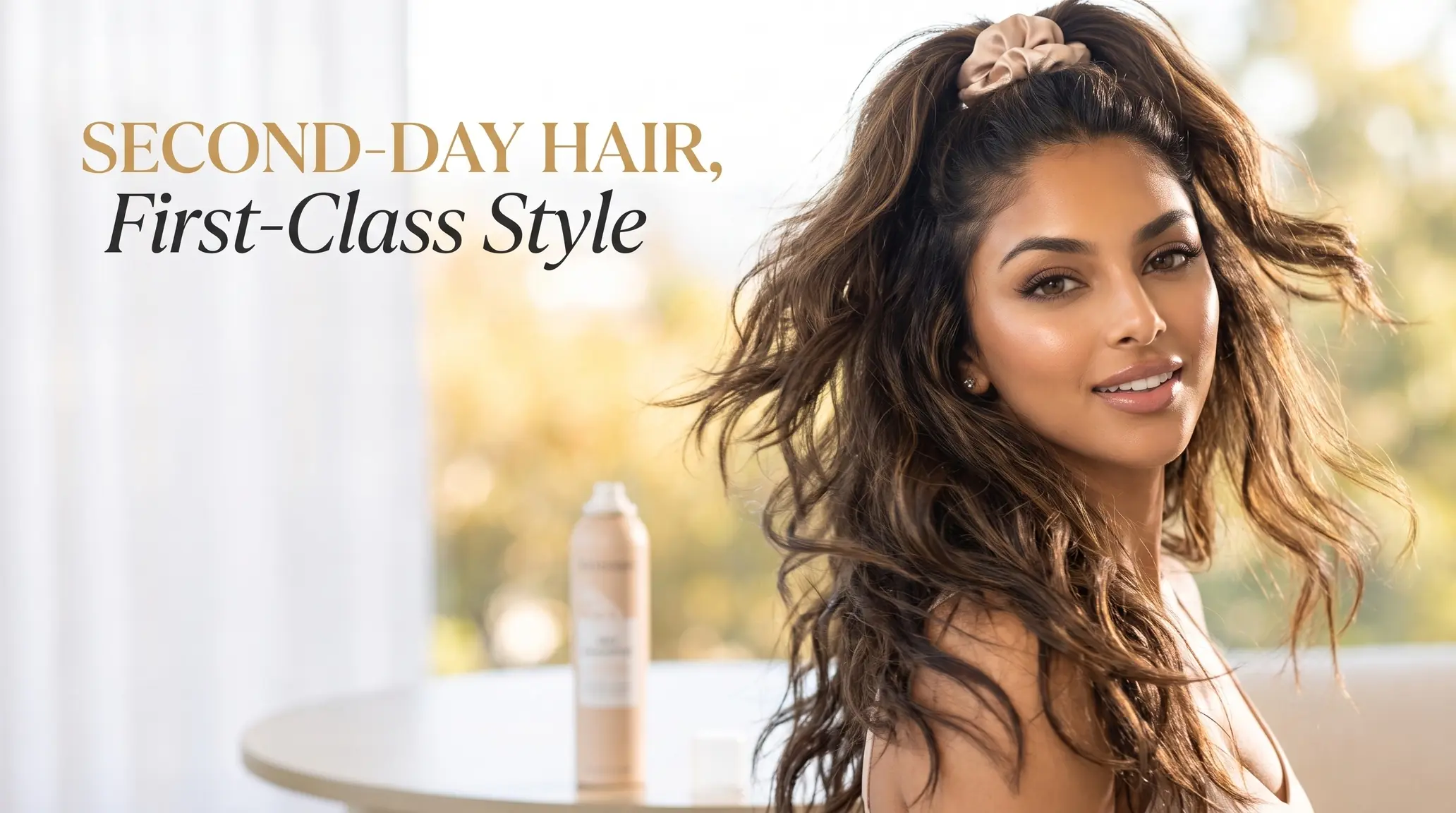
Second day hair is not a problem to fix, it is an opportunity to style something better with far less effort than a full wash day. The natural oils yo
Second day hair is not a problem to fix, it is an opportunity to style something better with far less effort than a full wash day. The natural oils your scalp produces overnight add grip, weight, and texture that freshly washed hair simply cannot match. That is exactly what stylists rely on before a shoot or runway show. This guide covers the techniques that transform yesterday’s look.
You open your eyes, glance in the mirror, and your hair tells a story you did not plan to share. The roots carry a little extra oil, the ends have lost their bounce, and the style you worked hard on yesterday has shifted into something unpredictable. Most people reach for the shower at this point. The ones who know better reach for their styling toolkit instead. Second-day hair is not a problem to solve. It is an opportunity to create something better, faster, and with significantly less effort than a full wash day requires. The natural oils your scalp produces overnight add grip, weight, and texture that freshly shampooed hair simply cannot replicate. That is exactly what professional hairstylists exploit when they prep hair before a shoot or runway show. This article covers every dimension of second-day styling, from the science of overnight hair changes to the specific techniques, products, and accessories that turn yesterday’s blowout into today’s best hair day. You will find practical methods, expert-level application tips, and nighttime routines that make the next morning easier. Whether your hair is fine, thick, curly, or colour-treated, there is a strategy here built for you.
The Science Behind Second-Day Hair
Understanding what actually happens to your hair between wash days changes how you approach styling. Most people treat second-day hair as a deficit. In reality, the biological processes at work overnight create conditions that professional stylists actively try to recreate with products. When you understand the science, you stop fighting your hair and start working with it.
Reviewed by the BeautynFacts editorial team. Last updated: May 2026.
What Happens to Your Scalp and Strands Overnight
Your scalp contains sebaceous glands that continuously produce sebum, a waxy, oily substance made up of triglycerides, wax esters, squalene, and fatty acids. On wash day, shampoo strips much of this sebum away. Within hours, production ramps back up. By the time you wake on day two, a thin, even coating of sebum has distributed from the roots down varying lengths of the shaft, depending on your hair type and texture. This coating does several things simultaneously. It conditions the cuticle layer, the outermost protective shield of each strand, making individual hairs more pliable and less prone to static. It also adds weight to the hair, which reduces the kind of flyaway frizz that plagues freshly washed hair. The result is a head of hair that behaves more predictably under styling tools and holds shapes, waves, and braids far longer than clean hair does.
The Oil Balance: Why Some Sebum Is a Styling Asset
Sebum has a reputation problem. Most hair care marketing frames oil as the enemy, pushing daily shampooing and mattifying products as the solution. However, dermatological research consistently shows that a moderate level of sebum is protective and beneficial. Sebum forms a hydrophobic layer around the hair shaft that reduces moisture loss, which means second-day hair is actually better hydrated at the cortex level than freshly washed hair that has not yet had time to rebalance. For styling purposes, this benefit translates to better curl definition in wavy and curly hair types, stronger hold for braids and updos, and improved slip that makes hair easier to section and manipulate. The challenge is to redistribute this oil strategically so it does not visibly concentrate at the roots while the lengths remain dry and dull.
Texture Changes and How to Use Them
Beyond oil production, your hair undergoes physical changes overnight. Movement during sleep roughs up the cuticle slightly, creating microscopic surface variation that adds grip. This is why a braid or twisted style holds significantly better on second-day hair than on freshly conditioned hair, which is too smooth and slippery for secure styling. Humidity absorbed during sleep also causes slight swelling of the cortex, giving fine hair types a subtle boost in diameter. Stylists call this “lived-in” texture, and it is prized specifically because it cannot be fully replicated from a bottle. Learning to read these changes in your hair and respond with the right techniques is the foundation of confident second-day styling.
Dry Shampoo Mastery: Beyond the Basics
Dry shampoo is the most widely used second-day hair product on the market, yet most people apply it incorrectly and get mediocre results. The product itself is not complicated, but technique, timing, and formula selection all matter far more than most tutorials acknowledge. Getting this right is the single fastest way to upgrade your second-day routine.
Choosing the Right Formula for Your Hair Type
Dry shampoos generally fall into three categories: aerosol sprays, powder formulas, and foam applications. Aerosol sprays deliver a fine mist of starch or clay particles, making them ideal for fine to medium hair that needs light oil absorption without added weight. Powder formulas, often applied with a brush, offer more control and are better suited to thick or coarse hair where a more robust application is needed. Foam dry shampoos sit somewhere between the two, absorbing oil while adding a small amount of moisture, making them a good choice for colour-treated or chemically processed hair that tends to be dry at the mid-lengths and ends. Pay attention to tinted formulas if your hair is dark. Standard dry shampoos leave a white cast that appears as ‘ashy residue’ under certain lighting, and no amount of brushing fully eliminates it from very dark hair. Brands now produce colour-matched formulas in brunette, auburn, and black ranges that absorb oil without leaving a residue problem.
Application Technique for Maximum Effect
The most common mistake is spraying dry shampoo directly onto visible roots at close range. This deposits too much product in one concentrated area, creating caking and buildup that feels heavy and looks chalky. The correct method starts with distance. Hold the can or brush at least eight to ten inches from your scalp. Part your hair into sections and apply it to each parting individually, focusing on the areas that show oil most prominently, typically the crown and the hairline around the face. After application, resist the urge to immediately rub or brush. Allow the product to sit undisturbed for one to two minutes. During this time, the starch or clay particles bind to sebum molecules and lift them away from the shaft. Once the dwell time is complete, use your fingertips to massage the product into the scalp using small circular motions, the same way you would work in a scalp treatment. This distributes the product, breaks up any concentrated deposits, and stimulates blood flow to the follicle. Finish by brushing from root to tip with a natural bristle brush, which buffs away excess product and redistributes any remaining sebum down the length of the shaft, adding shine to the mid-lengths and ends.
DIY Dry Shampoo Alternatives That Actually Work
If you run out of dry shampoo or prefer to avoid aerosols, several household ingredients perform the same function. Arrowroot powder is the most effective natural substitute, with a particle size and texture nearly identical to commercial starch-based dry shampoos. Apply it sparingly to a makeup brush and dust directly onto the roots. For dark hair, mix arrowroot powder with an equal portion of unsweetened cocoa powder to neutralise the white cast. Baby powder works on a similar principle but often contains talc or synthetic fragrance, which some people prefer to avoid. Cornflour is another option and is widely available, though it has a slightly coarser texture than arrowroot and should be applied in even smaller amounts to avoid build-up. Whichever substitute you use, apply it with a light hand, allow the dwell time, and follow with a thorough scalp massage and brushing for the best result.
Embracing and Enhancing Your Natural Texture
Second-day hair holds texture differently than freshly washed hair. Rather than trying to recreate the polished, uniform look of wash day, the smarter approach is to lean into whatever natural movement your hair is showing and amplify it with targeted products and techniques. This approach takes less time, causes less heat damage, and often produces results that look more effortless and intentional.
Reading Your Hair’s Texture Profile
Hair texture exists on a spectrum from completely straight (type 1) through wavy (type 2), curly (type 3), and coily (type 4), with subcategories within each. Your texture profile determines which second-day strategies will be most effective. Type 1 and 2 hair tends to go flat at the roots on day two while retaining some wave pattern in the mid-lengths and ends. The priority for these types is volume restoration at the roots and wave enhancement in the lengths. Type 3 and 4 hair face a different challenge: shrinkage and frizz increase as the curl pattern tightens and dries out after wash day. For these types, the priority is moisture restoration and curl definition rather than volume. Knowing your type allows you to select products and techniques precisely rather than guessing.
Products That Work With Second-Day Texture
Sea salt sprays are among the most versatile second-day products for wavy and straight hair types. They contain sodium chloride and often magnesium sulphate, both of which rough up the cuticle slightly and create grip and separation between strands, mimicking the effect of a day at the beach. Apply to slightly damp or dry hair, scrunch, and allow to air-dry. For curly hair, a small amount of a water-based curl refresher or leave-in conditioner mixed with water in a spray bottle re-activates the curl pattern without weighing hair down. Mousse applied to second-day hair works particularly well because it creates structure without adding the heaviness of a cream on top of already present sebum. For fine hair, a lightweight texturising spray adds grit and separation. Apply it to dry hair, flip the head upside down, and scrunch from ends to roots for immediate body and movement.
Heat-Free Styling for Enhanced Natural Texture
Heat-free methods are ideal for second-day hair because they preserve the texture that already exists without risking damage to a cuticle that may be more vulnerable after a day of exposure to environmental factors. Twist-outs are an excellent technique for wavy to curly hair types. Divide damp or lightly misted second-day hair into sections, apply a small amount of curl cream or leave-in, and twist each section tightly from root to tip. Allow it to dry completely before unravelling. The result is a defined, separated curl pattern with volume. Bantu knots on second-day hair produce a similar result and work across a wider range of textures. For straight hair types, braiding damp second-day hair before bed and releasing the braids in the morning creates soft, natural waves that require no heat and last through the full following day.
Braids and Updos: Elevated Styles That Disguise Oily Roots
Braids and updos are the workhorses of second-day styling. They function on a simple but effective principle: removing the root area from view eliminates the primary visual marker of unwashed hair. Beyond concealment, these styles can look more intentional and polished than a blowout and require far less time to execute on hair that already has built-in texture and grip.
Quick Braided Styles for Every Skill Level
The three-strand French braid is the most classic option and requires nothing beyond basic technique. Starting at the crown, where oil is most visible, and working backwards towards the nape keeps the roots neatly incorporated into the structure of the braid. A single French braid takes under five minutes on second-day hair and looks deliberate and polished. The fishtail braid suits hair that has visible texture from the previous day’s styling because the interlaced sections show that pattern beautifully. Divide hair into two sections and alternate pulling small pieces from the outer edge of each section across to the opposite side. The result is intricate-looking but surprisingly fast once you establish the rhythm. A box braid or cornrow refresh using just the front sections of hair, combined with leaving the rest loose, creates a hybrid style that reads as modern and editorial rather than rushed.
Chic Updo Options for Every Hair Length
The messy bun has endured as a second-day staple because it works across almost every hair length above the shoulders and disguises uneven texture effectively. The key to a messy bun that looks deliberate rather than accidental is asymmetry. Pull the bun slightly to one side and allow a few pieces to fall around the face. This moves the style away from “didn’t try” territory and into something that reads as artfully undone. A low chignon at the nape of the neck suits second-day hair that still retains some smoothness at the mid-lengths. Twist the hair into a loose rope, coil it at the nape, and secure with pins rather than a hair tie, which leaves a crease and reduces the elegance of the style. A half-twisted updo, where the top section is French-twisted and pinned while the bottom half hangs loose, is another option that works beautifully on second-day hair and requires no heat tools whatsoever.
Securing Your Style to Last the Full Day
Second-day hair holds styles longer than clean hair, but a proper securing technique matters. Use spiral hairpins rather than bobby pins for updos that need to last longer than a few hours. Spiral pins grip hair without slipping in the way standard pins can. For braids and styles that need to stay taut, mist a small amount of medium-hold hairspray over the finished look and allow it to dry before touching. This creates a film over the surface of the stile that resists humidity and movement. If flyaways emerge at the hairline by midday, a light application of a hair balm or pomade on the fingertips, smoothed gently along the edges, resets the look without disturbing the rest of the style.
Strategic Use of Hair Accessories
The right accessory transforms second-day hair from something you are managing into something you are wearing on purpose. Hair accessories have moved far beyond the functional and into genuine fashion territory, and knowing how to deploy them is as important a styling skill as knowing how to use a curling iron. They also offer the fastest possible route to a polished look when time is genuinely short.
Headbands, Scarves, and Structured Clips
A headband placed at the hairline covers the most visible area of oil accumulation instantly. Structured headbands with a slight forward curve push the hair back from the face while keeping the crown area relatively flat and neat. For a more directional look, a wide fabric headband worn further back on the head, slightly behind the crown, creates volume at the very top while keeping the sides sleek. Silk and satin scarves tied as headbands serve a dual purpose: they conceal the root area and add pattern and colour, drawing attention to your face rather than your hair. Fold the scarf into a one-to-two-inch band, tie it over the crown, and knot it at the back of the neck with the ends tucked under. Structured jaw clips and claw clips have experienced a major style revival and are ideal for creating an effortless-looking updo in under thirty seconds. Gather hair loosely and clip it at the crown or nape for a style that looks casual and intentional simultaneously.
Choosing Accessories for Your Face Shape and Occasion
Round face shapes benefit from accessories that add height at the crown, such as tall claw clips placed at the very top of the head or headbands worn slightly forward to create visual length. Oval face shapes work well with nearly any accessory placement. Heart-face shapes, which are wider at the forehead and narrower at the chin, look best with accessories worn at the back of the head or nape rather than across the forehead, which can emphasise width. For professional settings, choose accessories in neutral tones such as tortoiseshell, black, gold, or ivory. For casual or social occasions, printed scarves, embellished barrettes, and colourful clips add personality without requiring any additional styling time. The occasion-appropriate accessory also shifts the perceived formality of a simple second-day style, making the same low bun look appropriate for a business meeting in the morning and a dinner out in the evening.
Bobby Pins as a Styling Tool
Bobby pins are underutilised as a deliberate styling tool rather than just a fastening device. Pinning a section of hair back on one side creates asymmetry and draws the eye away from the overall texture of the hair. Cross two pins in an X pattern for a more secure hold and a more decorative result. A row of matching pins, placed in an arc along the side part, creates a minimalist, geometric look that reads as ‘carefully considered’. For a bolder statement, cluster several embellished or pearl-tipped pins in a scattered arrangement at the back of the head or along a braid. This technique turns a simple style into a focal point and requires no additional product or tools beyond the pins themselves.
Volume and Body Restoration Techniques
Flat, lifeless hair at the roots is one of the most common second-day complaints, particularly for people with fine or medium hair. Volume loss happens because the weight of accumulated oils pulls strands downward and causes them to lie flat against the scalp. Reversing this condition requires a combination of product strategy, technique, and, in some cases, targeted heat tool use.
Texturizing Sprays and How They Work at a Molecular Level
Texturising sprays contain polymers, sometimes combined with salt or silica, that deposit a thin coat on the surface of each strand. This coating increases the diameter of the hair shaft microscopically and creates friction between neighbouring strands, generating the sensation and appearance of thickness and body. The key to effective application is working with sections rather than misting product over the entire head at once. Section the hair into four quadrants. Lift each section and spray the texturising product directly at the root, holding the can four to six inches away. Use your fingers to work the product into the root area before moving to the next section. Once all sections are treated, flip the head upside down and shake it from the roots with your fingers for thirty seconds. Flip back up, reshape with your hands, and finish with a light-hold spray. This method delivers significantly more volume than surface application alone.
Root-Lifting Techniques Using Heat Tools
A round brush and a blow dryer can restore significant volume to second-day roots in five to eight minutes without requiring a full restyle. Focus heat exclusively on the root area rather than the lengths, which already retain texture from the previous day. Work in sections no wider than two inches. Place the round brush under a root section, apply medium heat while pulling the brush upwards, and hold for three seconds before moving to the next section. The heat resets the hair’s hydrogen bonds at the root, lifting the shaft away from the scalp and holding it there as it cools. For a faster option, a hot root iron or a flat iron used at the roots only, clamping just half an inch of hair at the very base and lifting upward, delivers the same effect in about half the time and does not require sectioning. Avoid applying heat to the mid-lengths or ends of second-day hair unless those areas genuinely need it, as unnecessary heat accelerates damage and dryness.
The Flip-and-Set Method for Instant All-Over Body
The flip-and-set method requires no products and no tools. Bend at the waist so your hair falls completely forward and hangs towards the floor. Spend thirty seconds vigorously massaging your scalp with your fingertips, moving from the nape forward towards the crown. This loosens the root area from the scalp and disrupts the flat-lying pattern created by oil and gravity. Stand upright quickly and allow the hair to fall back into place naturally without touching it for ten seconds. Then use your fingers to shape and direct the hair rather than brushing or combing, which can flatten the volume you just created. Finish with a light spritz of flexible-hold spray over the entire surface. This technique works best on hair with some natural body or wave and is particularly effective for anyone with medium-length hair where the weight of the lengths is not too heavy to sustain root lift.
Half-Up and Hybrid Styles for Maximum Versatility
Half-up, half-down styles occupy a unique position in the styling toolkit. They conceal the root area effectively while allowing you to display the length and texture of the hair below. They are also highly adaptable, sitting at the intersection of casual and polished depending on the finishing details you choose.
Classic Half-Up Variations to Know
The simplest half-up style takes the top section of hair from the temples back and secures it at the crown with a hair tie or clip. On second-day hair, this basic version benefits from a small tease at the crown before securing it. Use a fine-tooth comb or a teasing brush to backcomb just the underside of the top section before gathering it. This creates a rounded, voluminous shape at the crown rather than a flat one. A twisted half-up style adds visual interest without increasing complexity. Instead of simply gathering the top section, divide it into two halves, twist each half in the same direction, and then combine them and secure. The twisted rope shape is more polished than a straight gathered section and holds its shape well on hair with any amount of texture. A knotted half-up, where the gathered top section is tied in a simple overhand knot before being secured with a pin, is a more fashion-forward variation that suits medium- to long-length hair.
Combining Texture With Partial Updos
Second-day hair’s built-in texture becomes an asset when the lower half of a half-up style is the focal point. Enhance the loose section with a quick pass of a one-inch curling wand, wrapping two-inch sections around the barrel and releasing without clipping. The curls drop into loose, bouncy waves rather than tight ringlets, and they hold exceptionally well because the hair’s texture and natural oils act as a fixative. Alternatively, separate the loose lower section into large chunks using your fingers and apply a small amount of curl cream or hair oil to each chunk, scrunching upward. This technique works particularly well on wavy and curly hair types and produces a look that appears far more deliberate and styled than it took to create it. Finish by misting the entire style lightly with a flexible-hold spray to unify the two sections of the look.
The Twisted Half-Up for a Polished Result
Take a section of hair from behind each ear, twist each section backwards and towards the centre of the head, cross them over each other at the back of the crown, and secure with two crossed bobby pins or a small claw clip. Allow the remaining hair to hang loose. This style takes under two minutes, requires no heat, and reads as deliberately sophisticated. It works especially well with second-day hair because the slight texture and grip of day-two strands keep the twists from unravelling the way they might on freshly conditioned hair. For an even more refined result, add a small embellished pin or a pearl clip at the point where the two twists meet at the back. This small detail elevates the style from simple to considered without adding time or effort.
Nighttime Habits That Set You Up for Better Second-Day Hair
What you do before you go to sleep largely determines the quality of your second-day hair. Small adjustments to your nighttime routine can be the difference between hair that is fully workable in the morning and hair that needs extensive intervention before it looks presentable. These habits require minimal time and produce compounding benefits the more consistently you practice them.
The Silk Pillowcase and Sleep Cap Advantage
Cotton pillowcases create significant friction against the hair shaft during sleep. This friction roughs up the cuticle, causes tangling, and contributes to both frizz and breakage over time. Silk and satin pillowcases reduce this friction dramatically because their smooth surface allows hair to glide rather than catch. The practical result is hair that retains more of its shape from the previous day’s styling, has less frizz to manage in the morning, and tangles far less, which means less detangling force is needed and less breakage occurs. Silk is the superior material because it also regulates temperature and absorbs less moisture from the hair than satin, which is typically a synthetic weave. For an even more protective option, a silk or satin sleep cap covers all the hair and eliminates pillow friction. Sleep caps also preserve styles like braids, twists, and curl sets more effectively than a pillowcase alone, as they prevent the physical movement of the style against a surface.
Loose Braids and Protective Overnight Styles
Sleeping with hair loose and unprotected allows it to move freely, tangle, and lose its shape. A simple alternative is a loose, single braid at the nape of the neck secured with a silk-covered hair tie. This keeps the hair contained without creating the crease that a tightly wound ponytail or bun would leave. In the morning, releasing the braid reveals a soft wave pattern that can be worn as-is or used as a base for further styling. For curly and coily hair types, the pineapple method, which involves gathering all the hair loosely at the very top of the head in a high, loose ponytail using a soft scrunchie, keeps the curl pattern intact overnight and prevents the flattening that occurs when these textures are slept on directly. Releasing the pineapple in the morning and gently separating the curls with fingers restores significant volume and definition with no additional product needed.
Evening Product Application for Morning Ease
Applying a small amount of leave-in conditioner or a hair oil to the mid-lengths and ends before bed addresses the dryness that often affects these areas by day two. The cuticle absorbs conditioning ingredients more effectively when they are left on for an extended period rather than rinsed out after minutes. A few drops of argan, jojoba, or marula oil worked through the ends of the hair before sleep reduce the brittleness and split-end visibility that make second-day hair look rough at the tips. For anyone with a dry scalp, a light scalp oil or a few drops of diluted rosemary oil massaged into the scalp before bed supports sebaceous gland function and skin barrier health, which contributes to healthier, more manageable hair overall. Keep the application minimal, particularly at the roots, to avoid adding unnecessary weight that would require more dry shampoo to manage the following morning.
Frequently Asked Questions
How often should you actually wash your hair?
The ideal wash frequency depends on your hair type, scalp activity, and lifestyle. Fine hair and oily scalps may genuinely require washing every two days, as sebum accumulates more visibly on finer strands. Thick, coarse, or curly hair types can typically go three to five days between washes without visible oil accumulation at the roots. Overwashing strips the scalp of sebum faster than it can be replenished, which signals the sebaceous glands to increase production. Over time, this process creates a cycle where the scalp becomes progressively oilier and requires more frequent washing to stay manageable. Gradually extending the time between washes, one day at a time over several weeks, allows the scalp to recalibrate and reduces overall oil production. Most dermatologists and trichologists recommend two to three washes per week as a reasonable baseline for most hair types.
Can dry shampoo damage hair if used too frequently?
Used correctly and in moderation, dry shampoo poses minimal risk to hair health. However, daily use over extended periods can cause scalp issues. The starch or clay particles in dry shampoo do not dissolve on the scalp the way water and shampoo cause them to. If they are not thoroughly removed through brushing and eventual washing, they accumulate around the follicle opening. This buildup can clog follicles, impede sebum drainage, and, in some cases, contribute to scalp inflammation or a condition called folliculitis, which is an inflammation or infection of the hair follicle. Using dry shampoo no more than two to three times between wash days and always following up with a proper wash that includes a thorough scalp massage keeps these risks negligible. A clarifying shampoo used once every two weeks removes any residual buildup effectively.
What is the best way to refresh curly hair on day two without frizz?
The curl refresh process for day two starts with rehydration rather than restyling. Mix water and a small amount of your regular leave-in conditioner in a spray bottle at a roughly four-to-one ratio. Mist this mixture over sections of hair, focusing on any area where the curl pattern has collapsed or frizz is visible. Scrunch each section upward from the ends towards the scalp to reactivate the curl shape. Apply a pea-sized amount of a water-based curl gel or cream to each section while it is still damp and scrunch again. Allow hair to air dry or use a diffuser on low heat. The key to frizz control during this process is avoiding touching the hair while it is drying. Disturbing the curl formation mid-dry is the most common cause of frizz in curly hair types, regardless of what products have been applied.
Why does second-day hair hold curls and styles better than freshly washed hair?
Freshly washed and conditioned hair has a very smooth, uniform cuticle surface. Conditioner deposits silicones and fatty alcohols on the hair shaft that increase smoothness and reduce friction between strands. While this process is beneficial for detangling and for daily wear, it creates a slippery surface that styling products struggle to grip. Curls fall out more quickly because the hair has very little internal structure to hold a set. By day two, natural sebum and environmental exposure have partially displaced the conditioner, and the cuticle surface has slightly roughened. This increased surface texture gives holding products a better mechanical grip, keeps curl formations in place longer, and allows braids and twists to stay secure with less product and fewer pins than clean hair would require. This is the same reason professional stylists often spray hair with a light salt spray or dry shampoo before a styling session, even on freshly washed hair.
Is it ever necessary to do a full wash on second-day hair, even with excellent styling techniques?
Yes. There are circumstances where styling techniques cannot substitute for a wash. If you exercised intensely and sweated heavily at the scalp, the combination of sweat, dissolved salts, and bacteria creates an environment that dry shampoo and styling products cannot adequately address. Similarly, if you applied heavy styling products such as thick pomades, waxes, or strong-hold gels the day before, residue accumulation at the scalp may cause irritation or visible buildup that requires water and shampoo to remove. Environmental exposure to heavy pollution, smoke, or strong odours is another scenario in which washing is the better choice. These situations aside, most people can extend their wash cycle from one to two days with proper technique, and many can go significantly longer depending on their hair type and how actively they use the strategies covered in this article.
Conclusion
Second-day hair is not a problem to apologise for or conceal with a baseball cap. It is a styling opportunity with more texture, grip, and natural body than your freshly washed hair can offer on its best day. The strategies covered here move across the full spectrum of what works: understanding the biology behind overnight hair changes, mastering dry shampoo application, leveraging natural texture, choosing the right braids and updos, using accessories as deliberate style elements, restoring volume through product and technique, building hybrid styles that are both practical and polished, and creating nighttime habits that make every next morning easier. The most important takeaway is that second-day hair rewards a proactive approach. When you have the right products on hand, the technical knowledge to apply them, and a few reliable styles in rotation, day two stops being a compromise and becomes something you look forward to. Start by building one nighttime habit this week, whether that is switching to a silk pillowcase or sleeping in a loose braid. Add one new styling technique on your next second day. Build from there. The results compound quickly, and within a few weeks, your second-day hair routine will feel as natural and confident as everything else in your beauty toolkit.
RELATED ARTICLES:
MOB WIFE HAIR: HOW TO GET THE VOLUMINOUS, LIVED-IN LOOK EVERYONE’S OBSESSING OVER
5 Hair Mistakes While Sleeping
Hair Care for the Outdoor Enthusiast: Field-Tested Tips to Protect, Style, and Recover Anywhere
Glass Hair in 2026: The Products and Techniques for a Frizz-Free, Mirror-Like Finish That Lasts
Trim Split Ends Regularly for Healthier, Stronger Hair: The Exact Schedule That Works
About The Author

COMMENTS