
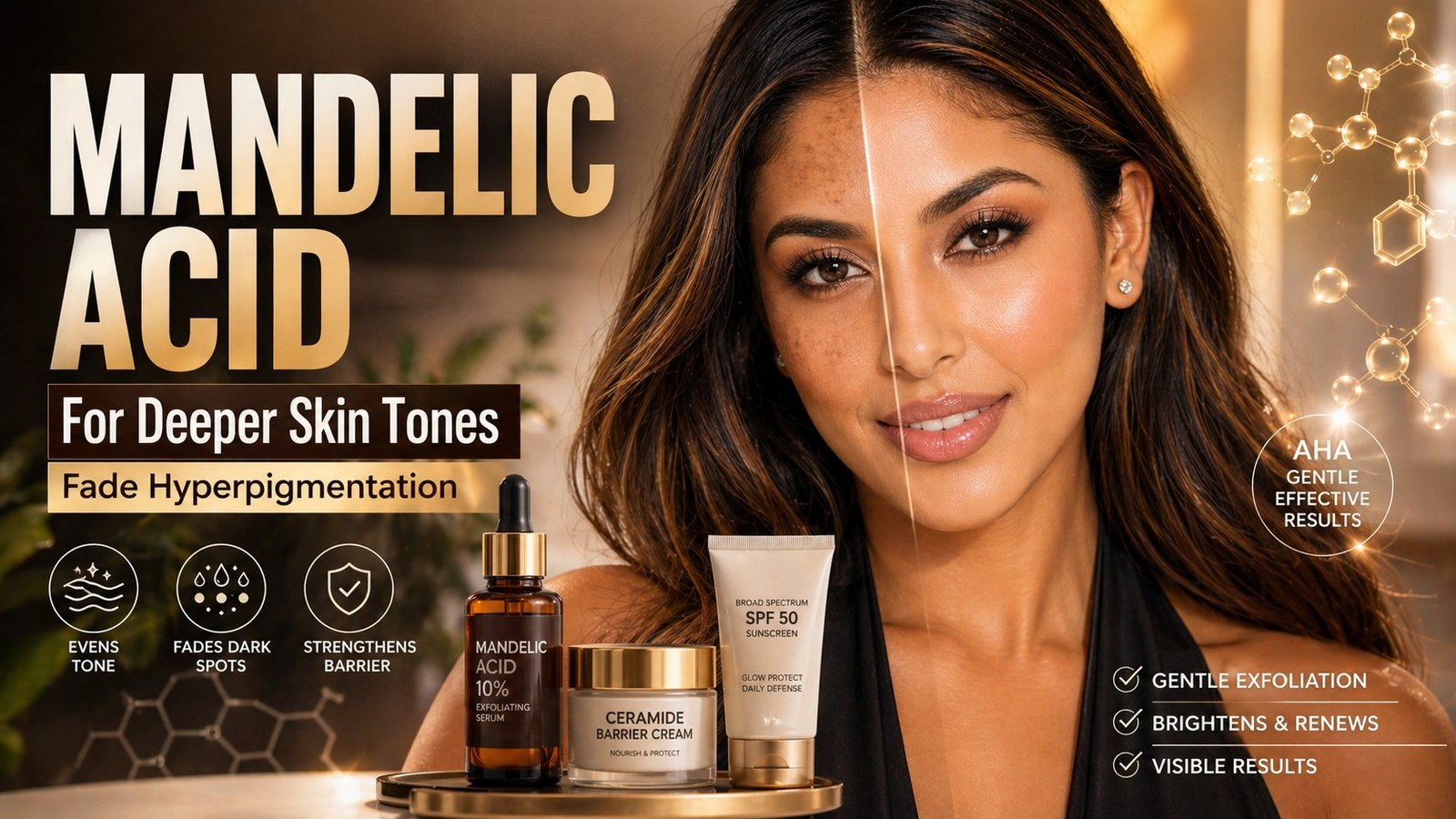
Discover how mandelic acid for dark skin safely fades hyperpigmentation without irritation. Learn why this gentle AHA is the best exfoliant for deeper, melanin-rich skin tones.
Mandelic acid for dark skin is the AHA dermatologists keep recommending for melanin-rich complexions prone to post-inflammatory hyperpigmentation. Larger and slower than glycolic acid, mandelic acid penetrates more gradually, which is why mandelic acid for dark skin tends to brighten without the rebound darkening that aggressive acids cause. This guide explains how mandelic acid works on darker tones, the routines that build tolerance safely, and the product picks that respect your barrier.
Reviewed by the BeautynFacts editorial team. Last updated: May 2026.

Mandelic Acid for Dark Skin: If you have a deeper skin tone and struggle with stubborn dark spots, uneven patches, or post-breakout marks that seem to last for months, you already know how frustrating it can be to find an exfoliant that actually works without making things worse. Mandelic acid for dark skin has emerged as one of the most clinically supported, dermatologist-recommended alpha hydroxy acids for people with melanin-rich complexions. Unlike stronger acids that strip and irritate, mandelic acid works gently yet effectively, making it an exceptional choice for skin that is prone to hyperpigmentation and post-inflammatory reactions. This guide covers everything you need to know: what mandelic acid is, how it works at a cellular level, why it is uniquely suited to deeper skin tones, how to build a routine around it, and what results you can realistically expect over time.
What is mandelic acid and where does it come from?
Mandelic acid is an alpha-hydroxy acid (AHA) derived from bitter almonds. Its name comes from the German word “Mandel”, meaning “almond”. Like all AHAs, it works by loosening the bonds between dead skin cells on the surface of the skin, encouraging them to shed and revealing fresher, more evenly toned skin underneath. However, mandelic acid has a molecular structure that sets it apart from other members of the AHA family.
Molecular Weight and Why It Matters
Mandelic acid has the largest molecular weight among commonly used AHAs, sitting at approximately 152 daltons. For comparison, glycollic acid, one of the most potent AHAs, has a molecular weight of only 76 daltons. This means mandelic acid penetrates the skin at a much slower, more measured pace. Rather than rushing into the deeper layers of the dermis quickly, it works gradually through the epidermal layers. For people with deeper skin tones, this slower penetration is not a limitation. It is a significant advantage. Rapid, deep penetration is one of the main reasons stronger acids can trigger reactive hyperpigmentation in melanin-rich skin, because melanocytes respond aggressively to injury and inflammation.
Natural Sources and Synthesis
While mandelic acid can be extracted from bitter almonds, most formulations used in skincare today use a synthesised version that is highly purified. This synthetic form is free of potential allergens associated with natural nut extracts. When you see mandelic acid on an ingredient label, it is almost always the purified, synthesised compound, which is safe for topical use even for people with nut sensitivities in most cases. However, if you have a known severe tree nut allergy, it is always worth consulting a board-certified dermatologist before introducing any new ingredient.
How Mandelic Acid Works on Hyperpigmentation
To understand why mandelic acid is so effective for hyperpigmentation, it helps to know what causes those dark spots in the first place. Hyperpigmentation occurs when melanocytes, the pigment-producing cells in your skin, become overactive and produce excess melanin. This can be triggered by sun exposure, hormonal fluctuations, inflammation from acne, eczema, or even minor skin trauma like a scratch or a tight elastic band.
The Exfoliation Mechanism
Mandelic acid dissolves the protein bonds, specifically desmosomes, that hold dead, pigmented skin cells together on the surface of the skin. As these cells shed, the hyperpigmented buildup at the skin’s surface is gradually removed. With consistent use, this process accelerates cellular turnover, which means newer, less pigmented cells rise to the surface more quickly. This is the foundational mechanism behind mandelic acid’s ability to fade dark spots over time.
Melanin Synthesis Inhibition
Beyond surface exfoliation, research suggests that mandelic acid may also interfere with the enzyme tyrosinase, which plays a critical role in the synthesis of melanin. By partially inhibiting tyrosinase activity, mandelic acid does not just remove existing pigment. It may also reduce the rate at which new pigment is formed. This dual action, exfoliation plus potential tyrosinase inhibition, makes it a more comprehensive ingredient for hyperpigmentation management than simple exfoliants alone.
Anti-Inflammatory Properties
One of the most underappreciated benefits of mandelic acid is its anti-inflammatory profile. Because it penetrates slowly and does not cause the sudden, intense activity that stronger acids can produce, it is less likely to generate the reactive inflammation that stimulates melanocytes in deeper skin tones. Some studies have even noted that mandelic acid has mild antibacterial properties, making it useful for acne-prone skin where post-inflammatory hyperpigmentation is a common secondary concern.
Why Mandelic Acid Is Especially Suitable for Dark Skin Tones
The relationship between AHAs and deeper skin tones is nuanced. Many people with darker complexions have been told to avoid strong chemical exfoliants entirely, a recommendation that is overly cautious and not fully supported by current evidence. The issue is not AHAs in general. The issue is the wrong AHAs, used at the wrong concentration, with the wrong formulation approach. Mandelic acid sidesteps most of these concerns.
Lower Risk of Post-Inflammatory Hyperpigmentation
Post-inflammatory hyperpigmentation (PIH) is a persistent challenge for people with Fitzpatrick skin types IV through VI. Any irritation to the skin, including over-exfoliation, can trigger a melanocyte response that leaves behind a dark mark that can take weeks or months to fade. Because mandelic acid’s slow penetration minimises inflammatory signals in the skin, it carries a significantly lower risk of triggering PIH compared to glycollic acid or lactic acid at equivalent concentrations. Clinical experience and dermatological consensus consistently point to mandelic acid as a first-line AHA for darker skin tones.
Suitable for Multiple Types of Hyperpigmentation in Dark Skin
Dark skin is susceptible to several overlapping forms of hyperpigmentation. These include post-inflammatory hyperpigmentation from acne or eczema, melasma from hormonal changes or sun exposure, sun spots or lentigines, and periorbital hyperpigmentation around the eyes. Mandelic acid addresses all of these through its combined exfoliating and melanin-inhibiting mechanisms. For melasma in particular, which is notoriously difficult to treat in darker skin, mandelic acid’s gentleness makes it a viable long-term treatment option when stronger agents like hydroquinone or retinoids are not tolerated.
Compatibility with Melanin-Rich Skin Barrier
Research in skin physiology has shown that people with deeper skin tones often have a more compact stratum corneum with more cell layers than lighter skin tones. This structural difference means the skin can tolerate certain treatments differently. Mandelic acid’s gradual, surface-level exfoliation works harmoniously with this skin architecture, gently loosening the more densely packed outer layers without over-exfoliating or compromising the skin barrier. This makes it suitable for regular, sustained use without the peeling, flaking, or sensitivity commonly associated with more aggressive AHAs.
Mandelic Acid vs. Other AHAs for Hyperpigmentation in Dark Skin
Understanding how mandelic acid compares to other popular AHAs helps clarify why dermatologists who specialise in treating skin of colour increasingly prefer it. Each acid has a different molecular weight, penetration depth, potency, and risk profile, and these differences matter enormously for melanin-rich skin.
Mandelic Acid vs. Glycolic Acid
Glycollic acid is the most well-researched AHA and delivers rapid, significant exfoliation. However, its small molecular weight means it penetrates quickly and deeply, which increases the risk of redness, irritation, and reactive PIH in darker skin tones. For people with Fitzpatrick types I to III, glycollic acid is often considered the standard treatment. For types IV to VI, it requires much more careful concentration management and is more likely to cause setbacks if the skin barrier is compromised. Mandelic acid offers comparable exfoliating benefits with dramatically lower irritation risk, making it the more consistent and predictable choice for deeper skin tones.
Mandelic Acid vs. Lactic Acid
Lactic acid, with a molecular weight of 90 daltons, is gentler than glycollic acid but still penetrates faster than mandelic acid. Lactic acid is an excellent choice for mild hyperpigmentation and has good hydrating properties, as it is a natural moisturising factor. However, for more stubborn hyperpigmentation or acne-prone skin, mandelic acid tends to outperform lactic acid because of its additional antibacterial action and stronger exfoliation at the same concentration levels. Many formulations combine mandelic and lactic acid to leverage both benefits simultaneously.
Mandelic Acid vs. Kojic Acid
Kojic acid is not an AHA but is frequently used in hyperpigmentation treatments. It works primarily as a tyrosinase inhibitor rather than an exfoliant. It is effective but can be unstable and irritating at higher concentrations, and it can cause contact dermatitis in some people. Mandelic acid exfoliates and may inhibit tyrosinase, making it a better option for dark spot correction, and it is safer for darker skin tones than kojic acid at similar concentrations.
Building a Mandelic Acid Skincare Routine for Dark Skin
Getting the best results from mandelic acid requires integrating it thoughtfully into a complete skincare routine. Simply adding an acid to your routine without considering the other products you use can lead to over-exfoliation, barrier disruption, or reduced effectiveness. The following guidance applies whether you are a complete beginner to chemical exfoliation or someone who has used other acids and is transitioning to mandelic acid.
Starting Frequency and Concentration
If you are new to mandelic acid, begin with a lower concentration between 5% and 10%, applied once or twice per week at night. Your skin needs time to adjust to the exfoliation cycle, and starting slowly prevents the sudden spike in cell turnover that can cause temporary sensitivity. After four to six weeks of consistent use at this frequency without any adverse reactions, you can consider increasing to three times per week or moving to a slightly higher concentration, typically 15% to 20%, depending on how your skin responds.
Application Steps and Timing
Mandelic acid should always be applied to clean, dry skin. Wet skin dilutes the acid and changes its pH, reducing its effectiveness. After cleansing, wait at least two to three minutes before applying the acid to allow your skin to fully dry. Apply a thin, even layer across the face, avoiding the eye contour area. Follow up with your regular moisturiser once the acid has absorbed, which usually takes three to five minutes. Mandelic acid is best used in the evening because, like all AHAs, it can increase photosensitivity. Morning use requires a broad-spectrum SPF of at least 50, which should be part of every routine regardless.
Ingredients That Work Well With Mandelic Acid
Mandelic acid pairs well with several complementary ingredients. Niacinamide is an excellent partner because it also addresses hyperpigmentation through a different mechanism, inhibiting the transfer of melanosomes from melanocytes to keratinocytes. Vitamin C, in a stable form like ascorbyl glucoside, can be layered with mandelic acid in a well-designed routine; however, it is best to use them at separate times of day: vitamin C in the morning and mandelic acid at night to avoid potential pH conflicts. Hyaluronic acid- and ceramide-based moisturisers help replenish the skin barrier after exfoliation and reduce the risk of transepidermal water loss.
Ingredients to Avoid Combining With Mandelic Acid
Avoid using mandelic acid on the same nights as retinol or prescription retinoids. Both promote cellular turnover and barrier thinning, and combining them dramatically increases irritation risk. Similarly, benzoyl peroxide and mandelic acid should not be used simultaneously on the skin. Physical exfoliants, whether scrubs or microdermabrasion devices, should never be used on the same day as mandelic acid, as this combination strips the skin far more aggressively than either treatment alone. If you use other AHAs or BHAs in your routine, consolidate your exfoliation to no more than three times per week in total to prevent over-exfoliation.
Choosing the Right Mandelic Acid Formulation
Not all mandelic acid formulations are the same; the form you choose will affect your experience and results. You should consider the key variables of concentration, pH, delivery vehicle, and any other active ingredients included in the formulation.
Serums vs. Toners vs. Peels
Mandelic acid is available in leave-on serums; toning solutions applied with a cotton pad; at-home peel pads; and professional-grade peel solutions. For beginners and for people with a history of reactive skin, a leave-on serum is the most controllable and lowest-risk option. Toning solutions can cover the face evenly but also tend to be applied more liberally, which can lead to uneven exposure. At-home peel pads typically contain higher concentrations and are better suited to experienced users. Professional peels with mandelic acid, sometimes called mandelic peel treatments, are performed in clinical settings and can reach concentrations of 40% or higher, yielding more dramatic results under controlled conditions.
pH of the Formulation
For mandelic acid to perform optimally as an exfoliant, the formulation needs a pH between 3.0 and 4.0. At higher pH levels, the acid is in its dissociated form and has significantly reduced exfoliating activity. Unfortunately, many product labels do not disclose pH, which is why buying from brands that are transparent about their formulation chemistry or from those with strong clinical reputations is important. If you can, look for independent reviews that include pH measurements using test strips, as these are increasingly common in the skincare community.
Combination Formulations
Many effective mandelic acid formulations also include other ingredients like kojic acid, azelaic acid, alpha-arbutin, or niacinamide to provide a more complete hyperpigmentation treatment. These combination products can be particularly effective for darker skin tones because they target multiple pathways of melanin production simultaneously. When evaluating these products, ensure that the combined active concentration does not create an overly aggressive formula. A product with 10% mandelic acid, 10% kojic acid, and 2% salicylic acid all in a very low-pH base, for example, may be too aggressive for sensitive or reactive dark skin.
Expected Results and Timeline for Dark Skin
One of the most important things to understand about mandelic acid, and honestly about any skincare ingredient targeting hyperpigmentation, is that results require consistent, long-term commitment. Hyperpigmentation in dark skin takes time to develop and time to fade. Setting realistic expectations prevents frustration and abandonment of an effective routine.
Short-Term Results: Weeks 1 to 4
In the first two to four weeks, you are unlikely to see any dramatic fading of dark spots. What you may notice is a subtle improvement in skin texture and tone, a slight increase in radiance, and possibly some mild flaking as dead cells shed. Some people with oily or acne-prone skin notice a reduction in breakouts during this phase because mandelic acid’s antibacterial properties help reduce the bacteria associated with acne. If you experience significant redness, burning, or increased breakouts during this phase, reduce your usage frequency and ensure you are not combining the acid with other potentially irritating ingredients.
Medium-Term Results: Weeks 4 to 12
Between one and three months of consistent use, most people with darker skin tones begin to notice meaningful improvements in the appearance of hyperpigmented areas. Post-inflammatory dark spots from past breakouts typically respond fastest because they are generally more superficial. Melasma and deeper sun damage may show partial improvement but usually require longer treatment durations and sometimes additional interventions. Skin texture continues to improve during this period, and the overall tone of the skin tends to look more even and luminous.
Long-Term Results: Three Months and Beyond
For significant hyperpigmentation, particularly deep dermal melasma or long-standing dark spots, treatment timelines of three to six months or longer are typical. The most important factor in long-term success is rigorous daily sun protection. Without it, UV exposure constantly stimulates new pigment, counteracting any progress the mandelic acid makes. People who pair consistent mandelic acid use with daily broad-spectrum SPF 50 or higher, along with other complementary brightening ingredients, tend to see the most dramatic and lasting improvements.
Sun Protection and Mandelic Acid: A Non-Negotiable Pairing
No conversation about treating hyperpigmentation in dark skin is complete without an extended discussion of sun protection. This is not a nice-to-have addition to your routine. It is the single most critical factor that determines whether your hyperpigmentation fades or persists regardless of what active ingredients you use.
Why Sun Protection Matters More When Using Acids
AHAs, including mandelic acid, increase the skin’s sensitivity to ultraviolet radiation by thinning the outer layer of the skin. This means that UV exposure during mandelic acid treatment has a proportionally greater pigmentary effect than it would on untreated skin. Using mandelic acid at night and then going outdoors the next morning without sun protection effectively neutralises much of the progress you made overnight. UV rays activate melanocytes and trigger new rounds of pigment production, and this cycle can perpetuate or worsen the very hyperpigmentation you are trying to fade.
Choosing the Right SPF for Darker Skin Tones
There is a common misconception that people with darker skin do not need sunscreen because their natural melanin provides adequate protection. While melanin does offer some degree of UV protection, the SPF equivalent of natural melanin in even the darkest skin tones is only estimated at 13, which is not sufficient for preventing hyperpigmentation, let alone skin cancer. Look for broad-spectrum SPF 50 or higher formulations that protect against both UVA and UVB rays. For darker skin tones, mineral sunscreens with zinc oxide or titanium dioxide have historically left a white cast, but newer tinted or micronised mineral formulations do a much better job of solving this problem than older mineral sunscreens.
Professional Treatments That Complement Mandelic Acid
While a consistent at-home mandelic acid routine can produce meaningful results over time, some people with deeply established hyperpigmentation, stubborn melasma, or multiple overlapping pigmentation concerns benefit from combining their at-home routine with professional treatments. Understanding your options helps you have more productive conversations with a board-certified dermatologist.
Professional Mandelic Acid Peels
In a clinical setting, mandelic acid peels can be performed at concentrations that would be unsafe for at-home use, typically ranging from 20% to 50%. These peels are applied by trained professionals who control the contact time and neutralise the acid when needed. For darker skin tones, mandelic peels are considered one of the safest professional peel options available, and many dermatologists who specialise in skin of colour prefer them over trichloroacetic acid (TCA) peels or Jessner’s solution precisely because the risk of post-peel PIH is lower. A series of four to six peels spaced two to four weeks apart is a common treatment protocol for significant hyperpigmentation.
Combining With Other Professional Modalities
Mandelic acid at home can be paired effectively with certain professional treatments between sessions. Low-fluence, longer-wavelength laser treatments that are specifically designed for darker skin tones can target deeper pigmentation that topical exfoliants cannot reach. Microneedling can help with some types of post-inflammatory hyperpigmentation by promoting collagen remodelling and improving pigment distribution, but only if done by an experienced provider using the right needle depths and not using aggressive topical products during recovery. Always discuss your at-home routine with your dermatologist before beginning any professional treatment so they can advise on whether to pause mandelic acid use in the days surrounding procedures.
Common Mistakes to Avoid When Using Mandelic Acid on Dark Skin
Even a highly suitable ingredient like mandelic acid can deliver disappointing results or cause setbacks if used incorrectly. Understanding the most common mistakes helps you avoid them from the beginning.
Using Too High a Concentration Too Soon
The desire to see faster results often leads people to start with a higher concentration than their skin is ready for. Starting with 20% or 30% mandelic acid when your skin has never been exposed to any chemical exfoliant is a recipe for irritation, barrier disruption, and, paradoxically, new hyperpigmentation from the resulting inflammation. Begin at 5% to 10% and let your skin adapt over at least a month before considering higher concentrations.
Inconsistent Use
Using mandelic acid sporadically, say once every two weeks, does not allow the cell turnover benefits to accumulate meaningfully. Results from AHAs are cumulative. Consistent use two to three times per week over months is far more effective than occasional intensive application. Think of it as a long-term investment in your skin rather than a quick fix.
Skipping Moisturizer After Application
Some people mistakenly believe that letting the acid work on bare skin for extended periods enhances results. Leaving an AHA on dry skin without using a moisturiser can cause transepidermal water loss and damage the skin barrier, leading to increased sensitivity and, paradoxically, more hyperpigmentation. Always moisturise after mandelic acid application once the acid has absorbed.
Neglecting SPF
As emphasised earlier, skipping sunscreen during a mandelic acid treatment routine is the single most counterproductive thing you can do. Even incidental sun exposure during commutes or brief outdoor activities is sufficient to stimulate new melanin production and undo weeks of progress. Make SPF application an immovable part of your morning routine without exception.
Mandelic Acid for Specific Skin Concerns Common in Darker Skin Tones
Beyond general hyperpigmentation, mandelic acid addresses several specific skin concerns that are disproportionately common in people with deeper skin tones. Understanding these applications helps you use the ingredient more strategically.
Post-Acne Dark Marks
Post-inflammatory hyperpigmentation from acne is arguably the most common complaint among people with deeper skin tones who seek skincare guidance. Even mild acne that resolves quickly can leave dark marks that persist for six to twelve months without treatment. Mandelic acid is well-suited to solve this problem because it does two things: it helps prevent future breakouts by keeping pores clear and reducing acne-causing bacteria, and it also fades existing post-acne marks by exfoliating and affecting melanin synthesis. This combination of acne prevention and PIH treatment makes it uniquely efficient for this skin type.
Melasma Management
Melasma in darker skin tones is one of the most challenging pigmentation conditions to treat because the pigment can exist at both epidermal and dermal levels, and the skin is prone to reactive PIH from aggressive treatments. Mandelic acid’s gentle action makes it a valuable tool in a melasma management protocol, particularly for the epidermal component of melasma. It is typically used alongside other depigmenting agents and always in conjunction with rigorous photoprotection. Patience is essential because melasma management is measured in months, not weeks.
Uneven Skin Tone and Dullness
Beyond discrete dark spots, many people with deeper skin tones experience overall uneven tone and a lack of luminosity that they find difficult to address. Mandelic acid’s regular exfoliation removes the accumulation of dead, dull skin cells that contribute to this uneven, flat appearance. Within four to eight weeks of consistent use, most people report a noticeable improvement in overall radiance and skin clarity, even before significant spot fading has occurred.
Frequently Asked Questions About Mandelic Acid for Dark Skin
Is mandelic acid safe for all shades of dark skin?
Yes, mandelic acid is widely considered safe across all deeper skin tones, including Fitzpatrick types IV, V, and VI. Its high molecular weight, slow penetration, and anti-inflammatory properties make it one of the least reactive AHAs available. It is specifically recommended in dermatological practice for patients with skin of colour who need chemical exfoliation but cannot tolerate glycollic or salicylic acid. As with any active ingredient, patch testing before full facial application is advisable, particularly if you have known sensitivities or a history of reactive skin. Apply a small amount to the inner forearm or behind the ear for three to five days before committing to full facial use.
How long does it typically take to see results for hyperpigmentation?
Results vary based on the depth and type of hyperpigmentation, the concentration and frequency of use, and whether daily sun protection is consistently applied. For superficial post-inflammatory dark spots from recent acne, noticeable improvement often occurs within six to ten weeks of consistent use. For melasma and deeper pigmentation, timelines of three to six months or longer are more realistic. The most important predictor of results is consistency: using mandelic acid regularly and pairing it with daily broad-spectrum SPF rather than expecting overnight transformation. People who approach the treatment as a long-term skin health investment rather than a rapid fix consistently achieve better outcomes.
Can mandelic acid make hyperpigmentation worse?
Used incorrectly, yes. If mandelic acid causes irritation or inflammation, whether from too high a concentration, too frequent use, or a combination with other aggressive ingredients, the resulting inflammation can stimulate melanocytes and temporarily worsen hyperpigmentation. This is called post-inflammatory hyperpigmentation and is the main risk of using any exfoliant incorrectly on darker skin tones. To minimise this risk, start with a lower concentration, limit use to two to three times per week initially, avoid combining it with other strong actives, always follow with a moisturiser, and never skip daily sun protection. If you notice new darkening or significant redness, discontinue use and consult a dermatologist.
Can I use mandelic acid if I have melasma?
Mandelic acid is one of the more appropriate choices for people with melasma and deeper skin tones because of its low irritation potential. It will not cure melasma, which is a chronic condition influenced by hormonal factors and UV exposure, but it can help manage and reduce its appearance over time, particularly the epidermal component. The best way to treat melasma usually includes several strategies: strict daily sun protection with SPF 50 or higher that has a physical UVA-blocking component, regular mandelic acid exfoliation, and possibly other depigmenting ingredients with a dermatologist’s guidance. Melasma tends to recur with UV exposure, so protection is an ongoing commitment rather than a temporary measure.
How does mandelic acid compare to hydroquinone for dark spots?
Hydroquinone and mandelic acid work through fundamentally different mechanisms and occupy different roles in a hyperpigmentation treatment protocol. Hydroquinone is a dedicated depigmenting agent that strongly inhibits tyrosinase, producing faster and more dramatic bleaching of dark spots. Mandelic acid is primarily an exfoliant with secondary pigment-inhibiting activity. For rapid spot correction, hydroquinone is often more potent. However, hydroquinone is associated with potential side effects, including paradoxical darkening with prolonged use, particularly in darker skin tones, and it is restricted or banned in some countries. Mandelic acid can be used long-term without these concerns and is generally considered safer for sustained maintenance. Many dermatologists use a rotational approach: a course of hydroquinone under professional supervision followed by mandelic acid maintenance to preserve results and minimise risk.
Is it safe to use mandelic acid during pregnancy?
This is an important question because melasma is strongly associated with pregnancy due to hormonal changes. The general guidance from most dermatologists and obstetric specialists is that AHAs, including mandelic acid, are considered low-risk during pregnancy when used topically and at standard concentrations, but that caution is always warranted given the limited clinical trial data on any skincare ingredient in pregnant women. At-home concentrations of 5% to 20% are unlikely to have systemic effects because dermal absorption of AHAs is minimal. However, the conservative and prudent approach is always to consult your obstetrician before continuing or starting any active skincare ingredients during pregnancy. They can help you weigh the risks and benefits based on your individual health context.
Conclusion
Mandelic acid for dark skin represents one of the most well-matched ingredient-to-skin-type pairings in contemporary skincare. Its uniquely large molecular structure provides the exfoliating and melanin-inhibiting benefits that deeper, melanin-rich skin tones need to address hyperpigmentation, without the aggressive penetration and inflammatory risks that make other AHAs problematic for this skin type. If you have post-acne dark marks, melasma, uneven tone, or ongoing sun damage, mandelic acid is a science-backed and clinically preferred way to achieve clearer, more even-toned skin over time.
The keys to success are patience, consistency, and pairing mandelic acid with a complete, barrier-supportive routine that includes non-negotiable daily sun protection. Begin slowly, allow your skin to adapt, and trust the process. Results will come, and they will be lasting if you maintain the habits that support them. When in doubt about concentration, frequency, or how to integrate mandelic acid into your existing routine, a consultation with a board-certified dermatologist who has experience treating skin of colour will provide you with personalised guidance that maximises your outcomes safely.
Your skin deserves care that is formulated for its specific needs and backed by real evidence. Mandelic acid for dark skin delivers exactly that, offering a reliable, well-tolerated, and long-term solution for one of the most common and challenging concerns faced by people with deeper complexions.
RELATED ARTICLES:
Glycolic Acid for Skin: The Skincare Secret to Brighter, Smoother, and Healthier Skin
Unclog Your Pores and Prevent Breakouts with Salicylic Acid
How to Treat Wrinkles Around the Mouth: Effective Tips and Treatments for Smoother Skin
Unveiling the Secret to Radiance: Tamarind Extract in Skincare
Skincare-infused makeup: Why your 2026 foundation should double as a serum
About The Author

COMMENTS