




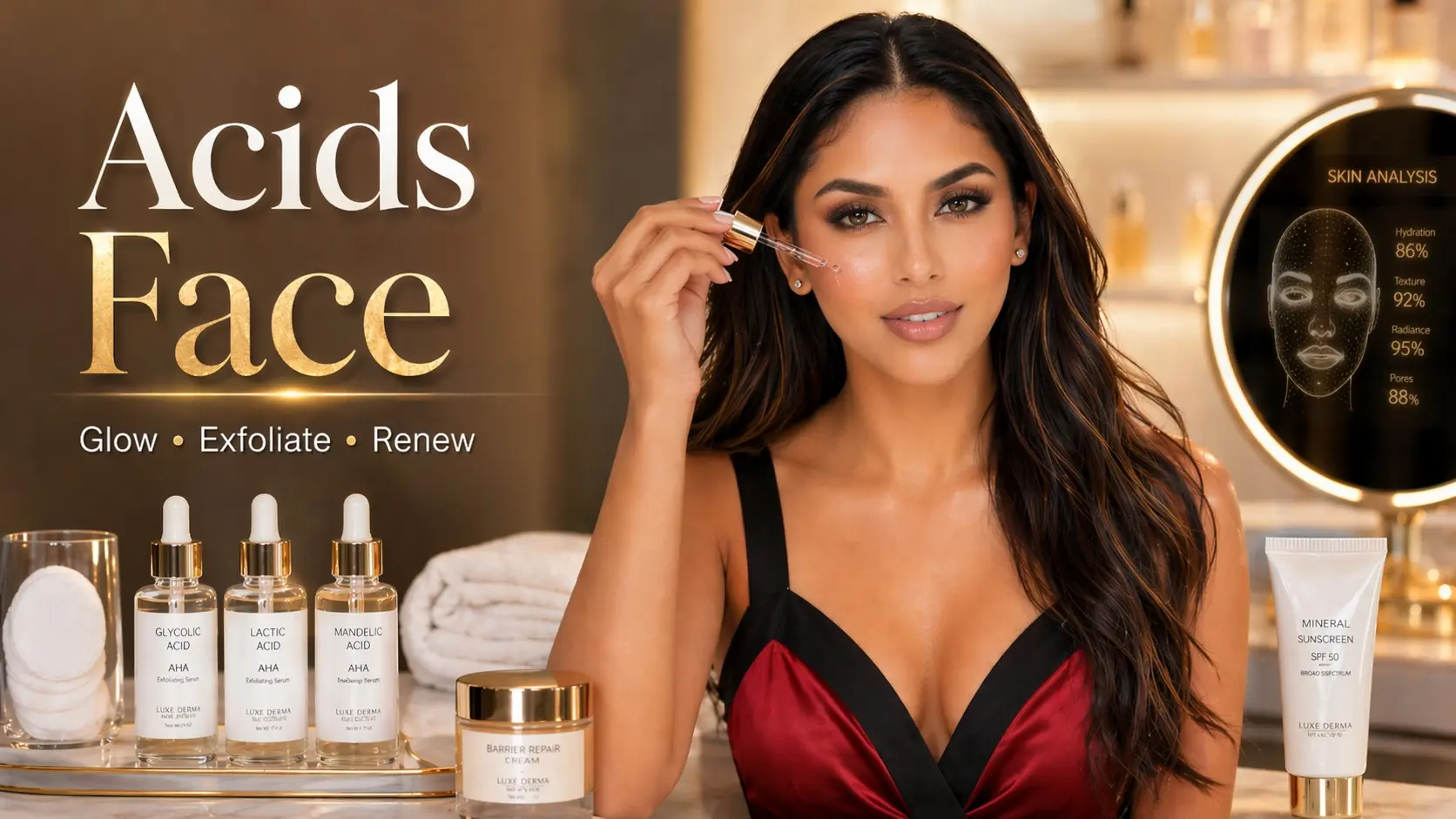
Facial Acids: Proven Tips and Routine: Your skin works hard every single day. It shields you from UV rays, pollution, and bacteria. In return, it cons
Facial Acids: Proven Tips and Routine: Your skin works hard every single day. It shields you from UV rays, pollution, and bacteria. In return, it constantly sheds millions of dead cells. When that shedding process slows down, the surface becomes dull, rough, and congested. That is where acid face treatments come in. Alpha hydroxy acids dissolve the bonds holding dead cells together. They exfoliate without friction, accelerate cell turnover, and trigger collagen production deep within the skin. The results are visible: smoother texture, fewer dark spots, smaller-looking pores, and a brightness that no amount of moisturiser can fake. This guide covers everything you need to make AHAs work for your skin. You will learn the science behind how these acids function, the differences between glycollic, lactic, mandelic, and malic acids, and how to choose the right concentration for your skin type. You will also get a step-by-step routine, guidance on ingredient pairing, and a clear breakdown of the most common mistakes. Whether you are trying chemical exfoliation for the first time or refining an existing routine, this guide is your complete, science-backed reference from beginner to intermediate.
Published · Updated
AHAs are water-soluble. This is a critical distinction. Water-soluble acids stay on the outermost layers of the skin. They do not penetrate into the pore lining the way oil-soluble acids do. This makes them particularly well suited for surface-level concerns: dull texture, uneven tone, fine lines, and post-inflammatory hyperpigmentation.
Skin naturally sheds dead cells through a process called desquamation. Enzymes break down proteins called desmosomes, which act like biological glue holding the outermost cells together. As we age, this process slows. Dead cells accumulate faster than they shed. The result is rough texture, congested pores, and a loss of natural radiance.
AHAs accelerate desquamation by lowering the pH at the skin surface. When the pH drops into acidic territory, typically between 3.0 and 4.5, it disrupts the desmosomal bonds. Dead cells release more easily. Exfoliation happens without any mechanical force. No scrubbing, no micro-tears, no inflammation from friction.
AHAs also act beyond the surface. They stimulate fibroblast activity in the dermis, the structural layer beneath the epidermis. Fibroblasts are the cells responsible for producing collagen and elastin. Regular AHA use increases collagen synthesis over time. This is why these acids carry genuine anti-ageing benefits that go well beyond surface exfoliation.
AHAs vs BHAs: Understanding the Core Difference
BHAs, or beta hydroxy acids, are the other major category of chemical exfoliant. Salicylic acid is the most well-known BHA. Understanding the difference between the two helps you choose the right acid for your specific skin concerns.
The primary structural difference is solubility. AHAs are water-soluble. BHAs are oil-soluble. Because BHAs dissolve in oil, they can penetrate the sebum inside a pore and exfoliate from within. This makes them highly effective for oily skin, acne-prone skin, and blackheads.
AHAs, by contrast, work primarily on the skin surface. They cannot penetrate the pore lining the way BHAs can. However, AHAs outperform BHAs in several areas. They are more effective at fading hyperpigmentation, smoothing fine lines, improving surface texture, and boosting radiance. Lactic acid in particular carries additional humectant properties, meaning certain AHAs hydrate while they exfoliate.
Many people benefit from using both. A product that combines AHAs and BHAs can address surface dullness and subsurface congestion simultaneously. This combination requires careful introduction. Always start with one acid type before adding the other, and monitor your skin closely.
The Role of pH in Chemical Exfoliation
pH is one of the most overlooked factors in AHA efficacy. The pH scale runs from 0 to 14. A pH of 7 is neutral. Anything below 7 is acidic. AHAs need an acidic pH to perform their exfoliating function.
Research indicates that AHAs are most effective when formulated at a pH between 3.0 and 4.5. At this range, they exist as free acids, which can interact with the desmosomes in your skin. When the pH rises above 4.5, a larger proportion of the acid converts to its salt form. Salt forms do not exfoliate. A product with a high pH may contain AHAs on the label but deliver little actual exfoliation.
This is why two products with identical AHA percentages can produce very different results. Always check whether a brand publishes the pH of their AHA products. Reputable brands typically do. A pH of 3.5 to 4.0 is ideal for effective exfoliation with manageable irritation. Below 3.0, the risk of irritation and barrier damage increases significantly.
The Main Types of AHAs for Your Face
Glycolic Acid: The Most Studied AHA
Glycollic acid is the smallest AHA molecule, with a molecular weight of 76 daltons. Its small size provides it the deepest penetration of all the AHAs. It moves quickly through the stratum corneum and interacts with cells at multiple depths. That is why glycollic acid delivers the most dramatic results and also carries the highest potential for irritation.
Clinical studies on glycollic acid are extensive. Research published in leading dermatology journals has demonstrated its ability to reduce fine lines, fade hyperpigmentation, improve acne scarring, and increase epidermal thickness with long-term use. These are not superficial improvements. They show changes in the skin’s structure that are caused by glycollic acid’s ability to boost collagen production.
Glycollic acid suits people with normal to oily skin who have used chemical exfoliants before. Start with a concentration of 5 to 7 percent in a leave-on product. Use it two to three times per week. Observe your skin for redness, flaking, or increased sensitivity. If your skin tolerates it well, gradually increase frequency rather than jumping to a higher concentration.
Lactic Acid: Gentle, Hydrating, and Versatile
Lactic acid has a larger molecular weight than glycollic acid, sitting at around 90 daltons. Its larger size means slower and shallower penetration. This makes it a gentler option with a lower risk of irritation while still delivering effective exfoliation at the skin surface.
What makes lactic acid particularly valuable is its dual function. It exfoliates and it hydrates. Lactic acid is a natural component of the skin’s natural moisturising factor, a group of molecules that maintain hydration in the stratum corneum. When applied topically, it functions as a humectant, drawing moisture into the skin while simultaneously removing dead cells. This combination makes it ideal for dry, dehydrated, or sensitive skin types.
Studies have also shown that lactic acid improves the appearance of age spots and strengthens skin barrier function over time. A concentration of 5 to 10 percent is effective for most users. It performs impressively in toners, serums, and overnight treatments. People new to chemical exfoliation often do well starting with lactic acid before moving to more potent options.
Mandelic and Malic Acid: For Sensitive and Melanin-Rich Skin
Mandelic acid is derived from bitter almonds and has a molecular weight of 152 daltons, making it the largest of the commonly used AHAs. Its size means it penetrates very slowly, producing the mildest exfoliating effect. This makes mandelic acid the safest option for sensitive skin, rosacea-prone skin, and darker skin tones.
Skin with higher melanin content is more prone to post-inflammatory hyperpigmentation. Harsher acids can cause irritation that triggers melanin overproduction, worsening dark spots rather than fading them. Mandelic acid’s slow penetration minimises this inflammatory response. It also carries mild antibacterial properties, which supports its use in acne-prone skin across all skin tones.
Malic acid, found in apples and other fruits, rarely appears alone in skincare. It is most common in multi-acid formulations. Malic acid works synergistically with other AHAs, enhancing their exfoliating action while softening the harshness of more aggressive acids. Its presence in a formula signals a well-rounded, balanced product designed to deliver results without excessive irritation.
How to Choose the Right Acids Face Product for Your Skin Type
Oily and Acne-Prone Skin
Oily skin tolerates acids well. Excess sebum provides a degree of natural buffering, and the skin barrier tends to be more resilient. For oily skin, glycollic acid is a strong first choice. It exfoliates effectively, helps clear congested pores, and reduces the appearance of oiliness over time by keeping the surface free of dead cell buildup.
For acne-prone skin, consider a product that pairs glycollic acid with a low concentration of salicylic acid. The glycollic acid handles the surface, while the salicylic acid penetrates the pore. This combination addresses both the cause and the surface appearance of acne more effectively than either acid alone.
Leave-on products outperform rinse-off formats for oily and acne-prone skin. Toners and serums that stay on the skin deliver sustained contact time, maximising exfoliating benefits. Apply at night, after cleansing, before other serums or treatments.
Dry and Sensitive Skin
Dry skin needs acids that exfoliate without stripping. Lactic acid is the best starting point. Its humectant properties mean it adds moisture while it works, preventing the dryness and tightness that harsher acids can cause. A lactic acid toner at 5 percent, used two nights per week, is a low-risk introduction to chemical exfoliation for dry skin.
Sensitive skin requires extra caution. Mandelic acid is the gentlest option available. Its large molecular size and slow penetration minimise the risk of triggering redness or barrier disruption. Introduce it once per week at first. If your skin shows no adverse reaction after two weeks, increase to twice weekly.
Avoid foaming cleansers on nights when you apply acids. They raise the skin’s pH and disrupt the barrier before the acid even reaches the skin. A gentle, cream-based or micellar cleanser preserves the barrier and creates a better environment for the acid to work. Always follow the AHA application with a rich moisturiser to seal in hydration overnight.
Mature and Hyperpigmented Skin
Mature skin benefits enormously from regular AHA use. Cell turnover slows with age. Dead cells accumulate faster, and the skin produces less collagen. AHAs address both problems simultaneously. They speed up desquamation and stimulate fibroblasts to produce new collagen, resulting in firmer skin with improved texture over months of consistent use.
For hyperpigmentation, glycollic acid at concentrations of 8 to 12 percent delivers the most clinical evidence of efficacy. It works by exfoliating pigmented cells at the surface and by interfering with the transfer of melanin to new skin cells. Consistent use over three to six months produces measurable lightening of age spots, post-acne marks, and melasma patches.
Pair glycollic acid with a vitamin C serum in the morning for a complete anti-pigmentation approach. Vitamin C inhibits melanin production during the day, while glycollic acid removes existing pigmented cells at night. Keeping them on separate schedules avoids the risk of irritation from combining two strong actives at the same time.
Concentrations and pH: Reading the Numbers Correctly
Safe Concentration Ranges for Home Use
AHA concentrations in over-the-counter products range from 1 percent to 30 percent. Not all concentrations are appropriate for home use. The safe and effective range for leave-on products sits between 5 and 15 percent. Rinse-off products like masks can use higher concentrations because the contact time is shorter and controlled.
For beginners, a concentration of 5 to 8 percent is the right starting point. This delivers real exfoliation without overwhelming the skin barrier. Once your skin builds tolerance over four to six weeks, you can step up to 10 to 12 percent. This range addresses the majority of common skin concerns effectively and safely.
Concentrations above 20 percent are professional-grade. Chemical peels at this strength should only be applied by trained aestheticians or dermatologists. At these concentrations, the risk of chemical burns, post-inflammatory hyperpigmentation, and barrier damage is real. Home use of professional-strength acids is one of the most common causes of acid-related skin injuries.
Over-the-Counter vs Professional Formulas
The difference between over-the-counter and professional AHA products is not just concentration. Formulation matters enormously. Professional peels often use unbuffered acids at very low pH levels, which accelerates penetration and reaction time. Retail products use buffering systems and conditioning agents to slow penetration and reduce irritation potential.
A well-formulated retail product at 10 percent glycolic acid with a pH of 3.8 can rival the results of a poorly conducted professional peel. The key variable is consistent, regular use. One professional peel every six weeks produces less cumulative exfoliation than a twice-weekly home routine with a quality retail product maintained over the same period.
Professional treatments hold advantages in specific scenarios. Deep acne scarring, severe hyperpigmentation, and significant photoaging may respond better to in-clinic peels. For everyday maintenance and moderate skin concerns, a consistent home routine with pharmaceutical-grade retail products is sufficient and considerably safer.
How to Read an AHA Product Label
Product labels list ingredients in descending order of concentration. An AHA listed in the first five ingredients is present in a meaningful quantity. An AHA listed near the bottom of a long ingredient list is present at a very low concentration and will not deliver significant exfoliation.
Look for the acid’s full INCI name: glycollic acid, lactic acid, mandelic acid, citric acid, malic acid, or tartaric acid. Marketing terms like “fruit acid complex” or “natural exfoliant blend” do not guarantee effective concentrations. Always look for the full chemical name.
Check whether the brand publishes the pH of the product. A pH between 3.5 and 4.5 indicates a formulation optimised for exfoliation. If pH information is not available, test with pH strips, which are inexpensive and widely available. Dip a strip in the product and compare the colour result to the chart. This gives a reliable proxy for whether the product will actually exfoliate.
Building an Acids Face Routine Step by Step
Morning vs Evening Application
AHAs increase photosensitivity. The freshly exfoliated skin they reveal is more vulnerable to UV damage than non-exfoliated skin. This is why evening application is the standard recommendation. Applying your AHA at night gives the skin hours to process the acid and begin recovery before any sun exposure occurs.
If you choose to use an AHA in the morning, for example, in a low-concentration daily toner, apply SPF 30 or higher immediately after your routine. No exceptions. UV exposure after using AHA without sunscreen not only risks sunburn but also reverses the hyperpigmentation benefits you are working toward.
Evening application follows a clear sequence. Cleanse first. Pat the skin dry. Wait two minutes for pH stabilisation if your cleanser is alkaline. Apply the AHA. Wait ten minutes before layering any other products. This gives the acid time to work before additional products alter the pH environment at the skin surface.
How Often to Use AHAs
Frequency depends on both the product concentration and your skin’s current tolerance. For a beginner, starting with two nights per week is the right approach. Use the acid on Monday and Thursday, for example, and observe how your skin responds over two to four weeks.
Healthy tolerance looks like mild tingling on application that resolves within a few minutes. It may include slight flaking in the first week as the accumulated dead cell layer begins to lift. It does not include persistent redness, burning that lasts beyond application, or increased breakouts continuing past four weeks.
Once your skin shows consistent tolerance, increase to three to four nights per week. Some people with resilient, oily skin tolerate daily use of low-concentration AHAs at 5 to 7 percent. Others find that every third night is their limit. Your skin’s response is the only reliable guide.
Layering AHAs with Other Active Ingredients
The order of application in a multi-step routine follows a logic based on pH and molecular weight. Apply AHAs before other serums in your evening routine. AHAs need direct contact with the skin surface at their native pH to be effective. Applying a moisturiser or serum first creates a layer that dilutes the acid and raises the contact pH.
After waiting ten minutes following AHA application, layer additional serums in order of thinnest to thickest consistency. A hyaluronic acid serum applied after your AHA adds hydration without interfering with the exfoliation that has already begun. A niacinamide serum applied afterwards can help reduce any transient redness and reinforce the skin barrier.
Always finish your evening routine with a moisturiser. AHAs remove the protective dead cell layer, which temporarily reduces the skin’s ability to retain moisture. A moisturiser with ceramides, glycerin, or squalane seals the barrier and stops transepidermal water loss overnight. This step is not optional. It is what separates effective AHA use from damaging over-exfoliation.
Pairing Acids with Other Skincare Ingredients
Ingredients That Work Well with AHAs
Hyaluronic acid is the most compatible ingredient to use alongside AHAs. It adds hydration without altering pH and causes no known interaction. Apply it immediately after your AHA has had time to work on the skin. The moisture it delivers counteracts the potential dryness from exfoliation without compromising the acid’s effect.
Niacinamide, also known as vitamin B3, pairs well with AHAs when used in the correct sequence. Apply niacinamide after the AHA in your evening routine. Niacinamide strengthens the skin barrier, reduces redness, and regulates sebum production. It reinforces many of the benefits AHAs deliver rather than competing with them.
Vitamin C in the morning and AHAs at night is a classic two-step approach for brightening and anti-ageing. They do not interact because they are applied at different times of day. Vitamin C prevents new pigmentation during the day. AHAs remove existing pigmented cells at night. Together they tackle hyperpigmentation from two directions without the irritation risk of simultaneous application.
Ingredients to Avoid Combining with AHAs
Retinol and AHAs in the same routine step are one of the most common skincare mistakes. Both ingredients are active. Both lower the skin’s pH and increase cellular turnover. Combining them in a single session causes cumulative irritation that can damage the skin barrier. The skin becomes red, flaky, and sensitised, which defeats the purpose of either ingredient.
Physical scrubs should not be used on the same nights as AHAs. Scrubbing already-exfoliated skin removes more than dead cells. It strips the newly revealed live cells, causes micro-abrasions, and triggers inflammation. Use a scrub on non-acid nights only, and keep it gentle.
Strong surfactants and foaming cleansers applied immediately before AHA use can compromise results. These cleansers have higher pH values that temporarily raise the skin’s surface pH. An AHA applied right after needs a lower starting pH to convert to its active, free-acid form. Wait two to three minutes after cleansing, or switch to a low-pH cleanser to remove this variable entirely.
The Retinol and AHA Relationship
Retinol and AHAs are two of the most proven anti-ageing ingredients available in skincare. Many people want to use both. The key is separation. Alternate nights are the safest and most effective approach. Use your AHA on Monday, Wednesday, and Friday. Use your retinol on Tuesday, Thursday, and Saturday. Give each ingredient its own dedicated session.
Some advanced users apply retinol first, wait for absorption, then apply a low-concentration AHA. This technique requires high skin tolerance and careful monitoring. It is not appropriate for beginners. Using both ingredients in close succession significantly compounds the risk of irritation, barrier disruption, and increased sun sensitivity.
Build tolerance to both ingredients separately before attempting any combined protocol. Start with retinol alone for six to eight weeks. Then introduce your AHA on alternating nights. Once your skin tolerates both independently and consistently, you can experiment with closer pairing. Always err on the side of less frequent use rather than more.
Common Mistakes When Using Acids on Your Face
Signs of Over-Exfoliation
Over-exfoliation is surprisingly common and consistently misunderstood. People assume that more exfoliation means better results. The opposite is true. The skin barrier needs intact dead cell layers to function. When too many cells are removed too quickly, the barrier breaks down. Moisture escapes. Irritants enter. The skin becomes vulnerable rather than protected.
Signs of over-exfoliation include persistent redness that does not resolve between sessions. Shiny, tight, or waxy-looking skin is another signal. The skin may feel uncomfortable after applying products that were previously well tolerated. Increased sensitivity to touch, temperature, or wind is common. Breakouts that appear despite regular exfoliation can indicate a compromised barrier allowing bacteria in rather than keeping them out.
If you notice these signs, please stop all acids immediately. Focus on barrier repair for two to four weeks. Use gentle, fragrance-free products. Prioritise ceramides, panthenol, and niacinamide. Once the barrier recovers, reintroduce your AHA at a lower concentration and frequency than before. This setback is calibration data, not failure.
Skipping Sunscreen After AHA Use
AHAs remove the surface layer of dead skin cells. That layer, while it appears dull and lifeless, provides meaningful protection against UV radiation. Without it, the fresh cells underneath are exposed to UV rays they are not equipped to handle. UV exposure on AHA-treated skin accelerates collagen breakdown, increases the risk of sunburn, and stimulates melanin production that worsens the very hyperpigmentation you are trying to treat.
SPF 30 is the minimum. SPF 50 is better for daily use while using AHAs. Broad-spectrum protection against both UVA and UVB radiation is essential. UVA rays penetrate deep into the dermis and cause the collagen damage that produces fine lines and laxity. UVB rays cause surface burns and immediate pigmentation responses. Both are active year-round, including on cloudy days and through glass.
Apply sunscreen as the final step in your morning routine. Allow it to settle for five minutes before makeup application. Reapply every two hours if you spend extended time outdoors. This one habit determines whether your AHA routine produces a net benefit or actively accelerates skin aging.
Introducing Acids Too Quickly
Impatience is the most reliable predictor of a bad experience with AHAs. Starting with a high concentration, applying it daily from the first week, or switching rapidly between products gives the skin no time to adapt. The result is an inflamed, barrier-compromised skin that rejects further use altogether.
A proper introduction follows a structured process. Start with the lowest effective concentration available, typically 5 percent. Use it twice per week for the first two weeks. Assess how your skin responds. If there is no significant redness or lasting irritation, continue at that frequency for another two weeks before increasing to three times per week.
Patch testing before full-face application is a practical safeguard. Apply a small amount of the product to the inner forearm or behind the ear. Leave it for 24 hours. Check for redness, itching, or swelling. If there is no adverse reaction, proceed with full-face use. This step takes one day and can prevent weeks of recovery from a full-face sensitivity reaction.
Long-Term Benefits of Consistent AHA Use
Collagen Stimulation and Anti-Aging Results
The anti-ageing benefits of AHAs go well beyond removing dead cells. Regular use at effective concentrations triggers a cascade of biological responses in the dermis. Fibroblasts increase their collagen output. Glycosaminoglycans, the molecules responsible for skin plumpness and moisture retention, also increase. The dermis literally thickens with sustained AHA use.
Clinical trials measuring skin thickness and collagen density in participants using glycollic acid over twelve weeks show statistically significant improvements. Wrinkle depth decreases. Skin elasticity increases. These are not anecdotal reports. They reflect measurable structural changes induced by consistent, correctly formulated AHA use over time.
The timeline for these results matters. Surface exfoliation improves within the first two weeks. Texture and radiance improvements typically appear within four to six weeks. Meaningful collagen and elasticity improvements require three to six months of consistent use. Each application adds to a cumulative biological response that compounds over time.
Fading Hyperpigmentation Over Time
Hyperpigmentation forms when melanocytes, the pigment-producing cells in the skin, produce excess melanin in response to inflammation, UV exposure, or hormonal changes. AHAs fade hyperpigmentation through two mechanisms. First, they exfoliate pigmented cells at the surface faster than the body would naturally shed them. Second, they interfere with the enzymatic processes that transfer melanin to new skin cells.
Consistent use of glycollic acid at 8 to 12 percent over three months shows a measurable reduction in the melanin index, a standardised measure of pigmentation density, in controlled studies. Results are most pronounced for post-inflammatory hyperpigmentation from acne, as well as solar lentigines, the technical term for sunspots.
Melasma responds more slowly and requires a combination approach. AHAs alone usually do not completely resolve melasma. Combining glycollic acid with vitamin C, niacinamide, and strict sun protection produces the most significant results. Dermatologist-prescribed ingredients like azelaic acid or topical tranexamic acid may also be recommended for persistent melasma alongside a consistent AHA routine.
Texture, Pore Appearance, and Skin Tone
One of the most immediately noticeable benefits of using AHA is an improvement in skin texture. The rough, uneven feel that dead cell buildup creates disappears within the first few weeks of regular exfoliation. Foundation applies more evenly. The skin reflects light more uniformly, which is the physical basis of the glow that consistent AHA users describe.
Pores do not actually shrink in diameter. Their size is determined by genetics and the collagen support structure surrounding them. However, pores appear larger when they are filled with dead cells and sebum. Regular AHA exfoliation keeps the surface around each pore clear. Without the buildup, pores appear smaller because they are no longer stretched open by congestion.
Skin tone becomes more even with regular AHA use, as the constant removal of surface cells prevents localised pigmentation from accumulating. The cumulative effect of weekly exfoliation over months creates a baseline of uniformity that is difficult to achieve with topical brighteners alone. This is why AHAs remain one of the most cost-effective and evidence-backed tools in any long-term skincare strategy.
Frequently Asked Questions About Acids on the Face
Can I use acids on my face every day?
Daily use depends on concentration and your skin’s tolerance. Low-concentration AHAs at 5 percent or below in toner formulas can be used daily by people with oily or resilient skin. At concentrations of 8 percent and above, most people risk over-exfoliation and barrier damage by using it too frequently each day. Start with two to three times per week. Only increase to daily use if your skin tolerates lower frequencies without any adverse response for at least four consecutive weeks.
What is the best AHA for beginners?
Lactic acid is the best starting point for most beginners. Its larger molecular size means slower penetration and less potential for irritation. It also hydrates while it exfoliates, which makes it forgiving on dry or sensitive skin. Begin with a product containing 5 to 8 percent lactic acid. Use it two nights per week. Give your skin four weeks to adapt before considering a step up in concentration or switching to a more potent acid like glycollic.
Can acids cause more breakouts?
An initial increase in breakouts is possible in the first two to three weeks of starting AHAs. This is sometimes called purging. It happens because accelerated cell turnover pushes congestion that was already forming beneath the surface to the top faster than usual. True purging resolves within four weeks. If breakouts continue beyond that point, or appear in areas where you do not normally break out, the product may be causing irritation rather than purging. Reduce frequency and assess your skin’s response over the following two weeks.
Should I use a toner, serum, or mask format for my AHA?
Each format serves a different purpose. Toners are low concentration, typically 5 to 8 percent, and are designed for frequent, regular use. They deliver consistent baseline exfoliation and suit maintenance-focused routines. Serums offer higher concentrations, often 10 to 15 percent, in leave-on formulas that provide deeper exfoliation. Masks use high concentrations in a short-contact format, typically 5 to 20 minutes, for a more intensive treatment once or twice per week. Begin with a toner or low-concentration serum. Introduce masks only after your skin has established clear tolerance to leave-on products.
Do acids interact with prescription skincare?
Tretinoin and other prescription retinoids are among the strongest skin actives available. Combining them with AHAs on the same night significantly increases the risk of irritation, peeling, and barrier disruption. Alternate nights are the safest approach. Hydroquinone, a prescription-strength pigmentation treatment, can be used alongside AHAs, as the combination may enhance efficacy. However, any use of prescription ingredients alongside AHAs should be discussed with the prescribing dermatologist. They can advise on sequencing, frequency, and whether adjustment to your prescription dose is appropriate.
Conclusion
AHAs are among the most effective, versatile, and evidence-backed tools in skincare. They exfoliate without friction, stimulate collagen production, fade hyperpigmentation, and improve texture with consistent use. The key is choosing the right acid for your skin type, starting at a sensible concentration, and building frequency gradually. Respect the pH requirements, follow the sunscreen rule without exception, and avoid using too many actives at once.
Your next steps are straightforward. Assess your skin type and choose your starting acid. Lactic acid is for dry or sensitive skin, glycollic acid is for oily or mature skin, and mandelic acid is for sensitive or darker skin tones. Select a product with a published pH between 3.5 and 4.5. Begin with two nights per week. Add SPF 50 to your morning routine from day one. Give the routine eight to twelve weeks before evaluating results. Consistency over time, not intensity in the short term, is what transforms skin.
RELATED ARTICLES:
How to Get Rid of Black Neck Fast: Proven Tips – New vs Traditional
Turmeric and Yoghurt Face Pack: The Ayurvedic Secret You Need in Your 2025 Skincare Routine!
Best Face Care Routine for Radiant Skin – Expert Tips & Skincare Secrets
Here Is How To Shave Your Face The Right Way—Without Nicks Or Cuts
30 Easy Beauty Tips to Improve Your Face, Skin, and Hair
About The Author

COMMENTS