
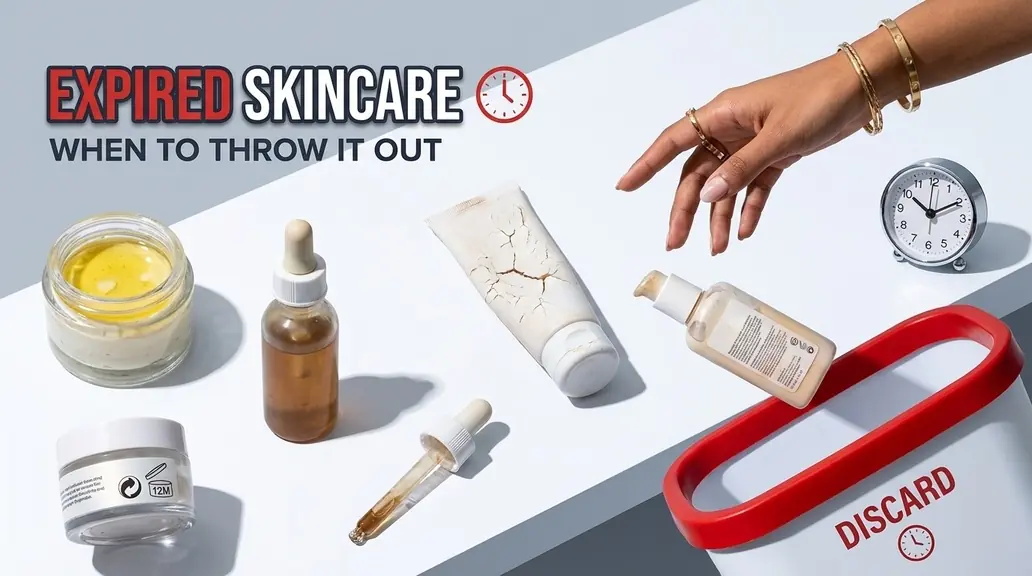
Expired skincare products sit in nearly every bathroom cabinet because the dates on the back of the bottles feel like guidelines and the products stil
Expired skincare products sit in nearly every bathroom cabinet because the dates on the back of the bottles feel like guidelines and the products still look fine. The truth about expired skincare products is messier: most do not become unsafe on the day they expire, but most lose meaningful potency, and some genuinely turn into irritants. This guide walks through expired skincare products honestly with the shelf-life rules by category, the visual signs to watch for, and what is actually unsafe to keep using.
Published · Updated
Why Skincare Products Expire in the First Place
The detail most guides skip on expired skincare products: results compound only when small habits stack. Two careful choices today are worth more than ten half-followed ones, and expired skincare products reward consistency over weeks, not chasing a single perfect product.
Every cosmetic formula is a small ecosystem. It contains water, oils, active ingredients, emulsifiers that hold everything together, and preservatives that keep microbes from colonising the product. The moment you break the seal, that ecosystem starts to destabilise. Oxygen begins oxidising sensitive molecules, such as vitamin C and retinol. Light degrades photosensitive compounds. Warm bathroom air encourages microbial growth. Your fingers, even after washing, introduce bacteria, yeast, and mould spores into the jar. Over time, the preservative system becomes overwhelmed, the emulsion separates, and the active ingredients lose the precise molecular structure that made them work.
Cosmetic chemists formulate products to remain stable for a specific window, typically validated through accelerated stability testing. These studies simulate months or years of real-world use under varied temperature and humidity conditions. The shelf life printed on your packaging is the manufacturer’s confident guarantee that the product will still look, smell, feel, and perform as intended. After that window, the guarantee expires, even if the product still looks fine to the naked eye.
There is also a critical distinction between two dates you will find on cosmetic packaging. The first is the expiration date, a hard cutoff typically used for products with active pharmaceutical ingredients like sunscreens, acne treatments, or some prescription creams. The second is the PAO symbol, short for Period After Opening. It looks like a small open jar with a number followed by an M, such as 6M or 12M. That number tells you how many months the product remains safe and effective once you break the seal. A serum with a 12M symbol, opened fourteen months ago, has quietly crossed into a zone where the manufacturer can no longer vouch for its safety or performance.
The Role of Preservatives and Why They Matter More Than You Think
Preservatives are often vilified in clean beauty conversations, but they are the single most important reason your skincare does not turn into a petri dish. Ingredients like phenoxyethanol, benzyl alcohol, potassium sorbate, and sodium benzoate keep fungi, yeast, and bacteria from multiplying in the warm, nutrient-rich environment of a moisturiser or serum. Products marketed as preservative-free are not truly preservative-free. They either rely on alternative antimicrobial systems like fermented radish root filtrate, use high alcohol content, or are packaged in airless pumps that prevent contamination.
The problem is that preservatives themselves degrade over time. After twelve to twenty-four months, a once-robust preservative system can drop below the threshold needed to inhibit microbial growth. This is why you might see a product pass its PAO date and still look fine for weeks, only to suddenly develop a strange smell, visible mould, or an off-colour film. By the time you can see contamination, microbial load has already been climbing invisibly for a while.
How to Read Expiration Labels and Batch Codes
Most modern skincare packaging includes at least one of three markers. The PAO jar symbol tells you the months after it is opened. A printed expiration date, often abbreviated as ‘EXP’ and followed by a month and year, tells you the absolute cutoff. A batch code, usually a short alphanumeric string stamped on the bottom or crimped onto the tube, encodes the manufacturing date. If you cannot find a PAO or EXP, you can often enter the batch code into free online lookup tools that decode the manufacturing date for major brands, then add two to three years as a conservative estimate.
When you bring home a new product, take thirty seconds to write the opening date on the bottom with a fine permanent marker. This simple habit eliminates the guesswork that leads most of us to keep products far longer than we should. Some people prefer tiny round labels with the opening month noted, stuck discreetly on the bottom of each bottle. Whichever method you choose, the goal is to remove doubt from future decisions.
Serums: When Your Most Expensive Products Turn on You.
Worth pausing on with expired skincare products: the products matter less than the order and timing. The same shelf can deliver visible expired skincare product results or flat ones depending on the layering.
Serums are the workhorses of a modern routine and often the most expensive items in a cabinet. Their high concentration of actives makes them powerful but also relatively fragile. Most well-formulated serums last six to twelve months after opening, though the exact window depends heavily on the active ingredient and the packaging.
Vitamin C serums, particularly those formulated with pure L-ascorbic acid, are the most temperamental. L-ascorbic acid oxidises on contact with air and light, turning from clear or pale yellow to deep orange, then brown. Once it browns, it has essentially become dehydroascorbic acid, a compound that still has some bioactivity but can also be pro-oxidant on the skin, potentially doing more harm than good. If your vitamin C serum has darkened significantly, even if you bought it last month, it is time to replace it. More stable vitamin C derivatives like sodium ascorbyl phosphate, magnesium ascorbyl phosphate, and tetrahexyldecyl ascorbate resist oxidation much longer, sometimes up to a year after opening.
Retinol and retinoid serums are similarly light-sensitive and prone to degradation. Air exposure converts retinol into less active breakdown products. If your retinol serum came in a clear jar, it was already compromised before you bought it. Opaque bottles, airless pumps, and aluminium tubes all extend the useful life of retinoids significantly. A well-packaged retinol will stay potent for around twelve months after opening. A jar-packaged one may lose meaningful potency within six months.
Hyaluronic acid, peptide, and niacinamide serums are generally more stable, lasting around twelve months after opening. Still, the presence of botanical extracts, essential oils, or fragrance can shorten that window. When a serum begins to smell rancid, waxy, or vaguely sour, it is the oils inside that are oxidising. Even if the active ingredient is still partially functional, oxidised lipids can irritate the skin and contribute to free radical damage.
Signs Your Serum Has Expired
Trust your senses before you trust the calendar. A serum that has gone off will often separate into distinct layers that do not recombine with a shake. It may develop a cloudy, hazy, or filmy appearance where it was once crystal clear. The colour may deepen dramatically, moving from pale to amber or from amber to brown. The scent shifts from neutral or lightly fragranced to sharp, sour, or metallic. Most tellingly, the skin’s reaction changes. A serum you tolerated perfectly for months may start causing tingling, stinging, redness, or small bumps. That is your skin telling you the formula no longer matches what your barrier signed up for.
Moisturizers and Creams: Jars Versus Pumps
A moisturiser typically lasts six to twelve months after opening, but the packaging is the single biggest variable. Wide-mouth jars, while beautiful on a vanity, are the least suitable option for product longevity. Every time you dip your fingers into a jar, you introduce bacteria, skin cells, and moisture from your hands. Over time, this repeated contamination wears down the preservative system. A jar-packaged moisturiser that claims a twelve-month PAO may realistically be compromised by month eight if you use your fingers.
Airless pumps and tubes perform dramatically better. Air cannot enter the container, so the product inside is not continuously oxidising, and your fingers never touch the formula. These packaging formats can extend effective shelf life to the full PAO window or beyond. If you invest in a high-performance moisturiser, choosing one in a pump or tube is one of the simplest ways to protect your money.
If you love a jar-packaged cream, there is a simple workaround. Use a small cosmetic spatula to scoop out what you need, then apply with clean fingers. Keep the spatula clean and dry between uses. This single habit can extend the life of a jar-packaged product substantially and reduce the risk of contamination-induced breakouts.
Ingredient-wise, moisturisers that rely on rich plant oils like rosehip, argan, or sea buckthorn will go rancid faster than those built on synthetic emollients. Rancid oils have a distinct sour, crayon-like smell. They can clog pores, trigger inflammation, and contribute to oxidative stress on the skin surface. A moisturiser that has lost its original creamy texture, developed visible oil pooling on the surface, or changed colour is no longer good to use.
Toners and Essences: Short-Lived but Often Overlooked
Toners are often the first products to go bad in a routine, which makes it ironic that they are among the most frequently kept far too long. Because toners are water-based and often contain active acids, their preservative systems are under constant strain from day one. Most toners last about twelve months after opening, but those containing alpha hydroxy acids like glycollic or lactic, beta hydroxy acids like salicylic, or enzymatic exfoliants will lose efficacy faster.
Acid-based toners have a specific problem beyond microbial contamination. The pH of the formula drifts over time, and the effective concentration of free acid drops. A glycollic toner that once provided a comfortable, tingling exfoliation may become either too gentle to be effective or, more dangerously, unstable enough to cause unexpected irritation. If your toner now stings where it used to glide or has become completely ineffective where it once visibly smoothed your skin, replace it.
Hydrating toners and essences packed with humectants, fermented ingredients, or botanical extracts also have shorter useful windows. Fermented extracts are particularly prone to instability, and essences in wide-mouth jars or frequently opened bottles can develop off-odours within six to eight months. Keep toners in a cool, dark cabinet rather than on the edge of a sunlit sink, and replace the cap immediately after each use.
Cleansers: The Most Variable Category
Cleansers are the chameleons of the skincare shelf. A surfactant-based gel cleanser packed with preservatives can easily last twelve to eighteen months after opening. A cream cleanser with botanical oils may only last nine months. A balm cleanser in a jar, dipped into with wet fingers after every use, can go rancid in as little as six months. An oil cleanser made from a single pressed oil, like jojoba or squalane, can last over a year if stored properly, but a blended oil cleanser with multiple fragile oils may oxidise in six to nine months.
Micellar waters deserve a specific mention. Despite feeling like plain water, they contain surfactant micelles, preservatives, and often botanical extracts. Once opened, most last about six to nine months. If your micellar water has developed a cloudy appearance where it was once clear, or a soapy film at the top, it is done.
Bar cleansers, both traditional soap and syndet formulations, last the longest of any cleaning category. Kept dry between uses on a draining dish, a bar cleanser can remain safe and effective for a year or more, since the low water content inhibits microbial growth. The problem arises when bars sit in pooled water, which softens the surface and creates a breeding ground for bacteria.
How Bathroom Conditions Shorten Cleanser Life
Most of us store cleansers in the shower, which is arguably the worst possible environment. Heat accelerates chemical breakdown. Humidity encourages microbial growth. Direct sunlight through a bathroom window degrades photosensitive ingredients. If you want your cleansers to last, store them in a linen closet or cabinet and bring only what you need into the shower. If that is impractical, at least close caps tightly immediately after use and wipe condensation off the bottle.
Masks: From Clay to Sheet to Sleeping
Masks are their own kingdom, and the rules shift dramatically by subcategory. Clay masks are among the longest-lasting products in a routine, often remaining stable for eighteen to twenty-four months after opening. The low water activity of clay makes it inhospitable to most microbes. However, clay masks dry out over time, which changes the application experience and can make them drag on the skin. If your clay mask has become stiff, cracked, or impossible to spread, it is time to replace it, even if it is still technically safe.
Gel and cream masks behave more like moisturisers and last for nine to twelve months. Sleeping masks, which are essentially overnight occlusive moisturisers, follow the same timeline. Exfoliating masks with acids or enzymes lose potency on a schedule similar to acid toners and should generally be replaced within twelve months.
Sheet masks exist in a category of their own. Sealed in individual foil packets, they can last eighteen to twenty-four months from manufacturing, since the serum inside is protected from air and light. Once you open the packet, however, the mask must be used immediately. You cannot reseal a sheet mask for later. Storing unopened sheet masks in the refrigerator can extend their useful life slightly and creates a lovely cooling sensation on application. Storing them in a hot bathroom can shorten their life significantly and degrade the serum inside.
Sunscreen: The Non-Negotiable Expiration
If every other product on this list deserves a careful evaluation, sunscreen deserves a strict rule. Sunscreens have a firm expiration date printed on the packaging because their ultraviolet filters are active ingredients regulated as over-the-counter drugs in many countries. Past the expiration date, those filters are no longer guaranteed to deliver the protection level stated on the bottle. Using expired sunscreen means you are gambling with your skin cancer risk, your photoageing outcomes, and the integrity of every other anti-ageing investment you have made.
Chemical sunscreens, which absorb ultraviolet radiation using molecules like avobenzone, octinoxate, and octocrylene, are especially prone to photodegradation. Avobenzone, one of the most common UVA filters, is notoriously unstable in its pure form and is typically stabilised with octocrylene or other partner molecules. Over time and with heat exposure, even well-stabilised avobenzone loses its efficacy. A two-year-old bottle of chemical sunscreen, especially one that has lived in a beach bag or car, may offer only a fraction of its labelled protection.
Mineral sunscreens based on zinc oxide and titanium dioxide are more physically stable, since the active particles themselves do not degrade in the same way. However, the emulsion that carries them absolutely does. Separated mineral sunscreens can leave uneven coverage that creates unprotected patches on the skin. If your mineral sunscreen has become grainy, separated, or significantly harder to spread, replace it.
As a general rule, sunscreen should be replaced every twelve months regardless of what the bottle says, because realistically, if you are using sunscreen correctly, a full bottle should not last you a whole year. A standard face-and-neck application uses roughly a quarter teaspoon every single day. A 50ml bottle contains about 200 applications, or just over six months of daily use. If your sunscreen bottle is still going strong after a year, you are not applying enough.
How to Store Sunscreen to Maximize Effectiveness
Never leave sunscreen in a hot car, on a sunny windowsill, or in direct sun on a beach towel. Heat accelerates the breakdown of ultraviolet filters and emulsifiers, meaning the sunscreen in your beach bag on a 95-degree day is losing potency in real time. Store sunscreen in a cool, shaded place. If you are spending the day outdoors, keep your sunscreen in an insulated bag with the rest of your skincare essentials.
Eye Creams and Lip Products: Small Packages, Short Windows
Eye creams occupy a uniquely vulnerable position. The skin around the eye is thin, delicate, and closer to mucous membranes than any other facial skin. Contamination in an eye cream jar can migrate into the eye itself, causing styes, conjunctivitis, or persistent irritation. Most eye creams carry a twelve-month PAO, but given the risk profile, replacing them every nine months is the safer call. Use a clean, dry ring finger or a small metal applicator, never fingers that are fresh from applying other products.
Lip balms and treatments range widely. A simple beeswax-based balm in a twist-up tube can last two years without issue. A tinted lip treatment with botanical oils and pigments may lose its effectiveness in twelve months. Lip products get contaminated rapidly because they touch the mouth, which is a microbial ecosystem. After an illness like a cold, flu, or cold sore outbreak, any lip product that touched your lips during the illness should be discarded to prevent reinfection.
Acne Treatments and Active Prescription Products
Benzoyl peroxide, salicylic acid spot treatments, and prescription acne medications follow their own stricter rules because the actives are relatively unstable and efficacy loss is clinically meaningful. Benzoyl peroxide degrades into benzoic acid over time, particularly when exposed to heat and light. An old tube may feel the same but deliver a fraction of the acne-fighting power, allowing breakouts that should have resolved to persist.
Prescription retinoids like tretinoin, adapalene, and tazarotene have specific expiration dates set by the pharmacy. While some research suggests these products retain potency for several months past their marked date if stored properly, using expired prescription actives undermines a regimen that may have taken months to dial in. Replace prescription products when instructed, and store them away from bathroom heat and light.
How Storage Habits Can Double or Halve Shelf Life
Where you store skincare matters almost as much as what you buy. The bathroom, despite being the cultural default, is the worst possible storage environment. Between morning showers, evening baths, and daily hot water use, the average bathroom swings through significant temperature and humidity changes several times a day. This cyclical stress accelerates the breakdown of nearly every active ingredient.
A cool, dark, dry cabinet in a bedroom or linen closet is ideal. Temperatures between 60 and 75 degrees Fahrenheit with low humidity and no direct light create the most stable environment. For particularly temperamental products like vitamin C, retinol, probiotics, and peptide-heavy formulas, a small beauty fridge or a shelf in your kitchen fridge can extend useful life considerably. Cold storage slows oxidation and microbial growth simultaneously. It also feels wonderful on the skin during application.
Avoid storing skincare in places with dramatic temperature swings. Cars in summer, cold cars in winter, windowsills, and the top of a hot radiator all cycle products through stress that preservative systems and emulsifiers were never designed to handle. If you travel with skincare, keep products in your carry-on rather than in a checked bag, where unheated cargo holds can freeze water-based formulas and break their emulsions.
The Beauty Fridge Debate
Beauty fridges have become a wellness trend, but they are not universally useful. Oil-based products like facial oils, balms, and some thick creams can solidify in a fridge and become difficult to work with. Products containing high concentrations of natural butters like shea or cocoa can separate or develop a grainy texture when repeatedly warmed and cooled. Water-based products, sheet masks, aloe gels, eye creams, vitamin C serums, and probiotic formulations, on the other hand, genuinely benefit from cold storage. Be selective, not universal, with your fridge strategy.
Conducting a Proper Skincare Audit
Twice a year, block out thirty minutes and give your entire skincare collection a real audit. Pull every product out of drawers, shelves, travel bags, and gym lockers. Line them up on a clean towel on a well-lit counter. For each product, note four things: the PAO or expiration date, the approximate date you opened it, any visible changes, and any changes in how the product smells or performs.
Create three piles. The first pile is products that are clearly still good. These go back on your shelf, organised so that products near the end of their PAO window are at the front and are used first. The second pile is products that are clearly expired, contaminated, or have changed dramatically. These get thrown away without second-guessing, regardless of cost. The third pile is the tricky middle ground: products you are unsure about. For this pile, apply a small amount to the inside of your wrist or forearm and wait twenty-four hours. If there is no reaction and the product looks and smells normal, you can cautiously continue using it, though it is wise to prioritise it in your routine so you finish it quickly. If there is any redness, itching, or irritation, throw it away.
Be honest during the audit. A product you bought on impulse nine months ago and have used only twice is not going to suddenly become your favourite. A product that irritated you the first time will not work differently on the twentieth application. Products you have been saving for a special occasion are silently going bad while you wait. Use them or lose them.
How to Shop Smarter So You Waste Less
The best way to avoid throwing away expensive skincare is to not buy more than you can reasonably use. Before you add anything to your cart, ask whether you will finish the current version of that product type first. Having three vitamin C serums in rotation means none of them will be finished before oxidation catches up.
favour smaller sizes for products you have not tried before. Deluxe samples, travel sizes, and trial kits let you test a product across several weeks without committing to a full bottle. Only size up once you are certain a product works for your skin and your routine. For actives like retinol and vitamin C that have short shelf lives, smaller bottles are often the smarter choice even once you know you love the product, because you will always be working with a fresher, more potent formulation.
Look for packaging that protects the formula. Airless pumps, aluminium tubes, opaque bottles, and dark amber or cobalt glass all significantly extend useful life. Brands that invest in better packaging usually invest in better formulations. Clear bottles with open jar lids for a potent active ingredient should be a signal to proceed with caution, since the formula inside may have been oxidising on the store shelf for months before you brought it home.
Frequently Asked Questions
Can I still use a product if it smells fine but has passed its expiration date?
The honest answer is that it depends on the product and how far past the date you are. For most moisturisers, cleansers, and masks, a few weeks past the PAO on a well-preserved formula is unlikely to cause immediate harm, though efficacy may be reduced. For active-heavy serums, retinoids, and especially sunscreens, even a small window past the expiration date can meaningfully reduce their performance. Sunscreen past its printed expiration date should always be discarded because the consequences of reduced ultraviolet protection are cumulative and irreversible. When in doubt, the cost of replacing a product is almost always lower than the cost of treating the breakouts, irritation, or damage caused by using an expired one.
Does refrigerating skincare actually extend its shelf life?
Yes, for certain product categories. Cold storage slows both the chemical breakdown of active ingredients and the growth of microbes, which are the two main reasons skincare expires. Water-based serums, vitamin C formulations, retinoids, sheet masks, aloe-based products, and eye creams all benefit measurably from refrigeration. The extension is not dramatic; think weeks rather than months, but it is real. Oil-based products, thick butters, and emulsions with high natural wax content generally do not benefit and may even separate or become difficult to use. Never freeze skincare, as freezing breaks emulsions and destroys most formulations.
What happens to my skin if I use expired products?
The outcomes range from inconsequential to serious. On the mild end, expired products simply stop delivering the results you expected, wasting both your money and your routine time. In the middle range, degraded preservative systems allow microbial contamination to reach your skin, which can trigger breakouts, folliculitis, clogged pores, and inflammation. Oxidised oils in older formulas can contribute to free radical damage and accelerate visible aging. On the more serious end, expired eye products can cause eye infections, expired sunscreens can result in sunburn and cumulative ultraviolet damage, and heavily contaminated products can trigger contact dermatitis or bacterial infections requiring medical treatment. Compromised skin barriers, like those healing from acne, eczema, or post-procedure skin, are especially vulnerable.
How do I know when my natural or organic products have expired?
Natural and organic products generally expire faster than conventional formulations because they rely on gentler, less robust preservative systems. A natural moisturiser with a six- to nine-month PAO is common, while a similarly formulated conventional product might have a twelve-month window. Trust the PAO symbol, but also pay close attention to scent changes. Natural products often contain cold-pressed oils and botanical extracts that give characteristic fresh or herbaceous scents, and the shift to rancid, sour, or off smells is usually dramatic and easy to detect. Visible mould in natural products is more common than in synthetic ones, so inspect creams and balms carefully if they are in humid environments.
Is it safe to share skincare products with family members?
Sharing skincare is riskier than most people realise, particularly for products applied around the eyes, lips, or on broken skin. Every use of a jar or dropper introduces a small amount of the user’s skin microbiome into the product. Sharing effectively combines those microbiomes that can transfer acne-causing bacteria, herpes simplex virus from lip products, or fungal organisms between people. If you must share, limit it to pump, tube, or spray products where nothing touches the applicator. Never share jar products, mascara, eyeliner, or lip products, especially if anyone has active skin or eye conditions.
How should I dispose of expired skincare products responsibly?
Do not pour liquid products down the drain, particularly those containing chemical sunscreens, exfoliating acids, or retinoids, as these can persist in water systems. Empty product contents into a sealed plastic bag before disposing of them in household trash. Many cities have cosmetics take-back programmes, and some brands run recycling initiatives for their packaging. Rinse out glass bottles and recycle them, peeling off paper labels first. Aluminium tubes can usually be recycled. Plastic jars, pumps, and droppers vary by local recycling rules, so check before tossing. Taking a few minutes to dispose thoughtfully is a small but meaningful way to reduce the environmental footprint of a routine.
Can I restore an expired product by mixing in something fresh?
No. Once a product has expired, you cannot reverse oxidation, restore preservative activity, or bring back the original efficacy of active ingredients by adding anything to it. Mixing vitamin C powder into an old moisturiser, adding essential oils to a rancid cream, or combining partially used bottles together only creates a new formulation with unknown stability and a dramatically higher contamination risk. Home mixing also disrupts the pH, emulsion, and preservative system that manufacturers carefully balanced during production. If a product has expired, the only safe action is to discard it and replace it.
How long do unopened skincare products last?
Unopened products generally last two to three years from manufacturing if stored properly, though the shelf life varies by formula. Sunscreens typically guarantee three years from production if unopened. Products with delicate actives like vitamin C or retinol may start degrading even in sealed packaging after eighteen to twenty-four months, particularly if stored in warm or bright environments. Check for a batch code on the bottom of any long-stored product and decode the manufacturing date if possible. Stockpiling backups of favourite products may feel efficient, but unopened products on a shelf are not frozen in time. They age slowly but continuously.
Your Next Steps for a Cleaner, Safer Routine
Skincare is meant to be used, not collected. Every product on your shelf was formulated with the assumption that you would open it, use it regularly, and finish it within a reasonable window. Keeping products long past their prime turns an investment in your skin into a liability against it, and the consequences, while sometimes invisible at first, compound over time into breakouts, irritation, and lost efficacy.
Start with a thirty-minute audit this week. Pull everything out; check PAO symbols and expiration dates; mark opening dates on bottles you have not yet labelled; and let go of the products that are no longer serving you. Commit to buying smaller sizes of unfamiliar products and to finishing one item before opening its replacement. Move your most temperamental actives out of the bathroom and into a cool, dark space, and consider a dedicated spot in the fridge for vitamin C, retinol, and eye creams.
Most importantly, trust what your skin tells you. A product that once felt wonderful and now stings, dulls your complexion, or triggers unexpected breakouts is trying to send you a clear message. Listening to those signals and acting on them without guilt about what the product costs is what separates a routine that protects your skin from one that quietly undermines it. Clean shelves, fresh formulas, and an honest relationship with your stash are the foundation of every glowing complexion you admire.
RELATED ARTICLES:
The Complete Geisha SkinCare Routine: Timeless Secrets for Radiant Skin
Unveiling the Secret to Radiance: Tamarind Extract in Skincare
Skincare-infused makeup: Why your 2026 foundation should double as a serum
PDRN Skincare: The K‑Beauty Ingredient That Went From Clinics to Your Vanity
Skin Tints That Work For a Natural Base
The honest bottom line on expired skincare products: consistency beats complexity. Build a few habits into your weekly rhythm, give your skin or hair a real window to respond, and expired skincare products become second nature.
About The Author

COMMENTS