










Quick answer: Exosomes for skin are tiny lipid-bound vesicles, about 30 to 150 nanometres across, that deliver signalling molecules to skin ce
Published · Updated
Exosomes for skin have become the most searched skincare ingredient of 2026, with global interest climbing 81 per cent over the last three months. The buzz is not just a passing TikTok wave. Dermatology clinics are stocking exosome serums, K-beauty brands are reformulating around them, and the search-engine signal lines up with what skin specialists are quietly recommending to clients chasing the “skin longevity” goal that has replaced traditional anti-ageing language this year. This guide explains what exosomes for skin actually do at the cellular level, who genuinely benefits from them, how to layer them into a routine, and where the marketing runs ahead of the evidence.

What are exosomes for skin?
Exosomes are tiny lipid-bound packages, about 30 to 150 nanometres across, that cells use to send signals to each other. Think of them as biological postal envelopes carrying proteins, growth factors, peptides, lipids, messenger RNA, and microRNA from one cell to a target cell, where they unload their contents and prompt a response. When you read that exosomes for skin “communicate with your cells”, that is literally what they are designed by nature to do.
In skincare, the exosomes for skin sold over the counter are extracted from a donor source, purified, and concentrated into a serum or treatment. The donor source matters and is one of the first questions a smart shopper asks. Some brands derive exosomes from human stem cells, usually from umbilical cord tissue or adipose tissue. Others use exosomes from plants such as roses, edelweiss, ginseng, or centella asiatica. A third group uses fermentation-derived exosomes from probiotic bacteria. Each source produces a slightly different cargo of signalling molecules and a different regulatory profile across different countries.
How exosomes work on the cellular level
When you apply exosomes for skin in serum form, the goal is for the exosomes to reach the upper layers of your skin and deliver their cargo to keratinocytes, fibroblasts, and immune cells in the epidermis and upper dermis. Because exosomes are nanoscale and lipid-bound, they can travel through the stratum corneum more efficiently than larger proteins. Once they arrive at a target cell, they fuse with the cell membrane or are taken up through endocytosis, and the cargo gets to work.
The downstream effects depend on what the cargo carries. Growth factors signal fibroblasts to make more collagen and elastin. Anti-inflammatory mediators calm overactive immune responses. MicroRNAs can switch certain genes on or off, including genes that regulate pigment production, wound healing, and barrier repair. This is why exosomes feel less like a single ingredient and more like a coordinated signalling package, and this is also why they have caught the attention of clinicians who were previously sceptical of “growth factor” marketing in serums.
Exosomes vs growth factors vs peptides
Peptides are short chains of amino acids that bind to specific receptors on cells, like a small key fitting a single lock. Growth factors are larger proteins that also bind to specific receptors but trigger broader responses. Exosomes are vehicles that can carry peptides, growth factors, and many other signalling molecules. In simple terms, peptides give your skin one message, growth factors give a louder version of one or two messages, and exosomes deliver an entire conversation.
This is not a tier list where exosomes for skin automatically beat peptides. A well-formulated peptide serum can absolutely outperform a poorly formulated exosome serum, and price-per-result still matters. But the mechanism is genuinely different, and that difference shows up in how the skin responds over twelve weeks of consistent use.
What exosomes for skin actually do
The evidence base for exosomes for skin is younger than the marketing implies, but it exists. Three areas stand out.
Wound healing and barrier repair
The strongest body of evidence sits in wound healing. Exosomes for skin accelerate the rate at which skin closes a wound, reduce inflammation in the surrounding tissue, and improve the quality of the resulting scar. This translates directly to post-procedure recovery. After microneedling, laser resurfacing, or radiofrequency treatments, applying an exosome serum to the treated area shortens downtime and reduces redness. If you have ever booked a Friday microneedling appointment and panicked about looking raw at a Saturday dinner, the post-procedure use case is where exosomes earn their cost.
Beyond procedures, the same wound-healing pathway supports daily barrier repair. People with compromised skin barriers, like those recovering from over-exfoliation, acne treatment irritation, or harsh-weather damage, often notice calmer, less reactive skin within two to four weeks of using exosomes consistently.
Pigmentation and tone
Any effect of exosomes on melanocytes, the cells that produce pigment, is indirect, working through anti-inflammatory and signalling pathways rather than through the direct enzyme blocking of ingredients like hydroquinone or tranexamic acid. The effect is gentler and slower, but for sensitive skin types that cannot tolerate aggressive brightening actives, exosomes can be a useful piece of a pigmentation strategy. For more aggressive pigmentation needs, our complete guide to tranexamic acid for pigmentation covers the active ingredient that is most often recommended with exosome treatments.
Fine lines and elasticity
The collagen-boosting claim is the marketing centrepiece for most exosome skin serums. The evidence here is mixed but trending positive. Twelve-week studies on adipose-derived exosomes have shown measurable improvements in skin elasticity and fine-line depth, though effect sizes vary widely between studies and between formulations. The honest summary is that exosomes can support collagen production, but they are not a retinoid replacement. They work best as part of a layered routine that already includes a retinoid or proven collagen-supporting active, not as a standalone fountain of youth.
Plant-derived vs human-derived exosomes
This is the single most important question to answer before spending real money. Human-derived exosomes (from stem cells in cord tissue or fat) carry signalling molecules that human cells naturally recognise, which should intuitively produce stronger and more targeted effects. Plant-derived exosomes carry plant signalling molecules, to which human cells respond differently, generally with milder and more anti-inflammatory effects.
The catch is regulatory. In several major markets, including parts of the United States, the European Union, and Japan, human-derived exosomes face stricter rules and may only be available through licensed clinics or as part of in-office procedures. Plant-derived and fermentation-derived exosomes face fewer restrictions and dominate the over-the-counter market. If you are shopping for exosomes for skin at retail, you are almost certainly buying a plant or fermented exosome, and the marketing claims should be read with that mechanism in mind. If you want the human-derived version, you should plan on a clinic visit.
Neither category is automatically better than the other. Plant exosomes have a strong calming and barrier-supporting profile that suits sensitive skin and post-procedure recovery. Human-derived exosomes have a more direct collagen and elasticity profile. Match the source to your goal.
Who should consider exosomes for skin
Exosomes for skin make the most sense for four groups. Anyone recovering from a clinical procedure such as microneedling, laser, or radiofrequency benefits from post-procedure exosome application to shorten downtime. People with compromised barriers, whether from over-exfoliation, harsh weather, or chronic sensitivity, often see meaningful calming within a month. Mature skin in the forties and beyond benefits from the cumulative collagen and elasticity signalling, especially when layered with a retinoid. And finally, those with stubborn pigmentation who cannot tolerate stronger actives can use exosomes as a gentler piece of a longer-term brightening plan.
Exosomes are less essential for younger skin without specific concerns. If you are in your twenties with no acne, no pigmentation, no sensitivity, and no procedural needs, your money is better spent on a solid SPF, a basic moisturiser, and one well-chosen active ingredient. For an age-appropriate framework, our decade-by-decade anti-ageing skincare routine walks through when each layer of complexity is worth adding.
How to add exosomes for skin to a routine
Apply exosomes to the skin to clean it after toner and before heavier creams. Two to three drops on damp skin, patted in gently, is the standard dose. Most formulations work well morning and night, but some serums are overnight treatments and should be used only in the evening. Read the label.
The most common ordering question is where exosomes for skin sit relative to vitamin C, retinoids, and peptides. The simplest rule is to use exosomes on their own at first to establish tolerance, then layer them once you know your skin accepts them. Thereafter, the order is arranged from thinnest to thickest. Vitamin C serum in the morning before exosomes is fine. Retinoid at night after exosomes is fine. Peptides can go either before or after exosomes since they target different pathways.
Give the routine eight to twelve weeks before judging results. Exosomes for skin are signalling molecules, and the changes they prompt occur at cellular timescales. The post-procedure benefit is faster, usually visible within days. The barrier and pigmentation benefits emerge over a month or two. The collagen and elasticity benefits take a full quarter of consistent use to evaluate fairly.
Side effects, risks, and the cost question
Exosomes for skin have a strong safety profile in clinical use. The most commonly reported side effect is mild redness or tingling on first application, which usually settles within days. People with serious medical conditions, those who are pregnant or breastfeeding, and anyone undergoing active cancer treatment should speak to a dermatologist before adding any growth-factor or stem-cell-derived skincare. The plant and ferment categories carry fewer concerns but still benefit from a patch test.
Cost is the other honest conversation. Over-the-counter exosome serums in 2026 range from around forty US dollars for a small plant-derived formulation to over three hundred for a high-concentration human-derived product. Clinic in-office exosome treatments after microneedling typically add two hundred to five hundred dollars to a procedure. Compared to peptides and retinoids, exosomes are expensive. The question is not whether they work but whether the marginal benefit over your existing routine justifies the spend. For barrier-compromised, post-procedural, and mature skin, the answer is often yes. For younger skin with no specific issue, the answer is usually no.
Exosomes for skin vs other 2026 hero actives
The 2026 skincare landscape is unusually crowded with new and reformulated actives. Exosomes for skin are not in competition with most of them. Polydeoxyribonucleotide, or PDRN, is a K-beauty regenerative ingredient that has caused a 700 percent increase in searches. It works on a similar regenerative pathway and is often used with exosomes in clinic protocols. Ectoin and beta-glucan are barrier-supporting ingredients that complement rather than compete with exosome use. The microbiome skincare conversation overlaps with exosomes because exosome signalling can influence which bacterial communities thrive on the skin, although the research here is still early.
Where exosomes do compete directly with something is in the growth-factor serum category. Growth factor serums and exosomes target overlapping benefits and have similar price points. The honest comparison: exosomes deliver a broader signalling package and currently have stronger post-procedure evidence, while traditional growth factor serums have a longer track record for general anti-ageing. If you can only choose one, post-procedure recovery and barrier sensitivity make exosomes the better choice; pure anti-ageing on otherwise healthy skin can go either way.
What to look for on the label
Strong exosomes for skin formulations name their source explicitly. Look for terms like “umbilical-cord-derived exosomes”, “rose-stem-cell exosomes”, “ginseng-derived exosomes”, or “Lactobacillus exosomes”. Vague language like “exosome complex” without a source disclosure is a warning sign. Concentration matters too, though most brands do not disclose the exact billion particles per millilitre count. A higher concentration is not automatically better; pairing with supporting ingredients is more useful than chasing the highest number.
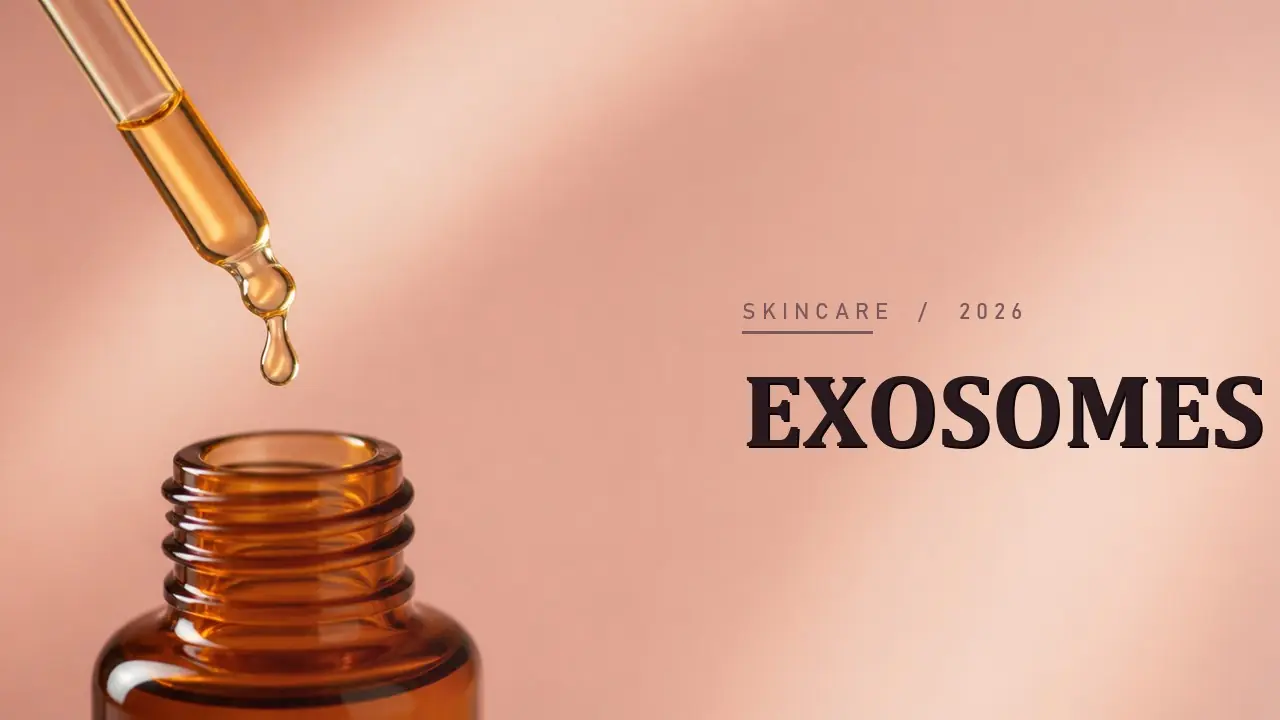
Packaging matters more than for most actives. Exosomes are biological and fragile. Look for airless pumps, opaque bottles, and refrigerated shipping for higher-end formulations. A clear glass dropper bottle sitting on a sunny bathroom counter for three months is not the format to choose.
Frequently asked questions
What are exosomes in skincare?
Exosomes in skincare are tiny lipid-bound vesicles, about 30 to 150 nanometres across, that carry signalling molecules from one cell to another. In a serum, they deliver proteins, growth factors, peptides, and microRNA to your skin cells, prompting responses that support repair, barrier health, and collagen production. Most over-the-counter exosomes are derived from plants or fermentation; human-derived exosomes are usually limited to clinic settings.
Do exosomes for skin actually work?
The evidence is strongest for post-procedure recovery, where exosomes meaningfully shorten downtime and reduce inflammation after microneedling and laser treatments. For barrier repair and gentle pigmentation support, the evidence is solid. For collagen and elasticity in daily use, results vary by formulation and are best evaluated over twelve weeks. Exosomes are not a retinoid replacement but a complementary signalling layer.
Are exosome serums safe for sensitive skin?
Plant-derived and fermentation-derived exosomes have a strong safety profile and often calm sensitive skin rather than irritate it. Patch test for two to three days behind the ear before full-face use. Anyone pregnant, breastfeeding, or with an active medical condition should consult a dermatologist before starting any growth-factor or stem-cell-derived skincare.
How long do exosome treatments take to show results?
Post-procedure recovery benefits are visible within days. Barrier calming usually appears within two to four weeks. Pigmentation improvements take six to eight weeks. Collagen and elasticity benefits need a full twelve weeks of consistent use to evaluate fairly. Inconsistent use slows or erases the benefit.
Are plant-derived exosomes as effective as human-derived ones?
They are different rather than strictly weaker. Plant-derived exosomes carry plant signalling molecules and tend to produce a milder, more calming and anti-inflammatory response in human skin. Human-derived exosomes produce a more direct collagen and elasticity response. Plant exosomes are particularly beneficial for sensitive skin and barrier repair, while human-derived exosomes are better for clinic use after procedures and for strong anti-ageing needs.
Can I use exosomes with retinol or vitamin C?
Yes. Apply vitamin C serum in the morning, then exosomes, then moisturiser and SPF. At night, apply exosomes after cleansing and toner, then retinoid, and then moisturiser. Start exosomes alone for one to two weeks to confirm tolerance before layering with active ingredients. The combinations work because exosomes target different cellular pathways than retinoids and vitamin C.
Related Articles
- Microbiome Skincare: Boosting Skin’s Good Bacteria for a Healthy Glow
- Anti-Aging Skincare Routine: Plans for Your 20s, 30s, 40s and Beyond
About The Author

COMMENTS