






Russian manicure has taken over nail feeds with its ultra-clean, deep-cuticle finish that makes polish last for weeks. This guide explains exactly wha
Russian manicure has taken over nail feeds with its ultra-clean, deep-cuticle finish that makes polish last for weeks. This guide explains exactly what a Russian manicure is, how it differs from a regular manicure, and whether it is actually safe for your nails.
If you have spent any time scrolling through nail art communities or beauty content online, you have almost certainly come across the term ‘Russian manicure’ paired with videos of impossibly clean cuticle lines and gel that appears to grow directly out of the skin. The results look flawless, almost surreal, and they have sent millions of people rushing to book appointments or searching for answers about what exactly is happening during that treatment. This guide covers everything you need to know, from the origins of the technique and the science behind why it looks the way it does to the very real safety questions every client should be asking before sitting down in the nail technician’s chair.
What Is a Russian Manicure and Where Did It Come From
Published · Updated
Safety note: the American Academy of Dermatology advises against cutting or forcefully pushing back cuticles, because the cuticle protects the nail from infection. If you choose a Russian manicure, go to a technician trained in e-file work, and ask them not to work gel under the skin: the British Association of Dermatologists warns that uncured gel touching the skin is a common cause of acrylate allergy.
The technique originated in Russia and Eastern Europe during the late Soviet era when professional nail care was developing its own distinct school of thought, separate from the wet manicure traditions popular in Western salons. Soviet-era technicians, working with limited product access but extensive vocational training, developed methodologies that prioritised meticulous preparation of the nail plate rather than product application. The dry method using electric rotary tools became standard in Eastern European nail education programmes long before it gained visibility in Western markets.
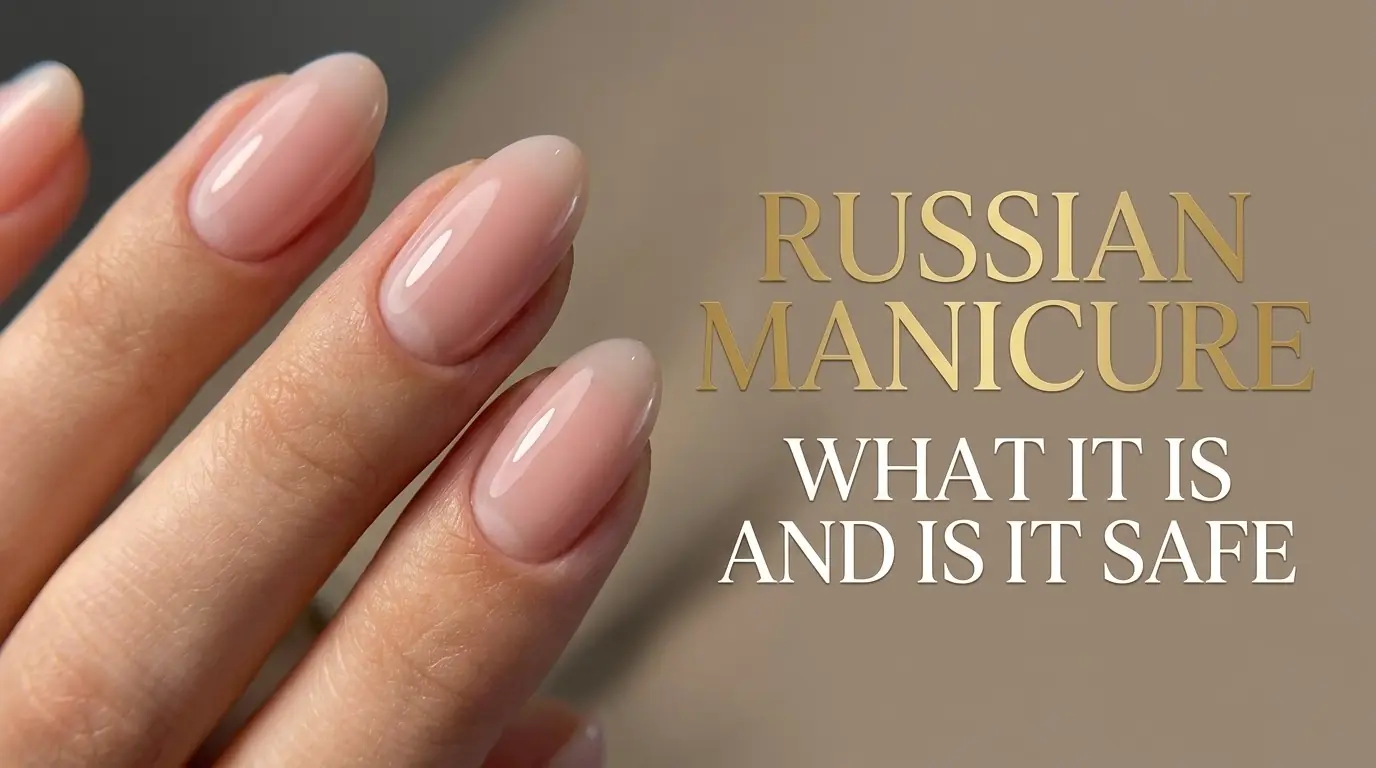
The technique gained widespread international attention roughly around 2018 and 2019 as Ukrainian, Russian, and Eastern European nail educators began teaching workshops abroad and building audiences on social media platforms. The signature look, which features a dramatically clean half-moon of exposed skin at the base of the nail and gel colour that appears to emerge seamlessly from the proximal nail fold, became instantly recognisable and intensely desired by clients who had never seen results like it from a standard salon visit.
Today the term is used broadly in the beauty industry to refer to any manicure that uses e-file tools to work on the living skin around the nail, though the depth and precision of what a trained Eastern European technician does versus what a newly trained technician in a Western salon might do can vary enormously. Understanding that variation is central to understanding the safety conversation around this technique.
How the Russian Manicure Differs from a Regular Manicure
To appreciate what makes the Russian manicure distinct, it helps to understand what happens during a conventional manicure. In a standard Western-style manicure, the technician begins by soaking the client’s hands in warm soapy water or a softening solution for several minutes. That soaking causes the skin and cuticle tissue to swell and soften, which makes it easier to push back or trim the cuticle using a metal pusher or small nippers. The nail plate itself is then shaped, buffed, and prepared for polish or gel application.
The soaking step, while comfortable, has a significant drawback: it temporarily changes the structure of the nail plate by introducing moisture. A nail plate that has absorbed water is slightly expanded and altered compared to its dry baseline state. Any gel or polish applied over a hydrated nail plate is, in effect, adhering to a temporarily inflated surface. As the nail returns to its natural dry state over the hours following the appointment, that surface contracts slightly, and the bond between the nail and the product can be subtly compromised from the very beginning. This is one reason why gel manicures sometimes lift at the edges sooner than expected.
The Russian manicure avoids this problem entirely by keeping the nail completely dry throughout the entire process. The e-file does the work that water and soaking used to do, but it does so without introducing any moisture to the equation. As a result, the nail plate that receives the gel or polish is in its true natural state, and adhesion tends to be significantly stronger and longer-lasting.
Beyond hydration, the Russian manicure achieves a level of precision at the cuticle line that is physically impossible with hand tools on unsoftened skin. The specialised e-file bits used in this technique can work along the contours of the proximal nail fold and the lateral nail folds, removing dead tissue and pterygium with a degree of accuracy that creates that distinctive clean line. A skilled technician using Russian technique can essentially extend the visual length of the nail by making the area where the nail meets the skin appear perfectly defined rather than obscured by overgrowth.
How the Russian Manicure Differs from a Gel Manicure
Many people assume that a Russian manicure and a gel manicure are mutually exclusive categories, but they actually operate on different axes. A Russian manicure describes the preparation technique used on the skin and nail plate. ‘Gel manicure’ describes the product applied afterwards. In most professional Russian manicure services, gel is applied following the e-file preparation work, which means the treatment is technically both a Russian manicure and a gel manicure simultaneously.
What distinguishes the gel application in a Russian manicure setting is that technicians trained in this method often use a thin layer of base coat that is worked right up to the edge of the cuticle to avoid a visible gap between the gel and the skin. Gel should never be worked beneath the nail fold, because uncured gel on skin can cause acrylate allergy. This technique, sometimes called flooding the cuticle or tight application, is part of what gives the finished look its seamless appearance. The gel appears to emerge from under the skin rather than sitting on top of it with a visible border.
A standard gel manicure, even a well-executed one, will typically leave a small margin of visible nail plate between the cuticle and the edge of the colour, both for safety reasons and because the preparation of the skin has not been as thorough. The Russian manicure’s preparation work makes the tight application possible without immediately lifting, because the dead and overgrown tissue that would prevent proper adhesion has been precisely removed.
The E-File Technique Explained
The electric file, or e-file, is the defining tool of the Russian manicure. Understanding how it works helps demystify why the results look different and why the technique carries risks when used improperly.
An e-file is a rotary handpiece connected to a motor unit that controls speed, measured in rotations per minute, or RPM, and sometimes torque. The handpiece accepts interchangeable bits, which are small cylindrical or cone-shaped grinding or cutting attachments made from materials including carbide, ceramic, diamond grit, and various abrasive compounds. Different bits serve different purposes: Coarser bits remove product like gel or acrylic. Medium bits shape the free edge; fine bits smooth the nail plate surface; and very specific bits designed for cuticle work have rounded, smooth ends made from soft materials that can work safely near living tissue.
In a Russian manicure, the technician uses small, specialised bits at carefully controlled speeds to work through a specific sequence around the nail. The sequence typically begins with removing any existing product, then moves to shaping the free edge, then addresses the surface of the nail plate, and finally works through the cuticle area using progressively finer and softer bits. The cuticle work involves removing the pterygium, which is the transparent or semi-transparent skin that adheres to the surface of the nail plate and grows forward from the proximal nail fold, as well as tidying any dead tissue on the lateral folds along the sides of the nail.
Speed control is critical. The bits used for cuticle work in a properly trained technician’s hands typically run at relatively low speeds, and the technician uses a very light touch, moving the bit continuously rather than holding it in one place, to prevent heat buildup and friction damage. Higher speeds and heavier pressure are appropriate for removing hard product but become dangerous when applied to living skin.
The bits used for skin work in authentic Russian technique are not sharp or aggressive. They are designed to gently abrade away only the dead or adherent tissue while leaving the living skin below intact. A technician who uses the wrong bit type, the wrong speed, or who applies too much pressure near the cuticle area can cause anything from mild redness to serious injury very quickly. This is why proper training is the single most important factor in whether a Russian manicure is safe or harmful.
Understanding the Cuticle and Why It Matters for Nail Health
The word ‘cuticle’ is used loosely in nail care conversations, but for the purposes of understanding Russian manicure safety, it is worth being precise about the anatomy involved.
The true cuticle is a thin layer of dead skin cells, technically called the eponychium or the cuticle proper, that seals the junction between the proximal nail fold and the nail plate. This seal is not decorative. It serves as a biological barrier that prevents bacteria, fungi, and other pathogens from entering the space beneath the nail fold and gaining access to the nail matrix. The nail matrix, located at the base of the nail beneath the proximal nail fold, is the tissue responsible for producing new nail cells. Any infection or damage that reaches the nail matrix can cause permanent changes to nail shape, texture, and growth.
Separate from the true cuticle is the pterygium, which is the overgrowth of skin tissue from the proximal nail fold onto the nail plate surface. This is the tissue that a Russian manicure specifically targets. When pterygium builds up on the nail plate, it can lift applied gel or polish, create an untidy appearance at the base of the nail, and in extreme cases cause discomfort. Removing pterygium is not the same as removing the true cuticle barrier, and this distinction is central to the debate about Russian manicure safety.
A properly performed Russian manicure removes the pterygium and dead skin buildup without disturbing the living proximal nail fold tissue or compromising the true cuticle seal. A poorly performed Russian manicure can blur those lines, removing too much tissue and breaking down the protective barrier at precisely the point where pathogens most want to enter.
The proximal nail fold itself is the fold of skin that overlaps the base of the nail. When the e-file works in that area, the technician is working in close proximity to living, vascularised tissue. Even a small cut or abrasion in that area creates an open pathway into the nail unit, and because the space beneath the proximal nail fold connects directly to the nail matrix, infections that enter here can be serious and potentially cause lasting changes to nail growth.
Safety Risks of the Russian Manicure
The safety profile of the Russian manicure is genuinely complex, and anyone who tells you it is either completely safe or completely dangerous is oversimplifying. The risks are real and specific, and they are almost entirely related to the skill level and hygiene practices of the technician, not to the fundamental concept of the technique itself.
Infection Risk
This is the most serious risk associated with the Russian manicure, and it deserves careful attention. Any time the skin barrier is breached or thinned in the nail area, bacteria and fungi gain a potential entry point. The nail fold area is warm and often slightly occluded, and when covered immediately with a gel product after the treatment, any pathogen that entered during the service is sealed in place under conditions that can promote growth.
The specific organisms that pose the greatest risk include Staphylococcus aureus, which can cause paronychia, an infection of the nail fold that presents as redness, swelling, warmth, and sometimes pus around the nail; and various species of dermatophytes and non-dermatophyte moulds that cause onychomycosis, or fungal nail infection. Candida species can also cause nail fold infections, particularly in people whose hands are frequently exposed to water.
In a salon environment, the transmission risk is compounded by the fact that e-file bits and other tools can carry pathogens from one client to the next if not properly sterilised between uses. Carbide and metal e-file bits should be sterilised in an autoclave between clients. Bits that cannot be sterilised must be discarded after a single use or, at minimum, treated with appropriate disinfectants capable of killing blood-borne pathogens. A salon that wipes tools with a cloth or even a basic alcohol wipe between clients is not meeting a professional standard for a service that works near living tissue.
Nail Plate Damage
The nail plate, while tough, is composed of layers of keratin that can be thinned or damaged by aggressive e-file use. Using too coarse a bit on the nail plate surface, running the e-file at too high a speed, or repeatedly going over the same area can thin the nail plate to the point where it becomes flexible, painful to the touch, and prone to breakage. Thinned nail plates can also develop ridges, white patches, and other textural changes that take many months to grow out, since nails grow at an average rate of approximately 3 millimetres per month.
Pterygium Removal and the Living Tissue Boundary
As discussed in the anatomy section, removing the pterygium is legitimate and appropriate nail preparation. The risk arises when the technician either removes too aggressively and takes living tissue along with the dead or when the technique causes micro-tears in the proximal nail fold that are not visible to the naked eye but compromise the barrier nonetheless. This is a scenario where a trained and experienced technician makes an enormous difference, because the margin between appropriate pterygium removal and tissue damage is measured in fractions of a millimetre.
Heat Generation
Electric files generate heat through friction. When a bit runs at high speed against a surface, particularly a curved surface like the area around the nail fold, heat builds up quickly. On the nail plate, moderate heat is generally not a problem. Near living skin, heat buildup can cause a burning sensation, inflammation, and, in severe cases, a superficial burn. Technicians are trained to keep the bit moving continuously, to use appropriate speeds for the task, and to recognize when a client is experiencing discomfort from heat so they can adjust immediately. Clients should feel comfortable communicating if they feel any warmth or stinging during the service.
Allergic and Chemical Reactions
This risk is less specific to the Russian manicure technique and more related to the gel products often used in conjunction with it. However, because Russian manicure preparation removes surface cells and sometimes works close to the living skin barrier, any sensitisation to gel monomers or acrylates can be accelerated. People who develop contact dermatitis from gel products often report that the reaction worsened over time as repeated services gradually sensitised their immune systems. Keeping the product away from skin and the use of high-quality, properly formulated gel products reduces this risk.
Who Should Avoid the Russian Manicure
While many people can safely enjoy a Russian manicure when it is performed by a trained technician, there are specific groups of people for whom the increased risk is not justified.
People with diabetes should approach this technique with significant caution. Diabetes impairs circulation, particularly in the extremities, and also reduces the body’s ability to fight infection and heal wounds. A minor break in the skin near the nail fold that would be inconsequential for a healthy person could become a serious infection in someone with poorly controlled blood sugar. If you have diabetes, consult your physician before undergoing any service that involves mechanical work near the living tissue of the nail unit.
Anyone with active nail infections, whether bacterial paronychia, fungal infection, or a viral infection like periungual warts, should not receive a Russian manicure until the infection is fully resolved and cleared by a medical professional. Performing e-file work over or near an active infection can spread it to other nails, cause it to worsen, and, in a salon environment, potentially transfer it to other clients.
People taking anticoagulant medications, including warfarin, newer oral anticoagulants, and even high-dose aspirin therapy, bleed more freely from minor skin abrasions and heal more slowly. The proximity of Russian manicure work to the vascular nail fold tissue makes this a meaningful consideration.
Individuals with inflammatory skin conditions such as psoriasis, eczema, or lichen planus affecting the nail area should consult a dermatologist before considering this technique. These conditions can involve altered nail unit anatomy, increased fragility of the skin around the nail, and heightened sensitivity to mechanical trauma.
Pregnant women are not automatically excluded, but the combination of increased blood flow to the extremities, greater skin sensitivity, and the general principle of minimising unnecessary risk during pregnancy makes it reasonable to either avoid or modify the service by requesting a less aggressive version of the technique.
What to Look for in a Russian Manicure Technician
Because the quality and safety of a Russian manicure depends so heavily on the technician’s training, choosing where and with whom you have this service done is arguably the most important decision in the entire process.
Training and Certification
Look for technicians who have completed formal training specifically in Russian or Eastern European manicure technique, not just general e-file certification. Authentic Russian manicure education programmes teach the specific sequence, the appropriate bits for each step, the speed settings for different tasks, and critically, the anatomy of the nail unit so that technicians understand what they are working near and why precision matters. Ask your technician directly where they trained and whether they have any documentation of that training. A professional who takes their craft seriously will welcome the question.
In countries where nail technician licensing exists, verify that the technician holds a current licence. Licensing requirements vary significantly by jurisdiction and do not always specifically address e-file technique, but a licensed technician has at minimum passed a baseline of regulatory scrutiny.
Sterilization Practices
This is non-negotiable. Ask the salon directly how they sterilise their e-file bits between clients. The answer should be autoclave sterilisation for metal and carbide bits, with single-use disposable bits for any bits that cannot be autoclaved. You should be able to see that a fresh set of bits is opened from a sealed package or removed from a sterilised pouch for your service. If a salon is vague, dismissive, or tells you that they use disinfectant wipes, that is a meaningful red flag.
All other tools, including cuticle nippers, pushers, and implements, should also be either single-use or autoclaved and sterilised. The surfaces the technician works on should be cleaned between clients. You have every right to ask these questions before committing to a service.
Consultation Behavior
A trustworthy technician will ask about your nail history, any medical conditions relevant to nail care, and any previous reactions to nail products before beginning. They should look at your nails before starting and note any existing damage, thinning, or health concerns. A technician who moves straight from greeting you to picking up the e-file without any discussion is not demonstrating the level of professional care this technique requires.
Communication During the Service
Throughout the service, a skilled technician should be checking in with you about sensation and comfort. You should not feel significant heat, stinging, or pain at any point. Mild pressure and vibration from the e-file are normal. Anything that feels sharp, burning, or acutely uncomfortable is a signal that something needs to adjust, and a good technician will make that adjustment immediately when you communicate it.
Portfolio and Experience
Ask to see examples of the technician’s work. Russian manicure results have a very specific appearance, and an experienced practitioner should have a body of work demonstrating clean cuticle lines, even gel application, and well-shaped nails across different natural nail types. Before-and-after photos are particularly useful because they show what the technician starts with and what they achieve, giving you realistic expectations.
Aftercare Routine for a Russian Manicure
Proper aftercare significantly affects both how long your results last and your nail health between appointments. Because the skin around the nail has been worked on during the service, it needs some time and support to fully recover and maintain its integrity.
The First 24 to 48 Hours
For the first day or two after your appointment, the skin around your nail folds may be slightly sensitive or pink. This is a normal response to mechanical work in the area. Keep your hands out of extended water exposure during this period. Prolonged soaking in the hours immediately following a Russian manicure can introduce moisture to the skin that has just been worked on and potentially create an environment more hospitable to bacterial or fungal colonisation. Wear gloves when washing dishes, and try to keep showers brief and cool rather than long and hot.
Avoid picking at or peeling the skin around your nails during this period. The treated area is in the process of recovering its normal cellular structure, and mechanical interference from picking can cause irritation or introduce pathogens.
Daily Cuticle Oil Application
Cuticle oil is the single most important aftercare product for a Russian manicure, and applying it consistently makes a visible difference in how long the results last and how healthy the nail area looks between appointments. Cuticle oil penetrates the nail plate, the nail fold skin, and the area along the lateral folds, keeping tissue flexible, healthy, and less prone to cracking or developing new pterygium overgrowth too quickly.
Apply cuticle oil at least once a day and ideally two to three times a day if your hands are frequently exposed to drying factors like hand sanitiser, cold air, cleaning products, or frequent hand washing. Apply a drop to each nail, massage it gently into the nail fold area, and allow it to absorb. Oils containing jojoba, vitamin E, and various plant-derived emollients are popular and effective choices. The specific formulation matters less than the consistency of application.
Hand Cream and Hydration
The skin of the hands, including the nail fold area, benefits from regular moisturisation. A good hand cream applied daily after handwashing helps maintain skin barrier integrity and reduces the rate at which dry skin and cuticle overgrowth return between appointments. Look for formulas containing ingredients like shea butter, glycerin, ceramides, or hyaluronic acid that provide both immediate moisture and longer-term barrier support.
Protecting the Manicure
Wearing gloves for household cleaning, gardening, and other manual tasks protects both the skin and the gel product from damage. Harsh chemicals found in cleaning products can both dry out the nail fold skin and cause the gel to lose its adhesion prematurely. Similarly, acetone-based products should be kept away from the nails until you are intentionally removing the gel at your next appointment.
Watching for Warning Signs
In the days following your appointment, monitor the nail fold area for any signs that warrant attention. Redness that intensifies rather than fades over the first 48 hours; swelling around any nail fold; pus; warmth; or significant pain can indicate infection developing in the nail fold area. These symptoms should be evaluated by a healthcare provider promptly. A paronychia that is caught early can usually be managed without significant intervention. Left untreated, nail fold infections can become serious and in rare cases spread.
How Long Do Russian Manicure Results Last
One of the most cited advantages of the Russian manicure is the longevity of the results, particularly when gel is applied as part of the service. Because the nail plate is prepared in its dry natural state and the application of gel is done with greater precision at the cuticle, adhesion tends to be superior to what most clients experience from a conventional gel manicure.
Most clients who receive a well-executed Russian manicure with gel can expect three to five weeks before significant regrowth or lifting occurs, compared to two to three weeks being a common ceiling for standard gel manicures. Some clients report even longer wear, up to six weeks, though at that point the visible gap between the cuticle and the base of the gel colour becomes significant simply because the nail has grown out.
The longevity is also influenced by individual nail characteristics. People whose nails grow quickly, who have naturally oily nail plates, or who subject their hands to frequent water exposure will tend to see shorter wear regardless of the application technique. People with slower-growing nails who maintain a consistent aftercare routine and protect their hands during household tasks often get the longest-lasting results.
The appearance of the cuticle area itself, that distinctive clean line that defines the Russian manicure look, tends to remain sharp for two to three weeks before the natural regrowth of skin in the nail fold area begins to obscure it. Regular cuticle oil use slows this process by keeping skin flexible and preventing the buildup of new dead tissue, but it cannot entirely halt the biological process of skin renewal.
Cost Comparison: Russian Manicure versus Traditional Manicure
The Russian manicure commands a premium price in virtually every market where it is available, and understanding why can help clients evaluate whether the cost is justified for their needs.
A conventional gel manicure at a standard nail salon in the United States typically costs between 35 and 55 dollars, with significant regional variation. A Russian manicure at a salon with properly trained technicians generally runs from 65 to 120 dollars or more in the same markets, with high-end establishments in major cities sometimes charging above that range. Specialist technicians who have trained directly with Eastern European programs and built a reputation for their work can charge significantly more.
The price difference reflects several factors. First, the time required is genuinely greater. A properly performed Russian manicure is a detail-intensive process that takes 90 minutes to two hours for a full set compared to 60 to 75 minutes for a conventional gel manicure. Second, the specialised training required represents a meaningful investment by the technician. Third, the specialised bits used in authentic Russian technique are themselves more expensive than standard nail tools, and the autoclave sterilisation equipment required represents a significant capital outlay for the salon.
When evaluating cost, it is also worth factoring in frequency of service. If a Russian manicure reliably lasts four to five weeks and a conventional gel lasts two to three, the cost per week of having beautiful nails is more comparable than the per-appointment price suggests. A client spending 45 dollars every three weeks is spending more annually than a client spending 85 dollars every five weeks.
Where the cost calculation can be thrown off is in the experience and training level of the technician. A cheaper Russian manicure from an undertrained technician is not a bargain if it results in damaged nail plates, an infection, or results that lift within a week. In this category specifically, the lowest-price option carries genuine downside risk that goes beyond cosmetic disappointment.
At-Home Russian Manicure versus Salon Service
As the popularity of this technique has grown, at-home e-file kits designed for personal use have proliferated, and many people are curious whether they can replicate Russian manicure results at home. The honest answer is nuanced.
The at-home e-files available to consumers are generally designed with safety limitations built in: they run at lower maximum speeds, use less powerful motors, and come with bits that are less aggressive than professional-grade equipment. These limitations reduce the risk of serious injury but also reduce the ability to achieve professional-level results, particularly in the cuticle work that defines the Russian manicure aesthetic.
Someone who invests time in learning proper technique, watches extensive educational content, and proceeds very slowly and cautiously can use a home e-file to maintain their nail plate surface and do moderate pterygium maintenance between salon appointments. This kind of maintenance use between professional services can extend the time between appointments and keep the nail area looking tidier.
However, attempting to perform the full cuticle work that defines a Russian manicure at home, without professional training, is a scenario that carries meaningful risk. The speed at which things can go wrong with an e-file near living tissue does not leave much margin for learning from mistakes. A common pattern among beauty enthusiasts who attempt this is that the first several attempts go reasonably well, building confidence, and then a moment of distraction or slightly too much pressure causes an injury.
If you want to use a home e-file at all, start with only nail plate surface work, avoid the cuticle area entirely until you are genuinely comfortable with the tool’s behaviour, and never use it when you are tired, distracted, or in a hurry. The investment in professional training, even a single course or workshop, makes a substantial difference to safety outcomes for anyone who wants to go further than basic surface maintenance.
Common Misconceptions About the Russian Manicure
Several persistent myths circulate about this technique, and clearing them up helps people make better decisions about whether to pursue it.
One common misconception is that the Russian manicure permanently removes the cuticle. This is not accurate. The technique removes dead skin and pterygium overgrowth, but the nail fold skin continues to produce new cells, and the skin naturally regenerates. Clients typically need to return for maintenance every three to five weeks precisely because the skin grows back.
Another misconception is that any e-file manicure is essentially a Russian manicure. Many salons have long used e-files to shape free edges and remove gel products without ever approaching the cuticle area or performing the detailed skin preparation that defines the Russian method. The term has become something of a marketing label, and clients sometimes discover after paying for a “Russian manicure” that they received a fairly conventional gel manicure with e-file finishing. Asking specifically what steps are included before booking helps set accurate expectations.
A third misconception is that the results are only achievable with very short natural nails. While the technique is particularly transformative on shorter nail shapes where the cuticle area is more prominent, it can be performed on longer nails, nail extensions, and a variety of nail shapes. The preparation principles apply regardless of nail length.
Finally, many people assume that if a salon offers the service, the technicians are automatically trained to perform it safely. The term ‘Russian manicure’ has outpaced formal training access in many markets, and not every salon advertising the service employs technicians with comprehensive training. This is why asking about training background and sterilisation practices is so important.
Frequently Asked Questions
Is the Russian manicure painful
When performed correctly by a trained technician, the Russian manicure should not be painful. You may feel pressure, vibration, and occasionally mild warmth from the e-file, and the cuticle work may produce a sensation of slight pulling or sensitivity, particularly in areas where there is a significant pterygium buildup. Significant pain, burning, or stinging is a signal that something is not right, and you should communicate immediately with your technician. Never endure pain silently during this service.
Can I get a Russian manicure if my nails are damaged or thin
Damaged or already thinned nail plates are a contraindication for aggressive e-file work on the nail plate surface, though a very experienced technician may still be able to perform the cuticle preparation work carefully. Disclose the condition of your nails fully during your consultation. A good technician will assess whether the service is appropriate for your current nail health and may recommend a modified approach or a period of nail recovery before proceeding with a full Russian manicure service.
How often should I get a Russian manicure
Most clients with healthy nails find a maintenance schedule of every three to five weeks appropriate. Going more frequently than every three weeks does not give the nail plate and surrounding skin adequate time to recover from the mechanical work of the service. Some clients stretch to six or even eight weeks and simply accept more visible regrowth toward the end of the wear period. Your own nail growth rate, aftercare habits, and aesthetic standards will determine what interval works best for you.
Will the Russian manicure ruin my nails
The technique itself, performed by a properly trained technician using appropriate tools at correct settings, should not cause lasting nail damage. The risks to nail plate integrity arise from incorrect technique, primarily using too coarse a bit on the nail plate surface, applying too much pressure, or running the e-file at excessive speeds for skin work. Consistently working with a skilled technician and maintaining a healthy aftercare routine, particularly regular cuticle oil use, supports nail health over repeated appointments.
Can I remove gel from a Russian manicure at home
You can remove gel using the standard acetone soak-off method at home with appropriate care. Apply acetone-soaked cotton to each nail, wrap in foil, and allow sufficient time for the gel to soften fully before gently sliding the product off with a wooden pusher. Avoid forcing or scraping gel that is not fully loosened, as this can thin the nail plate. Because Russian manicure gel application tends to be very thorough and precise, removal may take slightly longer than you expect. Patience during removal protects the nail plate from mechanical damage.
Is the Russian manicure banned anywhere
Some regulatory bodies and nail licensing organisations in certain regions have expressed concern about or placed restrictions on specific aspects of the Russian manicure, particularly the live skin work near the cuticle. In some jurisdictions, working on living skin is considered outside the scope of a nail technician’s licence and would require a cosmetology or aesthetics licence. Regulations vary widely by country, state, and province. Reputable salons in your area should be able to advise on how they perform the service within local regulatory requirements, and the technique may be slightly modified in regulated markets to comply with local rules.
What is the difference between a Russian manicure and an e-file manicure
An e-file manicure is a broad category that simply indicates the use of an electric file somewhere in the manicure process. The Russian manicure is a specific, structured approach within that broader category, characterised by the dry method, the detailed cuticle and pterygium preparation, and the tight gel application technique. All Russian manicures use an e-file, but not all e-file manicures are Russian manicures.
How do I find a qualified Russian manicure technician
Start by asking specific questions rather than simply searching for salons that advertise the service. Ask where the technician trained, whether they hold any certifications in Russian or Eastern European nail technique, how they sterilise their e-file bits between clients, and whether you can see examples of their work. Social media portfolios are a useful tool since authentic Russian manicure results have a specific and recognisable aesthetic. Reviews that specifically mention the cleanliness of the cuticle area and longevity of the results are more informative than general positive reviews. Word of mouth from people whose nail results you have admired in person remains one of the most reliable referral methods.
Final Thoughts on the Russian Manicure
The Russian manicure represents a genuine evolution in professional nail care, offering results in terms of precision, longevity, and aesthetic quality that are difficult or impossible to achieve through conventional techniques. The clean cuticle lines, the seamless gel application, and the extended wear that define this technique have earned it a permanent place in the professional nail care landscape, and for good reason.
At the same time, the technique is not without meaningful risks when it is performed by someone without adequate training or in environments that do not maintain appropriate sterilisation standards. The skin around the nail is biologically significant, not merely cosmetic, and the proximity of e-file work to the nail matrix and the proximal nail fold means that the margin for error is genuinely narrow.
The most important takeaway is not whether to get a Russian manicure, but how to approach the process of finding someone qualified to perform it. Prioritise training, sterilisation, and communication. Be willing to pay an appropriate price for expertise rather than seeking out the cheapest available option. Maintain your nail health between appointments with consistent cuticle oil and moisturiser use. And pay attention to how your skin responds in the days following each appointment, because early awareness of any problem makes resolution far simpler.
For the right client, in the right hands, the Russian manicure delivers results that are genuinely remarkable, and the longevity and precision it provides can make it a more cost-effective and nail-healthy choice than repeated conventional gel services. Armed with the information in this guide, you are well positioned to make that choice thoughtfully and confidently.
Sources
- Artificial nails: Dermatologists' tips for reducing nail damage, American Academy of Dermatology
- Paronychia (nail fold infection): Causes, Images, treatment, and more, DermNet
- Dermatologists reiterate artificial nails warning and risk of at-home kits, British Association of Dermatologists
- Gel manicures: Tips for healthy nails, American Academy of Dermatology
RELATED ARTICLES:
Lip retouching is one of the most frequently performed treatments in aesthetic medicine clinics.
Me, better: I tested the French Kiss, the most natural lip augmentation technique in Paris
The Influence of Celebrity Nail Trends: Uncovering the Power of A-List Manicures
Transform Your Nails with Acrylic Manicure
About The Author

COMMENTS