The TriangleConcealer makeup technique is the viral under-eye trick that has racked up billions of views on TikTok for making skin look instantly lift
The TriangleConcealer makeup technique is the viral under-eye trick that has racked up billions of views on TikTok for making skin look instantly lifted, brightened, and wide awake. By placing concealer in a downward triangle and blending it with a damp sponge, you catch light in all the right places. In this guide you will learn why it works, how to master it for every skin type, and the mistakes to avoid.
In this deeply researched guide, you will discover exactly why this placement works from an optical and facial-anatomy perspective, how to execute it flawlessly on every skin type and undertone, the mistakes that sabotage the finish (and the professional fixes for each one), the best product pairings for dry, oily, mature, and sensitive skin, and how to adapt the technique for everyday wear versus full-glam occasions. Whether you are a beginner picking up your first concealer or a seasoned enthusiast looking to upgrade your routine, this article breaks down the science, the strategy, and the subtle artistry behind the trend that refuses to fade.
What Is the TriangleConcealer Makeup Technique, Really?
Reviewed by the BeautynFacts editorial team. Last updated: May 2026.
The TriangleConcealer technique, sometimes stylized on TikTok as #triangleconcealer or #triangleofpower, is a concealer-placement method in which the product is applied in a distinct downward-pointing triangle rather than the traditional half-moon or thin crescent directly beneath the lower lash line. The base of the triangle sits horizontally across the upper cheekbone, the inner corner reaches toward the side of the nose, and the outer corner extends toward the temple, while the tip of the triangle points down toward the center of the cheek, roughly aligned with the middle of the pupil.
This broader canvas of concealer accomplishes far more than traditional under-eye coverage. It simultaneously highlights the center of the face, counteracts the shadow cast by the orbital bone, lifts the eye visually, and creates a subtle contour effect by making surrounding areas appear deeper by comparison. Makeup artists have quietly used variations of this triangle for decades, with legendary artists like Bobbi Brown and Wayne Goss referencing the shape long before TikTok named it. What the platform did was codify the placement, attach a memorable name, and translate it into a digestible fifteen-second demonstration that anyone could replicate at home.
The reason the technique went viral is rooted in how dramatically it transforms the face without requiring expensive products or advanced skill. A single well-placed triangle can shave visual years off tired features, make eyes look larger and more open, and deliver the coveted snatched appearance that dominates modern beauty aesthetics. It is also forgiving: unlike cut-crease eyeshadow or precision winged liner, a triangle blends and softens as you work, meaning small errors disappear rather than compounding.
The Science Behind Why the Triangle Works
Understanding why this shape outperforms a simple dab of concealer under the eye requires a quick tour of facial anatomy and the optics of light on skin. The under-eye area is not flat. It is a complex three-dimensional landscape involving the tear trough, the orbital bone, the nasojugal groove, and the cheekbone. Each of these creates subtle shadows that the brain reads as fatigue, age, or illness, even when the skin itself is perfectly healthy.
Light Reflection and the Illusion of Lift
When light hits the face, our eyes interpret lighter areas as forward-projecting and darker areas as receding. A broad triangular zone of lightness in the center of the cheek pushes that area visually forward, which in turn creates the illusion of higher cheekbones and a lifted midface. Dermatologists and cosmetic scientists refer to this as strategic highlighting, and it is the same principle behind professional contouring. The difference is that the triangle achieves both tasks, highlighting and quasi-contouring, with one product and one step.
Counteracting the Tear Trough Shadow
The tear trough is the hollow that runs from the inner corner of the eye downward toward the cheek. As we age, this area deepens due to fat pad displacement and collagen loss, which is why dark circles seem to worsen over time even in people who sleep well. Placing concealer only under the lash line misses this hollow entirely. The triangle, by extending the product downward and inward, actively fills and neutralizes the trough, which is why so many users report that it makes them look rested in a way their previous routine never did.
The Golden Ratio and Facial Proportions
Artists and plastic surgeons have long referenced the golden ratio when discussing facial symmetry and perceived attractiveness. The triangular placement happens to align closely with the proportional zones that the golden ratio flags as focal points of a balanced face. By brightening precisely these zones, the technique enhances features that the brain already reads as youthful and harmonious.
Tools and Products You Will Need
Executing the triangle well does not require a professional kit, but the products you select will dramatically influence your results. Concealer chemistry has evolved significantly in recent years, and the formula you pick should match both your skin type and the level of coverage you want from the triangle.
For dry or mature skin, a hydrating liquid concealer with hyaluronic acid, squalane, or glycerin will blend effortlessly and avoid settling into fine lines. Brands have invested heavily in this category because the under-eye is the first area to reveal dehydration. For oily or combination skin, a long-wear formula with a slightly matte finish prevents the triangle from sliding down the cheek by midday. For sensitive skin or rosacea-prone complexions, mineral-based concealers with zinc oxide or niacinamide soothe while covering.
Beyond the concealer itself, the following items will streamline your application. A damp makeup sponge, often a beauty blender style, is widely considered the gold standard for blending the triangle because its round base presses product into the skin rather than dragging it across. A small fluffy brush, sometimes called a pencil brush or detail blender, helps refine the inner corner where the triangle meets the nose. A finely milled translucent or slightly tinted setting powder locks the triangle in place without adding a dry, dusty appearance. Finally, a good eye cream applied fifteen minutes before makeup preps the skin so concealer does not cling to dryness.
Choosing the Right Concealer Shade
Shade selection is where most people go wrong. The conventional wisdom of going two full shades lighter than your foundation actually dates from editorial photography, where harsh studio lighting demanded exaggerated brightness. In real life, that level of contrast can look ghostly, particularly in selfies with flash. A more flattering approach is to choose a concealer that is half to one shade lighter than your foundation for everyday wear, reserving two shades lighter for events where you want a pronounced highlight effect.
Undertone matters just as much as depth. Cool undertones (pink or rosy) suit most fair to light complexions, neutral undertones flatter medium skin, and warm or peach undertones beautifully neutralize blue and purple darkness common in deeper skin tones. Many brands now offer color-correcting concealers in peach, salmon, and orange specifically to cancel under-eye discoloration before the main concealer is layered on top.
Step-by-Step: How to Apply the TriangleConcealer Technique
The following sequence has been refined by comparing dozens of viral tutorials with professional makeup artist demonstrations. Each step builds on the last, so resist the urge to skip ahead, particularly if you are new to the technique.
Step One: Prep With Intention
Begin with clean skin. Apply a pea-sized amount of eye cream and gently pat (never rub) it into the under-eye area, extending down toward the cheekbone. Let it absorb for at least five minutes. Follow with a moisturizer appropriate to your skin type, then a primer if your concealer tends to crease. The purpose of the prep phase is to create a smooth, flexible surface that concealer can sit on without breaking apart during the day.
Step Two: Apply Foundation First
Apply your foundation before the concealer, not after. This is a common order of operations mistake. Foundation applied over concealer can disturb and thin the coverage you worked to build. By foundation-first, you establish an even canvas, and any discoloration that remains visible is exactly what the triangle will treat.
Step Three: Optional Color Correction
If you have significant dark circles, apply a peach or orange corrector in a very thin layer under the lash line first. Press (do not swipe) it in with your ring finger or a small brush. The warmth neutralizes the cool shadow beneath, so your main concealer can work with a blank slate rather than trying to cover darkness on its own.
Step Four: Draw the Triangle
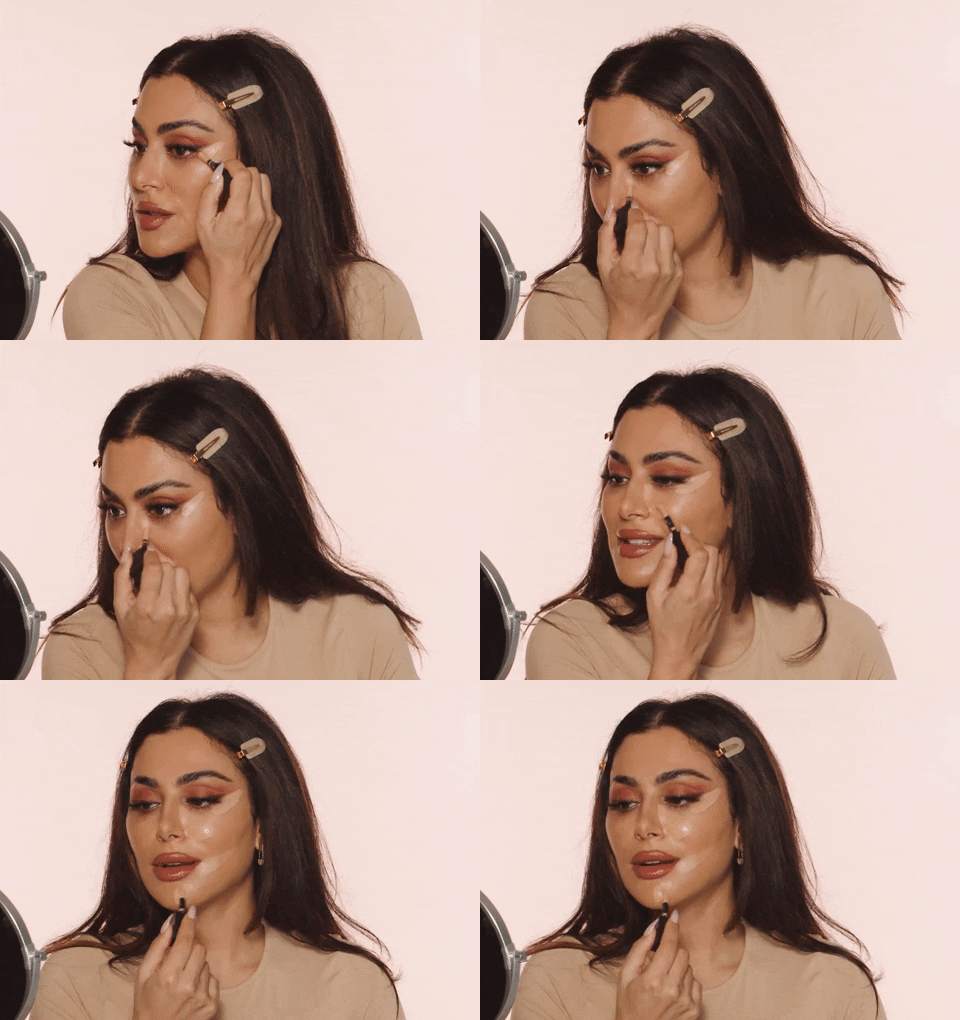
Using the doe-foot applicator or a small brush, draw three connecting lines to form the triangle. The first line runs horizontally just under the lash line, extending slightly past the outer corner. The second line runs diagonally from the inner corner of the eye down along the side of the nose for about a centimeter. The third line completes the triangle, connecting the outer corner of the eye down to the apex point in the middle of the cheek. You can also simply draw three straight dashes and fill in between them, whichever you find easier.
Do not be alarmed by how much product this appears to be. A triangle that looks substantial unblended often blends down to a beautiful, natural brightness. Working with too little concealer is the more common issue, especially for those new to the technique.
Step Five: Let It Sit
Pause for thirty to sixty seconds before blending. This gives the formula a moment to settle and slightly warm against your skin, which improves how it melts during blending. Use this time to do your eyebrows or start on eye shadow, keeping your eyes busy so you do not rush the blending.
Step Six: Blend With a Damp Sponge
Dampen your sponge with water and squeeze out any excess until it is barely moist. Using a bouncing motion rather than a dragging swipe, work from the outside edges of the triangle inward, pressing the concealer into the skin. The goal is to diffuse the edges so no harsh lines remain while preserving the brightness in the center of the shape. Take extra care along the tip of the triangle on your cheek, which is where many people accidentally over-blend and lose the highlighting effect.
Step Seven: Set With Powder
Dip a fluffy powder brush into translucent setting powder, tap off the excess, and gently press (do not sweep) the powder into the under-eye area. Pressing locks the concealer in place without disturbing it, while sweeping can cause patchiness. Some makeup artists use the baking technique here, applying a heavier layer of powder, letting it sit for five to ten minutes while they complete the rest of their face, then dusting off the excess. This creates a crease-proof finish that lasts all day but can look too dry on mature skin, so adjust accordingly.
Common Mistakes and How to Fix Them
Even with the best intentions, the triangle can go wrong in predictable ways. Understanding these pitfalls in advance saves time, product, and frustration.
Applying too much product is the most frequent misstep. Viral tutorials often exaggerate the amount of concealer used because it photographs well, but real-world faces need restraint. Start with half of what you think you need, blend, and add only if necessary. Layering works; over-saturating the under-eye with a single heavy application does not.
Blending in the wrong direction pulls the brightness away from the center of the face, defeating the entire purpose. Always blend toward the outer edges, keeping the densest brightness in the middle of the triangle where you want that illuminated effect.
Skipping the powder step is tempting for those who want a dewy finish, but under-eye skin is particularly prone to creasing because it moves every time you blink or smile. A tiny amount of powder is always worth it. Choose a finely milled, colorless or lightly tinted formula to avoid any dry, dusty appearance.
Choosing the wrong undertone creates a gray, ashy cast that no amount of blending can fix. If your concealer looks lifeless after application, the undertone is likely mismatched. Try a warmer shade or layer a peach corrector underneath.
Ignoring the rest of the face unbalances the look. Because the triangle brightens the center of the face so dramatically, the perimeter can start to look dull by comparison. Add a subtle bronzer along the hairline, jawline, and below the cheekbone to restore dimensional balance.
Adapting the Technique for Different Skin Types
One reason this technique has lasted long after typical TikTok trends fade is its adaptability. With minor modifications, it works on every skin type, age, and complexion.
Dry and Mature Skin
For skin that skews dry or shows fine lines, use a hydrating concealer with a creamy, emollient texture and skip the baking step. Set only the outer edges of the triangle with a whisper of powder, leaving the center untouched so it retains a natural sheen. Apply a setting spray afterward to melt any powder into the skin and restore a skin-like finish. Eye cream containing peptides or retinol used consistently over weeks will gradually improve how makeup sits in the area.
Oily Skin
Oily under-eyes are rare but do occur, and anyone with oily overall skin should prioritize long-wear, transfer-resistant concealers. Prime the under-eye area with a mattifying primer before any product. After setting with powder, mist with a finishing spray designed for oily skin. Reapply a thin layer of powder midday if needed, but avoid stacking more concealer on top of existing product, which will only cake.
Acne-Prone and Sensitive Skin
Choose non-comedogenic formulas and avoid ingredients that commonly irritate: synthetic fragrance, certain essential oils, and heavy silicones for some individuals. Mineral concealers with zinc oxide offer coverage while soothing reactive skin. Always patch test a new concealer on the jawline for three days before committing to under-eye use.
Deeper Skin Tones
Deeper complexions require careful shade selection because a concealer that is only slightly too light reads distinctly pale under the eyes. Look for brands with robust deep-shade ranges and rich undertones. Orange and red correctors are particularly effective at neutralizing the deep blue or purple shadows common in richer skin tones. The triangle itself may need to be slightly smaller and more focused, as the highlighting effect is more pronounced against a darker base.
How to Modify the Triangle for Different Occasions
The beauty of the triangle is its versatility. By adjusting size, product weight, and finishing touches, you can take the same technique from a no-makeup workday to a high-glam red carpet look.
For a natural everyday look, keep the triangle small, use a sheer-to-medium coverage concealer, and blend thoroughly until the edges are imperceptible. Skip the baking step and use a light dusting of powder only if your skin tends to crease. The result is a rested, healthy appearance that looks like you simply slept well.
For office or professional settings, use a medium-coverage concealer and a slightly larger triangle, set with a pressed powder for longevity. Add a touch of cream blush on the apples of the cheeks for warmth and a neutral eye look to keep things polished without feeling overdone.
For evening or event looks, go for the full baked triangle with a high-coverage concealer one to two shades lighter than your foundation. The pronounced brightness photographs beautifully under artificial lighting and stands up to hours of wear. Pair with defined contour, lifted blush placement, and generous highlighter to complete the snatched aesthetic.
For video calls and selfies, remember that cameras flatten facial dimension. A slightly larger, brighter triangle compensates for this flattening and helps restore the natural structure of your face on screen. This is part of why the technique exploded during the remote-work era and has stayed popular even as in-person life resumed.
Pairing the Triangle With the Rest of Your Makeup
A triangle applied in isolation can look disconnected from the rest of your face. Thoughtful product choices across your routine will make the technique feel like part of a cohesive, intentional look rather than a spotlight on one zone.
Start with foundation that matches your true skin tone, not one that is darker (to avoid contrast) or lighter (which will compete with the concealer). Next, address blush placement carefully. Because the triangle tip extends into the upper cheek area, apply blush slightly above and outward from where you normally would to avoid muddying the highlight. Powder cream blush sits nicely over a set triangle without disturbing the concealer.
Bronzer becomes especially important with this technique. Apply it in a sideways three pattern, across the forehead, under the cheekbone, and along the jawline. This framing effect creates the illusion of a more sculpted face and prevents the brightened midface from looking disproportionately luminous. A subtle highlight on the top of the cheekbone, down the bridge of the nose, and on the cupid’s bow completes the luminous effect without competing with the triangle itself.
For the eyes, warm or neutral shadows tend to flatter the brightened under-eye better than cool or smoky looks, though anything can work with proper balance. If you choose a dramatic smoky eye, consider softening the triangle so the face does not feel top-heavy. Conversely, a bright triangle with a soft eye feels modern, fresh, and effortlessly glamorous.
Long-Term Skin Health and the Under-Eye Area
No makeup technique can replace the fundamentals of healthy skin, and the triangle is no exception. What looks best under concealer is well-hydrated, nourished, resilient skin, and building that foundation is an investment that pays off daily.
Dermatologists consistently recommend an eye cream containing peptides, caffeine, vitamin C, or retinol, depending on your primary concern. Caffeine temporarily constricts blood vessels to reduce puffiness, vitamin C brightens pigmentation over time, peptides support collagen production, and retinol accelerates cell turnover to smooth texture. Introduce only one active at a time and patch test, as the under-eye skin is the thinnest on the face and most prone to irritation.
Sleep, hydration, and sun protection remain the most impactful non-topical factors. Chronic sleep deprivation depletes collagen and worsens fluid retention under the eyes. Dehydration makes fine lines more pronounced and skin less reflective. Sun exposure accelerates pigmentation and collagen breakdown, which is why a mineral sunscreen applied around the eyes every morning is one of the highest-leverage anti-aging habits you can adopt. A silk pillowcase, while often dismissed as a luxury, genuinely reduces the morning puffiness that concealer then has to cover.
Diet matters as well. Foods rich in omega-3 fatty acids, vitamin K, and antioxidants support vascular health around the eyes, which can reduce the appearance of dark circles caused by visible blood vessels rather than pigmentation. Reducing excess sodium before bed minimizes morning under-eye puffiness for many people.
The Cultural Moment: Why This Trend Captured the Internet
Trends rarely explode without a cultural catalyst, and the TriangleConcealer moment is no exception. Several converging forces made this technique uniquely viral rather than just popular.
The rise of front-facing camera culture trained an entire generation to evaluate their faces through a lens that flattens and distorts features. Techniques that restore dimension on camera, like the triangle, became essential tools rather than optional embellishments. The pandemic-era boom in video calls accelerated this further, as millions of people suddenly spent hours each day watching their own face on screen.
Short-form video platforms also reward techniques that produce visible transformation in under a minute. The triangle delivers a dramatic before-and-after that satisfies the algorithmic preference for clear, measurable change. Beauty creators quickly discovered that posting triangle tutorials drove significantly higher engagement than standard concealer videos, which fed more content into the trend and expanded its reach exponentially.
The democratization of professional techniques played a role too. Makeup artists who once guarded their tricks now share them freely, and audiences have grown more sophisticated about the artistry behind red carpet looks. The triangle lets everyday users access a professional-grade technique without professional training, which is exactly the kind of empowerment modern beauty content excels at.
Expert Opinions and Professional Insights
Makeup artists working in editorial, film, and bridal settings have weighed in on the triangle, and their perspectives offer nuance that pure social media content sometimes lacks. Several prominent artists have pointed out that while the triangle is fundamentally sound, the exaggerated versions circulating online often do more harm than good for everyday wear. The principle (broader placement that highlights and brightens) is timeless. The execution (massive, cakey triangles that never fully blend) is a performance for the camera, not a practice for daily life.
Celebrity makeup artists frequently use a smaller, softer triangle on clients and rely on thin, buildable layers rather than one heavy application. They also emphasize skin preparation more than the technique itself, pointing out that a perfectly prepared canvas requires far less product than a neglected one. This expert consensus aligns with what dermatologists recommend from a skin health perspective: less product, better prep, more consistent results.
Professional retoucher perspectives add another layer. Retouchers who work on magazine covers note that the triangle achieves digitally what they would otherwise have to paint in post-production: a clean, balanced midface with natural highlights. The fact that real makeup can replicate professional retouching explains why the technique looks so polished even in casual photos.
Frequently Asked Questions
Is the TriangleConcealer technique suitable for beginners?
Absolutely. In fact, the triangle is often easier for beginners than traditional under-eye application because the larger shape is more forgiving of imprecision. Start with a medium-coverage, hydrating concealer and a damp sponge, keep the triangle small while you learn, and gradually increase size and pigment as your confidence grows. Most people see noticeable improvement in their under-eye appearance within the first few attempts.
Will this technique work if I do not have dark circles?
Yes. The triangle is not solely a corrective technique. Its highlighting and lifting effects benefit anyone, including those without significant under-eye darkness. If you lack dark circles, simply choose a concealer that matches your foundation rather than going lighter, which will deliver the dimensional brightness without creating obvious contrast.
How do I stop concealer from creasing in the triangle area?
Creasing usually stems from one or more of the following: insufficient skin prep, too much product, inadequate setting, or a concealer formula that does not suit your skin. Start by ensuring your under-eye is well moisturized and fully absorbed before makeup. Use thin layers rather than one thick application, press (do not drag) a setting powder into the area, and consider switching to a longer-wear formula if the issue persists. Mature skin may also benefit from a hydrating primer specifically designed for the eye area.
Can I do the triangle on hooded or deep-set eyes?
Yes, with a slight modification. On hooded or deep-set eyes, keep the triangle angled more steeply toward the temples and avoid extending the inner corner too far down, which can make the eyes appear more closed. Focus the brightness on lifting the outer cheekbone area to open up the eye visually. Many people with hooded eyes report that the technique is particularly effective for them because it counteracts the shadow the hood casts below the eye.
How long does a triangle last during the day?
With proper prep, a suitable formula, and setting powder, the triangle should hold beautifully for six to eight hours of normal wear. Hot, humid weather, oily skin, or rubbing the eyes frequently will shorten that window. A setting spray applied at the end of your routine extends longevity, and a compact of translucent powder can be used for quick midday touch-ups on only the areas showing wear.
Is the triangle too much for everyday makeup?
Not at all, provided you scale the technique appropriately. An everyday triangle uses less product, a softer sheer-to-medium coverage formula, and more thorough blending than a glam triangle. The goal for daily wear is to capture the brightening and lifting benefits without any visible makeup effect. When done well, observers will notice that you look rested and radiant without being able to pinpoint why.
What is the difference between the triangle and traditional under-eye application?
Traditional under-eye application places concealer in a thin half-moon directly below the lash line, primarily to cover darkness. The triangle extends that coverage downward and outward onto the upper cheek, treating not only darkness but also the tear trough, the midface shadow, and the overall brightness of the central face. The result is a more dimensional, lifted, and photographed-ready finish, whereas traditional application delivers only targeted coverage.
Do I need expensive products to achieve good results?
No. Drugstore concealers have improved remarkably, and many budget formulas perform comparably to luxury options for the triangle specifically. What matters more than price is matching the formula to your skin type, selecting the right shade and undertone, and executing the technique with proper prep and blending. Many professional makeup artists use drugstore concealers precisely because they blend well and perform reliably on a wide range of clients.
Bringing It All Together
The TriangleConcealer technique earned its viral status not because TikTok says so, but because it rests on sound principles of light, anatomy, and visual perception that makeup artists have quietly applied for generations. By placing concealer in a deliberate triangular shape that extends from the under-eye down toward the center of the cheek, you simultaneously address darkness, fill shadowed hollows, highlight the midface, and create the lifted, luminous appearance that reads as rested and radiant on camera and in person.
The technique works best when approached as part of a broader routine rather than a standalone trick. Healthy, hydrated skin is the foundation. Thoughtful product selection matched to your skin type and undertone determines the quality of the finish. Proper prep, restrained application, and patient blending turn good ingredients into a polished result. Balancing the brightened midface with bronzer, blush, and a cohesive eye look transforms an isolated technique into a complete, intentional face.
Start small the first few times you try the triangle. Use half as much concealer as you think you need, blend twice as long as you think is necessary, and set with a whisper of powder rather than a dusting. Practice on quiet mornings before bringing the technique to important occasions so you can learn how your skin responds and where your own face benefits most from the placement. Take photos in different lighting to see how the triangle looks outside the mirror, since the camera will always be the ultimate test.
Most importantly, remember that every face is different. The exact dimensions of your ideal triangle, the perfect shade of concealer for your undertone, and the specific formula that behaves best on your skin will be uniquely yours. The viral version on TikTok is a starting point, not a rulebook. Adapt it, refine it, and make it your own. Done thoughtfully, the TriangleConcealer technique is every bit as good as it seems, and often better, because it rewards practice with results that genuinely transform how you present yourself to the world.
RELATED ARTICLES:
The top permanent facial hair removal techniques explained
Douyin makeup: the Korean technique to camouflage droopy eyelids
The expert in facial gymnastics Steph Marin explains the keys to this revolutionary anti-aging technique
We’re Loving the Flirty Vibes of TikTok’s Coquette makeup Trend
Beat the Winter Blues with TikTok’s Latest Beauty Craze: I’m Cold Makeup
About The Author

COMMENTS