
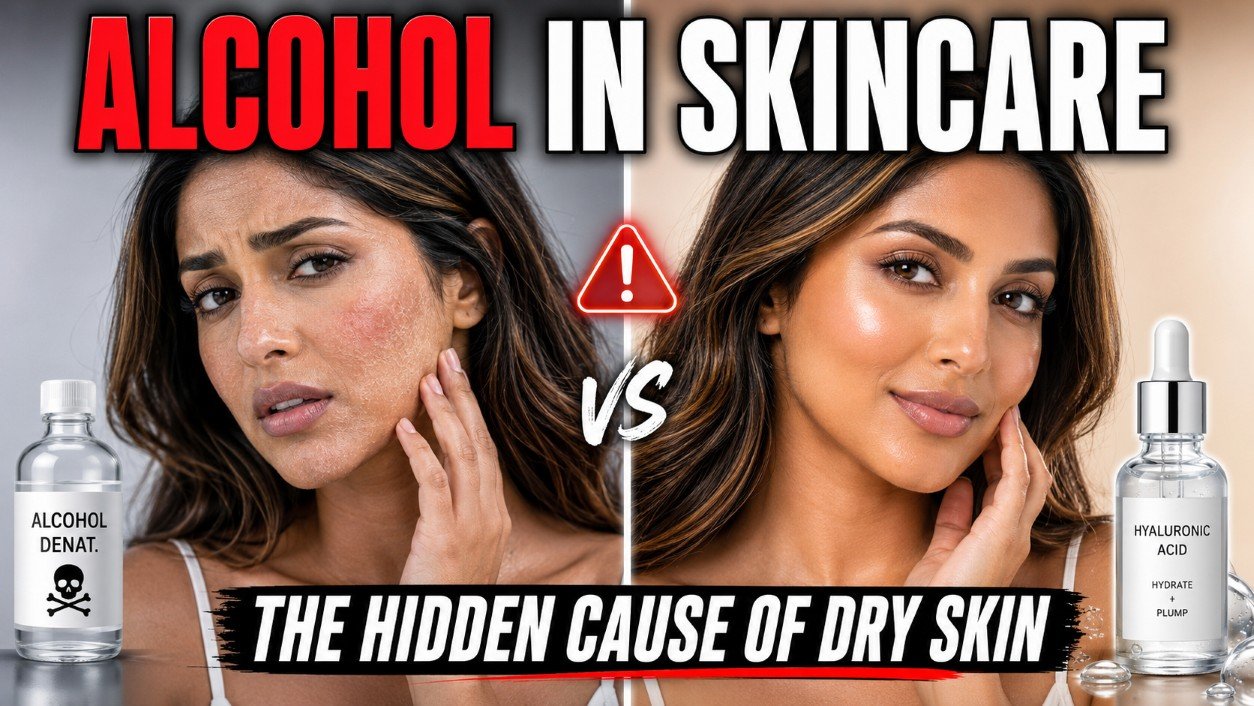
Alcohol in skincare is one of the most common reasons a routine leaves your face tight, flaky, and strangely more sensitive over time. Toners, mists,
Alcohol in skincare is one of the most common reasons a routine leaves your face tight, flaky, and strangely more sensitive over time. Toners, mists, serums, and even some moisturisers rely on volatile alcohols for that fast-absorbing, weightless feel we have been trained to love. The problem is that these solvents slowly erode the lipid barrier, letting water escape faster than skin can replace it. Learning to spot them is the first step to lasting hydration.
Walk down any beauty aisle and pick up five random products at random – toners, serums, mists, sunscreens, and even some moisturisers – and there is a strong chance that at least three of them will list some form of alcohol within the first ten ingredients. For decades, the cosmetics industry has relied on volatile alcohols to give formulas that satisfying, fast-absorbing, weightless feel that consumers have been trained to associate with effective skincare. The problem is that the very sensation we have learned to love is often the same sensation that quietly undermines our skin’s long-term health, leaving it parched, sensitive, and prematurely aged.
The single most important habit you can adopt for resilient, hydrated skin is to avoid skincare products with alcohol, because these volatile solvents progressively erode the lipid barrier that keeps moisture locked in and irritants locked out. When that barrier weakens, water evaporates faster than your skin can replace it, the microbiome shifts, and inflammation creeps in beneath the surface. The encouraging news is that once you understand which alcohols cause harm, which ones are harmless or even beneficial, and how to read a label like a chemist, you can build a routine that actually nourishes your skin rather than slowly stripping it.
This guide unpacks the science of alcohol in skincare in detail, distinguishes the helpful fatty alcohols from the harmful drying ones, explains exactly how these ingredients interact with your skin’s biology, and walks you through gentler, more effective alternatives that hydrate, repair, and protect.
Understanding What “Alcohol” Actually Means on a Skincare Label
Reviewed by the BeautynFacts editorial team. Last updated: May 2026.
The word ‘alcohol’ on a cosmetic label is one of the most misunderstood terms in the beauty industry. Chemically, an alcohol is simply any organic compound that contains a hydroxyl group, an oxygen atom bonded to a hydrogen atom, attached to a carbon. That is an enormous chemical family, and within it sit ingredients that range from devastatingly drying solvents to deeply nourishing emollients. Lumping them all together as bad is as inaccurate as lumping all acids together as exfoliants.
To make sense of any product label, you need to recognise that there are essentially three categories of alcohol you will encounter in skincare. The first group includes the simple, low-molecular-weight alcohols such as ethanol, denatured alcohol, methanol, isopropyl alcohol, and SD alcohol. These are the small, volatile molecules responsible for that quick-evaporating, almost stinging sensation. The second group consists of fatty alcohols like cetyl alcohol, stearyl alcohol, cetearyl alcohol, and behenyl alcohol, which are derived from coconut, palm, or other plant oils and behave nothing like their volatile cousins. The third group includes aromatic and speciality alcohols, such as benzyl alcohol, which is often used as a preservative in concentrations far too low to cause damage.
This distinction matters because consumer fear of the word ‘alcohol’ has driven some shoppers away from genuinely soothing, well-formulated products that contain perfectly safe fatty alcohols. The villains of the story are the volatile, drying alcohols, particularly when they appear high on an ingredient list, because their concentration directly determines how aggressively they disrupt the skin barrier.
Volatile Drying Alcohols to Watch For
The names you want to flag on a label are ‘alcohol denat’, ‘denatured alcohol’, ‘ethanol’, ‘ethyl alcohol’, ‘isopropyl alcohol’, ‘methanol’, ‘propanol’, and ‘SD alcohol’ followed by a number. When any of these appear within the first five ingredients of a leave-on product, the formula contains enough volatile alcohol to influence how your skin feels and behaves over time. In rinse-off products such as cleansers, the impact is reduced because the contact time is short, but in toners, essences, serums, and moisturisers that stay on the skin, the effect compounds with each application.
Fatty Alcohols That Help Rather Than Harm
Cetyl alcohol, stearyl alcohol, cetearyl alcohol, myristyl alcohol, and behenyl alcohol are waxy solids at room temperature and function as thickeners, emulsion stabilisers, and emollients. They form a soft occlusive film that helps lock in moisture rather than pulling it out. Dermatologists routinely include products with fatty alcohols in regimens for dry, sensitive, and even rosacea-prone skin because these ingredients improve texture and barrier function. If you see cetyl or stearyl listed, you do not need to worry. They are doing the opposite of what ethanol does.
How Volatile Alcohols Damage the Skin Barrier at the Cellular Level
To appreciate why drying alcohols deserve such caution, it helps to understand what they actually do when they touch your skin. The outermost layer of your epidermis, the stratum corneum, is built like a brick wall. Flattened skin cells, called corneocytes, are the bricks, and a complex mortar of ceramides, cholesterol, and free fatty acids holds them together in a precise ratio of roughly one to one to one. This lipid matrix is what gives healthy skin its ability to retain water and repel irritants.
Volatile alcohols are powerful solvents, which means they dissolve oils and lipids on contact. When you swipe an alcohol-heavy toner across your face, the ethanol immediately begins extracting cholesterol and fatty acids from the stratum corneum. Studies in dermatology journals have shown that even short-term exposure to ethanol concentrations above twenty percent can significantly increase transepidermal water loss, which is the rate at which moisture escapes through the skin. Over weeks and months of daily use, this lipid extraction creates microscopic gaps in the mortar between corneocytes, allowing water to evaporate freely and irritants, allergens, and pollutants to slip in.
Research has also demonstrated that repeated exposure to denatured alcohol can damage keratinocytes, the living cells beneath the stratum corneum that produce new skin. Damaged keratinocytes divide more slowly and produce less of the proteins and lipids needed to maintain a healthy barrier, which sets off a vicious cycle. The barrier weakens, water loss increases, inflammation rises, and the skin attempts to compensate by producing more oil, all while remaining genuinely dehydrated underneath.
The Microbiome Disruption Nobody Talks About
Beyond lipid stripping, volatile alcohols also act as antimicrobial agents, which sounds beneficial until you consider that your skin is home to trillions of microorganisms collectively known as the skin microbiome. Beneficial bacteria such as certain Staphylococcus epidermidis strains help train your immune system, produce protective fatty acids, and outcompete pathogenic species. Drenching your face in ethanol indiscriminately wipes out both helpful and harmful microbes, leaving the skin vulnerable to opportunistic colonisation by less friendly organisms. Emerging research suggests that microbiome disruption is a contributing factor in chronic conditions such as acne, rosacea, eczema, and seborrhoeic dermatitis.
The Deceptive Pleasant Sensation
Part of why drying alcohols persist in formulations is that they feel wonderful in the moment. They evaporate quickly, leaving skin feeling cool, smooth, and oil-free. This sensory experience tricks the brain into thinking the product is working, when in reality the cooling effect is the energy of evaporation that pulls water out of your skin alongside the alcohol itself. The matte finish is dehydration in disguise. Once you understand the truth, you can recognise the sensation for what it is and choose products that feel hydrating rather than evaporative.
The Vicious Cycle of Dehydration and Compensatory Oil Production
One of the most counterintuitive consequences of using alcohol-based skincare is that it can actually make oily skin worse. People with naturally oily or combination complexions often gravitate toward astringent, alcohol-heavy toners and mattifying serums, hoping to control shine, only to find that their skin becomes simultaneously oilier and more dehydrated over time. The biological mechanism behind this paradox is straightforward but rarely explained on product packaging.
Sebaceous glands respond to a wide range of signals, including hormonal fluctuations, temperature, stress, and crucially, the moisture status of the skin’s surface. When the stratum corneum becomes dehydrated and the lipid barrier is compromised, the skin sends biochemical signals to the sebaceous glands requesting reinforcement. The glands respond by ramping up sebum production in an attempt to restore the protective oily layer that the alcohol just stripped away. The result is a face that feels tight and parched within twenty minutes of cleansing, then becomes shiny by mid-afternoon as the glands overcompensate.
This cycle is particularly destructive for people with acne-prone skin. The excess sebum combines with dead skin cells and bacteria in enlarged pores, creating ideal conditions for Cutibacterium acnes to multiply and for inflammatory lesions to form. Meanwhile, the compromised barrier allows irritants to penetrate more deeply, increasing redness and post-inflammatory hyperpigmentation around healing breakouts. Switching from alcohol-based to barrier-supportive products often produces a noticeable reduction in both shine and breakouts within four to six weeks, as the skin recalibrates its oil production once it perceives that hydration has been restored.
Why Premature Aging Is the Long-Term Cost
Skin ageing is driven by a combination of intrinsic factors such as genetics and time and extrinsic factors such as ultraviolet radiation, pollution, smoking, and yes, ingredient exposure. Among the extrinsic factors, anything that causes long-term skin inflammation or weakens the skin barrier speeds up visible signs of ageing by activating matrix metalloproteinases, which are enzymes that break down collagen and elastin in the dermis.
Volatile alcohols contribute to this ageing cascade in several ways. First, by causing chronic low-grade inflammation, they keep matrix metalloproteinase activity elevated, which steadily degrades the structural proteins that give skin its firmness and bounce. Second, by promoting oxidative stress at the cellular level, they generate free radicals that damage DNA, proteins, and lipids within keratinocytes and fibroblasts. Third, by reducing the skin’s ability to retain moisture, they allow fine lines to become more pronounced as plumpness disappears from the upper layers of the dermis.
Long-term observational data from dermatology practices suggests that patients who consistently use barrier-friendly skincare maintain better skin tone, fewer fine lines, and more even pigmentation than those who rely on harsh, stripping products. The difference is most visible around the eyes, mouth, and neck, areas where the skin is thinnest and the consequences of barrier damage become apparent earliest.
Collagen, Elastin, and the Hydration Connection
Collagen and elastin are produced by fibroblasts in the dermis, and their production depends on a stable, well-hydrated cellular environment. Dehydrated skin sends stress signals down through the epidermis that affect fibroblast behaviour, slowing collagen synthesis and increasing the activity of collagen-degrading enzymes. Over years, this slowdown contributes to the thinning of the dermal layer and the loss of structural support that creates sagging and wrinkles. Keeping the surface barrier intact is therefore not just a cosmetic concern; it is a structural investment in the skin’s long-term architecture.
Hyperpigmentation and Uneven Tone
Inflammation triggered by harsh ingredients also stimulates melanocytes, the pigment-producing cells of the skin. Repeated low-grade inflammation can lead to gradual development of melasma, post-inflammatory hyperpigmentation, and a generally duller, less even complexion. People who switch to gentle, barrier-supportive routines often report that their skin tone evens out within several months, even without using dedicated brightening products, as removing the inflammatory trigger allows pigmentation to normalise on its own.
How to Read an Ingredient Label Like a Skincare Detective
Reading a cosmetic ingredient list is a skill that will benefit you for years to come. By international labelling convention, ingredients are listed in descending order of concentration down to one percent, after which they may appear in any order. This means that anything in the first five ingredients usually represents a meaningful percentage of the formula, while ingredients near the end may be present in trace amounts.
When evaluating a product, scan the first eight ingredients first. If you see alcohol denat, ethanol, isopropyl alcohol, or SD alcohol in this top tier, the formula contains a substantial amount of volatile alcohol and is likely to be drying with regular use. If those terms appear lower on the list, the concentration is probably small enough to function as a stabiliser or carrier without significant impact on the barrier. Look for fatty alcohols such as cetyl, stearyl, cetearyl, or behenyl alcohol with confidence, since these contribute to a smoother, more comfortable product.
Pay attention to the overall philosophy of the formulation rather than fixating on a single ingredient. A toner that lists alcohol denat third but also includes glycerin, panthenol, niacinamide, and a complex of botanical extracts may still cause issues, while a product that contains a tiny amount of alcohol alongside ceramides, cholesterol, fatty acids, and humectants might be perfectly balanced. The dose and the company an ingredient keeps determine its real-world effect.
Marketing Terms That Can Mislead You
Phrases such as ‘alcohol-free’, ‘clean beauty’, ‘natural’, and ‘dermatologist-tested’ have no standardised regulatory definitions in most countries. A product labelled ‘alcohol-free’ may technically be free of ethanol while still containing isopropyl alcohol or fragrance ingredients that are equally problematic. Always verify with the actual ingredient list rather than trusting front-of-package claims. Conversely, do not dismiss a brand simply because it includes a small amount of ethanol in a formula where it serves a legitimate technical purpose, such as helping retinoids penetrate or stabilising certain antioxidants.
The Position of Water and Glycerin Tells a Story
In well-formulated hydrating products, water is typically the first ingredient, and glycerin appears within the top five. If glycerin or another humectant such as butylene glycol, propanediol, or sodium hyaluronate appears prominently, the product is designed to deliver moisture rather than strip it. If the second ingredient is alcohol denat and humectants are buried near the end, the formula is built around the volatile solvent rather than around hydration.
Hydrating Alternatives That Actually Repair the Skin
Replacing alcohol-heavy products with thoughtfully formulated alternatives is one of the most rewarding shifts you can make in your routine. The market has expanded enormously over the past decade, and you no longer have to compromise on texture, performance, or sensory pleasure to get formulas that respect the skin barrier. The following ingredient families form the backbone of barrier-friendly skincare.
Glycerin is the workhorse humectant of modern cosmetic chemistry. It draws water from the deeper layers of the skin and from the surrounding humidity into the stratum corneum, where it integrates with the natural moisturising factor to maintain hydration. Concentrations between three and ten percent provide noticeable plumping and softening without stickiness, and glycerin pairs beautifully with virtually every other active ingredient.
Hyaluronic acid is a polysaccharide naturally produced by the body that can hold up to a thousand times its weight in water. In skincare, it appears in various molecular weights, with low molecular weight fragments penetrating more deeply and high molecular weight versions sitting on the surface to form a hydrating film. Multi-weight hyaluronic acid formulas deliver hydration to multiple layers simultaneously, producing visibly plumper skin within minutes of application.
Niacinamide, a type of vitamin B3, is one of the most studied ingredients in modern skincare. At concentrations between two and ten percent, it strengthens the lipid barrier by stimulating ceramide production, regulates sebum output, evens skin tone by interrupting the transfer of melanin to keratinocytes, and reduces redness through anti-inflammatory action. It is one of the few actives that genuinely improves multiple skin concerns simultaneously and is exceptionally well tolerated.
Panthenol, also known as provitamin B5, penetrates the skin and converts to pantothenic acid, where it acts as both a humectant and a wound-healing accelerator. It calms irritation, supports barrier repair, and gives formulas a beautifully smooth feel without occlusiveness. Panthenol is particularly valuable for people recovering from over-exfoliation or transitioning away from harsh products.
Ceramides are the lipid building blocks of the stratum corneum mortar, and using ceramide-containing products on the skin really restores what daily life takes away. Look for formulas containing multiple ceramide types alongside cholesterol and fatty acids in a balanced ratio for the most complete barrier restoration.
Botanical Ingredients With Real Science Behind Them
Aloe vera has been used for thousands of years, and modern research has confirmed its anti-inflammatory, wound-healing, and humectant properties. The polysaccharides in aloe vera help retain moisture in the skin while providing a soothing effect for irritated or sun-exposed complexions. Centella asiatica, often listed as madecassoside or asiaticoside, supports collagen synthesis and reduces inflammation, making it a star ingredient in Korean and French pharmacy skincare alike. Green tea extract provides strong antioxidants called polyphenols, especially epigallocatechin gallate, which neutralises free radicals caused by ultraviolet exposure and pollution.
Natural Oils That Reinforce the Barrier
Plant-derived oils such as squalane, jojoba oil, rosehip seed oil, marula oil, and sweet almond oil mimic the skin’s own sebum and blend well with the lipid matrix. Squalane, which comes from olives or sugarcane, is a stable, saturated form of squalene that gives lightweight occlusion and does not cause comedones. Jojoba oil is technically a wax ester and is the closest plant-based analogue to human sebum, making it suitable for nearly every skin type. Rosehip seed oil delivers vitamin A precursors and essential fatty acids that support cellular turnover and tone evenness.
Building an Alcohol-Free Routine From Cleanser to Sunscreen
Transitioning to a barrier-friendly routine does not require throwing out your entire cabinet overnight. A gradual replacement strategy allows your skin to adjust and helps you identify which products were causing problems versus which were performing well. Start with the products that stay on your skin the longest, since these have the greatest cumulative impact, and work your way through the rest of your shelf over a few months.
For cleansing, choose a gentle, low-foaming gel, cream, or oil cleanser with a pH between four and a half and six and a half. Avoid foaming cleansers loaded with sulphates and ethanol, which compound barrier damage at the very first step of the routine. Cream cleansers with glycerin and ceramides leave the skin feeling soft rather than squeaky, and oil cleansers are ideal for removing sunscreen and makeup without disturbing the natural lipid layer.
For toning, replace alcohol-based astringents with hydrating essences or toners built around glycerin, hyaluronic acid, panthenol, and soothing botanicals. Apply with clean hands by patting rather than wiping, which avoids both friction and the unnecessary use of cotton pads.
For serums, focus on barrier-supporting actives during morning routines and consider gentler treatments such as low-percentage retinol or peptide complexes in the evening. Layer thinner formulas before thicker ones, and allow each layer thirty to sixty seconds to absorb before applying the next.
For moisturising, choose creams or lotions with a balanced mix of humectants, emollients, and occlusives. A well-formulated moisturiser will feel cushioning rather than sticky, keeping your skin comfortable for at least eight to ten hours. People with dry skin benefit from richer formulas containing shea butter, ceramides, and fatty alcohols, while those with oilier skin do well with lighter gels containing squalane and niacinamide.
For sun protection, look for mineral or hybrid sunscreens that have been reformulated with barrier-friendly bases. Older alcohol-heavy chemical sunscreens have largely been replaced by silky, hydrating formulas that provide broad-spectrum protection without the dehydrating finish, though you may need to read labels carefully to find them.
The Order of Application Matters More Than You Think
Skincare products are formulated to be applied in a specific sequence, generally from thinnest and most water-soluble to thickest and most occlusive. After cleansing and patting the skin until it is just barely damp, apply hydrating toner or essence, followed by water-based serums, then oil-based serums or facial oils, then moisturiser, and finally sunscreen during the day. Applying products in the wrong order can prevent active ingredients from penetrating effectively and can also cause pilling or sliding.
How Long Before You See Results
Skin operates on a roughly twenty-eight-day renewal cycle in younger adults and slightly longer in older adults. Most people notice improved comfort and reduced tightness within a week of switching to barrier-friendly products, visible plumping and smoothness within three to four weeks, and significant improvements in tone, texture, and resilience within two to three months. Patience and consistency outperform aggressive intervention every time when it comes to long-term skin health.
Special Considerations for Sensitive, Mature, and Compromised Skin
Different life stages and skin conditions require different levels of caution when it comes to alcohol exposure. Sensitive skin types, including those with rosacea, eczema, perioral dermatitis, or a history of allergic reactions, should avoid volatile alcohols almost entirely, since their barrier is already operating at reduced capacity and any additional disruption can trigger flares. Seek products specifically formulated for sensitive or reactive skin, and patch test new additions on the inner forearm or behind the ear for several days before applying to the face.
Mature skin produces less sebum, sheds dead cells more slowly, and has a thinner dermis with reduced collagen content. These changes make alcohol-induced dehydration more visible and more difficult to reverse. Women going through perimenopause and menopause often notice that products they tolerated in their twenties and thirties suddenly feel uncomfortable, which is a signal that the underlying hormonal shifts have reduced barrier resilience. Switching to richer, more emollient formulas with ceramides, peptides, and fatty acids supports the skin through these transitions.
Skin that is recovering from procedures such as chemical peels, microneedling, laser treatments, or aggressive exfoliation needs particularly gentle care. The barrier is in active repair mode, and exposure to volatile alcohols can interrupt healing, increase the risk of post-inflammatory hyperpigmentation, and prolong recovery. Stick to bland, fragrance-free, alcohol-free formulas with humectants and ceramides during the recovery window, and reintroduce active ingredients gradually under professional guidance.
Pregnancy and Breastfeeding
While topical alcohol exposure does not pose direct risks to a developing foetus, hormonal shifts during pregnancy can often increase skin sensitivity and reactivity. Many pregnant and breastfeeding women find that products they previously enjoyed suddenly cause stinging, redness, or breakouts. Switching to gentle, alcohol-free formulas during this period helps maintain comfort and reduces the risk of new sensitivities developing.
Climate and Environmental Factors
Cold, dry winter air, low-humidity indoor heating, and high-altitude environments all accelerate transepidermal water loss, making the skin more vulnerable to alcohol-induced dryness. People who live in or travel to such environments should be especially vigilant about avoiding stripping products and may benefit from layering occlusive balms over their moisturisers during the harshest months. Conversely, hot and humid climates can mask the early signs of barrier damage because the surrounding air provides passive hydration, which means the cumulative damage may only become apparent after a season change.
The Truth About Alcohol in Specific Product Categories
Not every product category presents the same risk profile, and understanding where alcohol is most problematic can help you prioritise your replacement strategy. Toners and astringents have historically been the worst offenders, with classic formulations sometimes containing forty percent or more denatured alcohol. The good news is that the modern toner has evolved into something closer to an essence, and excellent alcohol-free options exist at every price point.
Setting sprays and facial mists frequently contain alcohol to help products dry quickly and lock makeup in place. While occasional use of a setting spray is unlikely to cause significant damage, daily use of an alcohol-heavy mist can contribute to ongoing barrier disruption. Look for mineral water mists, rose water sprays, and hyaluronic acid mists as gentler alternatives.
Hand sanitisers and body sprays obviously contain high concentrations of ethanol or isopropyl alcohol, which is essential for their antimicrobial function. The skin on the hands tolerates alcohol better than facial skin in the short term but still suffers cumulatively, which is why frequent sanitiser users often develop dry, cracked, irritated hands. Following sanitiser with a rich hand cream containing glycerin, shea butter, and ceramides offsets some of the damage.
Acne treatments and toners marketed for oily skin frequently include alcohol as a degreasing agent. While the immediate matte finish feels satisfying, the long-term effect is usually counterproductive for the reasons discussed earlier. Modern acne treatments built around salicylic acid, niacinamide, azelaic acid, and benzoyl peroxide in non-stripping bases are far more effective and considerably gentler on the barrier.
Sunscreen Formulas to Approach With Care
Some chemical sunscreens, particularly ultra-light or high SPF formulas, contain meaningful concentrations of alcohol to help filters dissolve and dry quickly. While the protection these products offer is genuinely valuable, daily use of an alcohol-heavy sunscreen on already compromised skin can perpetuate dehydration. The newest generation of sunscreens, particularly Korean and French pharmacy formulas, offers excellent protection in elegant, barrier-friendly bases that hydrate rather than strip.
Hair and Scalp Products Worth Watching
Although this guide focuses on facial skincare, the scalp is also skin and follows the same biological rules. Alcohol-heavy dry shampoos, hairsprays, and styling products can dry the scalp, contribute to flaking, and exacerbate conditions such as seborrhoeic dermatitis. People with sensitive scalps benefit from choosing alcohol-free or low-alcohol styling products and from avoiding the direct application of alcohol-heavy sprays to the hairline and forehead.
Frequently Asked Questions
Are all alcohols in skincare bad for my skin?
Absolutely not. The term ‘alcohol’ describes a vast chemical family that includes both drying solvents and beneficial emollients. Volatile alcohols such as ethanol, denatured alcohol, isopropyl alcohol, and SD alcohol are the ones to be cautious about, particularly when they appear high on an ingredient list. Fatty alcohols such as cetyl alcohol, stearyl alcohol, cetearyl alcohol, and behenyl alcohol are derived from plant oils and behave like waxy emollients, helping to thicken formulas and lock in moisture. Aromatic alcohols, such as benzyl alcohol, are used as preservatives in tiny concentrations and are generally well tolerated. Always check the position of an alcohol on the ingredient list and consider it in context with the rest of the formula.
How long does it take for my skin to recover after I stop using alcohol-based products?
Skin barrier recovery is gradual and depends on the extent of the damage, your age, and your overall skin health. Most people notice reduced tightness and stinging within three to seven days of switching to gentler products, visible improvements in hydration and plumpness within two to four weeks, and substantial improvements in tone, texture, and resilience within two to three months. Using barrier-supportive ingredients like ceramides, niacinamide, panthenol, and humectants regularly speeds up recovery. Avoid the temptation to introduce strong actives during the early weeks of recovery, since the barrier needs time to rebuild before it can comfortably tolerate retinoids or strong acids again.
Can I use alcohol-based hand sanitiser without damaging my hands?
Hand sanitiser plays an important role in hygiene, particularly during cold and flu season or when soap and water are unavailable. The concentrated alcohol that makes sanitiser effective at killing pathogens does cause cumulative damage to the skin barrier on the hands, which is why frequent users often develop dry, cracked, or eczematous skin. The solution is not to avoid sanitiser entirely but to follow each application with a barrier-repairing hand cream containing glycerin, shea butter, ceramides, and fatty alcohols. Keep cream on your desk, by the bathroom sink, in your car, and in your handbag so that reapplication becomes automatic.
Why does my alcohol-based toner feel so refreshing if it is bad for my skin?
The pleasant cooling sensation produced by alcohol-based toners is the energy of evaporation pulling water out of your skin, along with the alcohol itself. The matte, oil-free finish that follows is dehydration disguised as cleanliness, and the sensation has been carefully engineered by formulators to feel satisfying and effective. Once you understand the mechanism, the same sensation may start to feel less appealing, and you can train your skin to recognise the cushioning, plumping feel of a hydrating toner as the more genuinely beneficial experience. Many people report that within a few weeks of switching, the older astringent feel becomes uncomfortable.
Are alcohol-free products always better than products containing alcohol?
Not necessarily. The quality of a skincare product depends on the entire formulation rather than on a single ingredient. A poorly formulated alcohol-free product packed with fragrance, harsh preservatives, or irritating essential oils can cause more damage than a thoughtfully formulated product containing a small amount of alcohol that serves a legitimate technical purpose. Some active ingredients such as certain retinoids and antioxidants require alcohol or alcohol derivatives for stability and penetration. Focus on the overall ingredient list, the presence of barrier-supportive ingredients, and how your skin actually responds rather than fixating on a single criterion.
Can I still use products with alcohol if my skin is oily and I need oil control?
Using alcohol-heavy products to control oil is one of the most common mistakes people with oily skin make. Stripping the skin of oil triggers the sebaceous glands to compensate by producing even more sebum, creating a cycle of dehydration and excess oil that worsens both shine and breakouts. The more effective approach is to support barrier health with humectants and lightweight emollients while using ingredients such as niacinamide, salicylic acid, and zinc to regulate oil production at the source. Many people with oily skin discover that switching to a barrier-friendly routine actually reduces their shine within a few weeks, since the skin no longer feels the need to overcompensate for missing moisture.
What should I do if I have already been using alcohol-based products for years?
The skin has remarkable regenerative capacity, and consistent care can substantially reverse even years of damage. Begin by replacing the products that stay on your skin the longest, such as moisturisers, serums, and toners, with barrier-supportive alternatives. Simplify your routine to four or five essential products and avoid layering multiple actives during the recovery period. Incorporate ceramides, niacinamide, and humectants daily, and protect your skin from sun exposure with a gentle broad-spectrum sunscreen. Resist the urge to exfoliate aggressively, even if your skin feels rough during the transition, since the roughness usually resolves on its own as the barrier rebuilds.
Is it okay to use alcohol-based perfumes on my skin?
Traditional perfumes contain high concentrations of denatured alcohol and fragrance compounds that can sensitise the skin over time. Putting perfume directly on sensitive areas like the neck, décolletage, and inner wrists can cause dryness, irritation, and even pigmentation changes, especially if you then go out in the sun. To enjoy fragrance with less skin impact, spray perfume onto your clothing or hair rather than directly onto your skin; choose alcohol-free or oil-based fragrance formulations; or apply a thin layer of unscented moisturiser first to create a buffer between the perfume and your skin.
Bringing It All Together for Healthier Skin
Choosing skincare products thoughtfully is one of the most accessible and powerful forms of self-care available, and avoiding volatile drying alcohols is among the simplest changes that delivers the largest cumulative benefit. The science is clear that ethanol, denatured alcohol, isopropyl alcohol, and similar small-molecule solvents gradually damage the lipid barrier that keeps moisture in and irritants out, leading to dehydration, sensitivity, breakouts, and accelerated ageing when used consistently in leave-on products. The good news is equally clear that the modern skincare market offers extraordinary alternatives built around glycerin, hyaluronic acid, niacinamide, panthenol, ceramides, and plant-based emollients that genuinely repair, protect, and beautify the skin.
Start by reading the labels of the products currently on your shelf and identifying which ones list volatile alcohols within the first five ingredients. Replace these gradually, starting with leave-on products like toners, serums, and moisturisers, and pay attention to how your skin feels during the transition. Within a few weeks, you should notice reduced tightness and stinging, improved hydration, and a more even, comfortable complexion. Within a few months, deeper improvements in tone, texture, and resilience should become apparent.
Build your routine around the principle that skincare should add resources to your skin rather than take them away. Choose cleansers that respect your barrier, hydrators that genuinely hydrate, actives that work with your skin rather than against it, and sunscreens that protect without stripping. Treat your skin as a living, intelligent organ that responds to consistent kindness with visible, lasting results. The reward for this thoughtful approach is skin that feels comfortable, looks luminous, and ages gracefully across decades, which is the truest expression of beauty rooted in genuine health.
RELATED ARTICLES:
2025’s Best Natural Wrinkle Remedy: Garlic Skincare Hacks for Ageless Beauty!
Gently Pat Your Skin Dry: The Key to Preventing Irritation After Washing
Unclog Your Pores and Prevent Breakouts with Salicylic Acid
How to use sunscreen to prevent the appearance of spots?
How to prevent premature ageing in sensitive skin?
About The Author

COMMENTS