
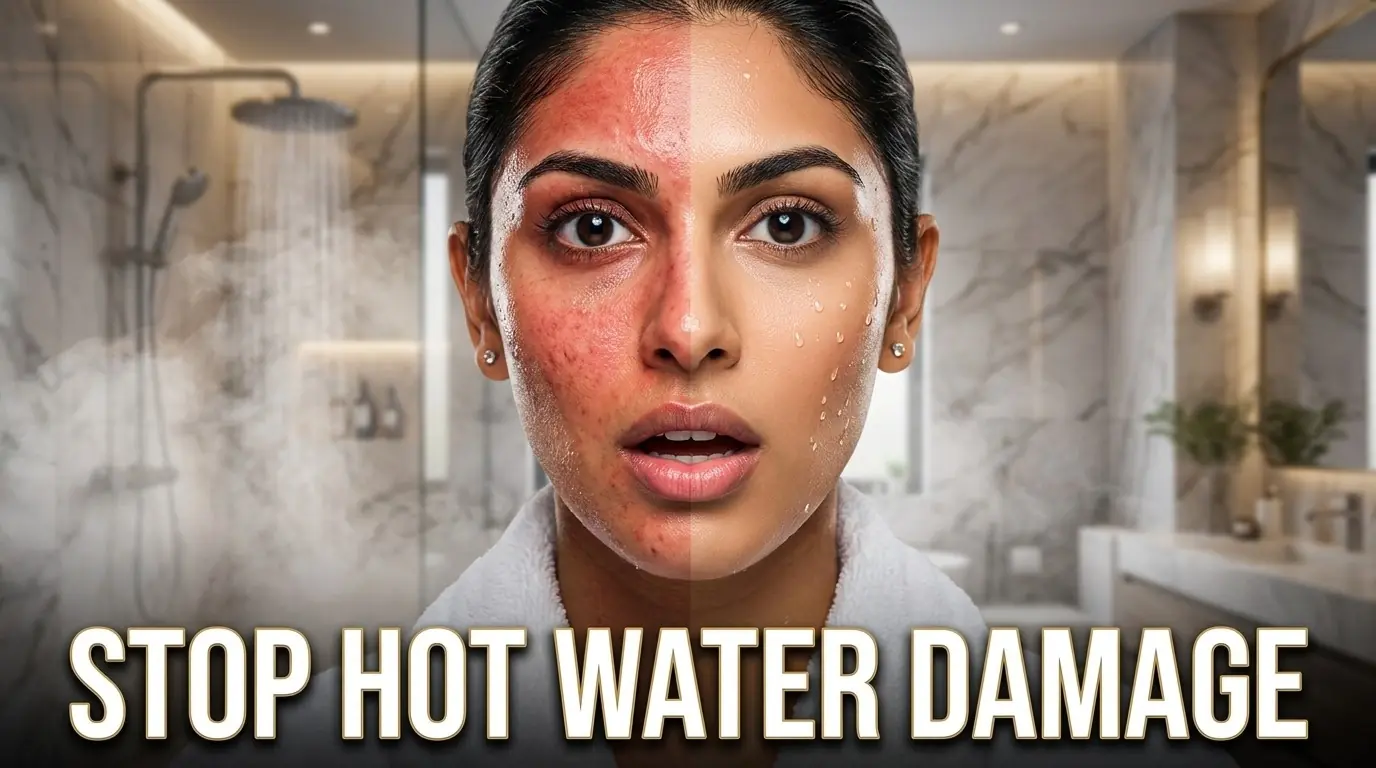
Hot water skin damage is one of the most overlooked causes of dryness, dullness, and premature aging. A scalding shower or face wash strips the skin's
Hot water skin damage is one of the most overlooked causes of dryness, dullness, and premature aging. A scalding shower or face wash strips the skin’s protective acid mantle in minutes, breaks down its lipid barrier, and triggers the inflammation behind eczema, rosacea, and wrinkles. This guide explains the biology, gives you the ideal water temperature, and shares the simple shower swaps that visibly restore your skin.
Reviewed by the BeautynFacts editorial team. Last updated: May 2026.
Steer Clear Hot: There is something deeply satisfying about stepping into a hot shower after an exhausting day. The heat soothes your muscles. The steam clears your head. Your stress evaporates within seconds. But your skin tells a completely different story. Every time you turn that dial toward scalding, you erode the very foundation of healthy, resilient skin. That foundation is your skin’s natural oil layer, and it is far more vulnerable than most people understand. The choice to steer clear hot water and replace it with lukewarm water is one of the single most effective habits you can adopt for long-term skin health.The benefits run deep. Hot water dissolves protective sebum, disrupts your acid mantle, increases transepidermal water loss, and accelerates visible aging. Lukewarm water preserves moisture, reinforces your skin barrier, and reduces chronic redness and irritation. This guide covers everything: the science of skin oils, the chemistry of pH, the mechanics of inflammation, and the practical steps to transform your routine starting today. Whether your skin is dry, oily, sensitive, combination, or mature, every section of this guide delivers actionable value. Your skin begins benefiting with your very next shower.
Why You Must Steer Clear Hot Water: The Biological Case
What Sebum Actually Is and Why It Matters
Your skin produces a waxy, lipid-rich substance called sebum. Sebaceous glands, found across nearly every surface of your body, secrete this oil continuously. Sebum is not a flaw or a sign of poor hygiene. It is a critical biological mechanism your skin relies on to function properly.
Sebum forms a thin protective film over your skin’s surface. This film performs several essential functions simultaneously. It slows water evaporation from the skin, keeping tissues hydrated throughout the day. It creates a mildly acidic environment that discourages harmful bacteria and fungi. It lubricates the skin surface to prevent cracking, flaking, and surface fissures. It also serves as a delivery vehicle for fat-soluble antioxidants, including vitamin E, which neutralize environmental and UV-induced free radical damage.
Sebum composition varies slightly by body region, age, and hormonal status. But its core function remains constant: it is a multi-role protectant that shields your skin from dehydration, microbial invasion, and oxidative stress. When it is present and intact, your skin looks plump, feels smooth, and stays resilient. When it is stripped away, every one of those protective mechanisms fails simultaneously.
How Hot Water Destroys the Sebum Layer
Water at temperatures above 40 degrees Celsius (104 degrees Fahrenheit) acts as a lipid solvent. It breaks down and rinses away fat-based substances. Because sebum is largely lipid-based, hot water dismantles it efficiently and completely. One long, hot shower can strip the sebum layer your glands spent hours building.
The damage is not gradual. Hot water removes sebum rapidly, often within the first two minutes of exposure. The longer and hotter your shower, the more completely the protective layer dissolves. After the shower, your skin is left exposed: unprotected from water loss, vulnerable to environmental irritants, and stripped of its natural antibacterial film.
This is why your skin often feels tight and dry immediately after a hot shower. That tightness is not a sign of cleanliness. It is the physical sensation of a damaged, oil-depleted skin barrier struggling to hold onto moisture. Applying moisturizer after the fact helps, but it cannot fully replace what was lost. Prevention is more effective than correction at every level.
The Overproduction Cycle That Follows
When your sebaceous glands detect that the skin’s oil layer has been stripped, they respond. They ramp up sebum production to compensate for the loss. This survival response is designed to restore the protective film as quickly as possible.
For people with oily or acne-prone skin, this overproduction creates a damaging cycle. The skin compensates with excess oil. That excess oil mixes with dead skin cells and clogs follicles. Clogged follicles become breeding grounds for acne-causing bacteria. More breakouts follow. Many people then wash more aggressively, often with hotter water, which strips the skin further and perpetuates the problem.
For people with dry or sensitive skin, the overproduction response is often insufficient. Their glands cannot produce sebum fast enough to offset repeated hot-water stripping. The result is persistent dryness, flaking, and heightened sensitivity that worsens with every passing season.
Your Acid Mantle: The Invisible Shield Hot Water Strips Away
Understanding pH and Skin Health
The acid mantle is a thin, slightly acidic film on the skin’s outermost surface. It forms from a combination of sebum, sweat, and naturally occurring amino acids. Healthy skin maintains a pH between 4.5 and 5.5, which is mildly acidic. This acidity is not incidental. It is essential to nearly every protective function your skin performs.
At the correct pH, your skin’s microbiome stays balanced. Beneficial bacteria thrive in this acidic environment. Harmful pathogens, which prefer a more neutral or alkaline environment, find it difficult to colonize the skin surface. Your skin’s own enzymes work correctly at acidic pH. Lipid-processing enzymes in the stratum corneum, the outermost skin layer, require an acidic environment to build and maintain the tight lipid matrix that forms your skin barrier.
When the acid mantle is healthy, skin resists irritation, heals efficiently, and maintains its moisture content without external help. It is the body’s most effective built-in skin care product. It operates continuously and automatically, as long as you do not disrupt it.
How Heat Shifts Your Skin’s pH
Hot water does not just strip oils. It also raises skin surface pH. Heat opens pores and temporarily disrupts the tight junctions in the stratum corneum. As the acidic sebum and sweat film washes away, the surface pH shifts upward toward neutral or mildly alkaline levels. Studies have measured post-shower pH increases of more than one full unit on the pH scale, which represents a tenfold shift in hydrogen ion concentration.
This shift matters enormously. At a higher pH, the enzymes responsible for building your skin barrier slow down. Ceramide synthesis, which is critical for retaining moisture inside the skin, becomes less efficient. The antimicrobial properties of the acid mantle diminish. Harmful bacteria, including Staphylococcus aureus, a pathogen associated with eczema flares, find it far easier to colonize the skin surface.
The pH shift caused by one hot shower can persist for two hours or longer. If you shower with hot water twice a day, your skin’s acid mantle may never fully recover between exposures. The cumulative effect over weeks and months is a chronically disrupted barrier, increased sensitivity, and a skin surface that reacts more aggressively to products, weather, and environmental stressors.
What Happens When the Acid Mantle Breaks Down
A damaged acid mantle creates a cascade of downstream problems. Moisture escapes the skin more readily. Irritants from the environment penetrate more deeply. The skin’s immune cells trigger more frequently, creating low-grade, chronic inflammation. This inflammatory state accelerates collagen breakdown and contributes to premature fine lines and uneven skin texture.
Skin conditions with a well-established link to acid mantle disruption include atopic dermatitis, rosacea, psoriasis, and perioral dermatitis. For people who already have these conditions, hot water is one of the most reliable triggers for flares. For people without these conditions, repeated acid mantle disruption over years significantly raises the risk of developing them.
Rebuilding the acid mantle after disruption is possible but takes time. The skin naturally rebalances over two to four hours in mild disruption scenarios. Severe or repeated disruption requires consistent avoidance of hot water, use of pH-balanced cleansers, and regular application of barrier-supporting moisturizers before full recovery occurs.
Transepidermal Water Loss: Why Hot Showers Leave Skin Thirstier
The Mechanism Behind Transepidermal Water Loss
Transepidermal water loss, commonly abbreviated as TEWL, is the passive diffusion of water through the skin and into the surrounding environment. It is a normal physiological process. Your skin allows a controlled amount of water to pass through its layers continuously. The stratum corneum, with its tightly organized lipid matrix and corneocyte layers, regulates this flow precisely.
When TEWL rates are low and controlled, your skin retains adequate hydration. The lipid matrix between skin cells acts like mortar between bricks. It fills the gaps through which water would otherwise escape. Ceramides, fatty acids, and cholesterol form the bulk of this lipid matrix. Each plays a specific structural role in maintaining low TEWL and keeping skin hydrated from within.
Measuring TEWL is a standard tool in dermatological research. It provides a direct, quantifiable measure of skin barrier integrity. Elevated TEWL indicates a compromised barrier. Lower TEWL indicates a healthy, intact one. The goal of virtually every evidence-based skin care routine is to keep TEWL as low as possible.
How Hot Water Elevates TEWL Rates
Hot water elevates TEWL through two distinct mechanisms. First, it strips the sebum layer that partially occludes the skin surface and slows passive water evaporation. Second, heat directly disrupts the lipid matrix in the stratum corneum. The organized lamellar structure of skin lipids is sensitive to temperature. High heat disorders this structure, creating microscopic gaps through which water escapes more rapidly.
Research published in dermatology journals consistently shows that TEWL increases significantly following hot water exposure compared to tepid or lukewarm water exposure. One study found that TEWL rates remained elevated for up to 30 minutes after a hot shower, even after the skin appeared dry and normal. The damage is not visible. It is measurable at the molecular level.
People who shower with hot water daily and then apply a heavy moisturizer are partially addressing this problem. But they are treating the symptom rather than the cause. Reducing water temperature is a more direct and effective intervention. Moisturizer applied to lukewarm-washed skin performs substantially better than moisturizer applied to heat-damaged skin.
Chronic TEWL Elevation and Accelerated Aging
Chronically elevated TEWL has long-term consequences that go beyond daily dryness. Persistent water loss keeps the skin in a mildly dehydrated state. Dehydrated skin cells do not divide and differentiate as efficiently. Collagen-producing fibroblasts in the dermis are less active in dehydrated tissue. Hyaluronic acid, a molecule that holds water in the skin and gives it volume, depletes faster when TEWL is chronically elevated.
The visible result is accelerated aging. Fine lines appear earlier. Skin texture becomes rougher. Pores look larger because surrounding tissue lacks the plumpness that normally makes them appear smaller. Skin tone becomes uneven as cellular turnover slows. The skin’s ability to bounce back from compression, known as elasticity, decreases faster than it would with proper hydration maintained throughout the years.
Women in their 30s and 40s who struggle with premature signs of aging despite using quality skin care products often overlook water temperature entirely. Investment in serums and moisturizers cannot undo the structural dehydration caused by daily hot showers. Addressing TEWL at the source produces results that topical products alone cannot achieve.
Inflammation and Redness: The Immediate Damage Hot Water Causes
Heat-Induced Vasodilation and Visible Redness
Hot water causes immediate vasodilation, the widening of blood vessels beneath the skin surface. This is why your skin turns red during and after a hot shower. Vasodilation itself is not inherently harmful in isolated incidents. But repeated, prolonged dilation of facial capillaries causes them to gradually lose their elasticity. Over time, these capillaries remain permanently dilated, creating visible redness that does not fade, a condition called telangiectasia or broken capillaries.
Facial skin is particularly vulnerable. It is thinner than body skin. Its blood vessels sit closer to the surface. The capillaries in the cheeks, nose, and chin are small-caliber vessels that handle dilation poorly when subjected to repeated thermal stress. People with fair skin or rosacea experience this damage faster because their vascular response to heat is already heightened.
Switching to lukewarm water significantly reduces the degree of vasodilation during washing. Over weeks, consistent use of lower temperatures allows the skin’s vascular response to calm. Existing redness may not disappear entirely, especially if capillary damage has already occurred. But new damage stops accumulating, and existing inflammation begins to reduce measurably.
How Hot Water Triggers Inflammatory Pathways
Beyond vascular effects, hot water triggers cellular inflammatory pathways in the skin. Heat activates transient receptor potential (TRP) channels in skin cells. These channels are part of the body’s sensory and alarm system. When activated by high temperatures, they initiate a cascade that releases pro-inflammatory cytokines, including interleukin-1 and tumor necrosis factor-alpha.
These cytokines signal immune cells to the skin surface. Mast cells, which are present in abundance in facial skin, respond by releasing histamine. Histamine increases vascular permeability, causing further redness and swelling. It also stimulates itch receptors. This is why some people feel their skin itch after a very hot shower, even without any diagnosed skin condition.
In people with existing inflammatory skin conditions, this cytokine cascade can trigger a full flare. In people without these conditions, repeated low-level activation of the same pathways creates chronic subclinical inflammation. This chronic state is now understood to be a major driver of accelerated skin aging, where inflammation and biological aging processes reinforce each other continuously.
The Link Between Hot Showers and Chronic Skin Conditions
Dermatologists consistently identify hot water as a primary aggravating factor for eczema, rosacea, psoriasis, and seborrheic dermatitis. For eczema patients, hot water strips the ceramide-rich lipid layer that is already structurally deficient due to filaggrin gene mutations. The resulting barrier collapse triggers itching, cracking, weeping, and secondary bacterial infections.
For rosacea patients, the heat-triggered vascular response dramatically worsens flushing episodes. The heat from shower steam alone can trigger a flare before water even contacts the face. Dermatologists treating rosacea universally recommend lukewarm or cool water for all facial washing as a primary management strategy.
For psoriasis, the link involves a mechanism called the Koebner phenomenon, where physical trauma or irritation causes new plaques to form. Lukewarm water can soften existing psoriatic plaques and improve penetration of topical treatments without triggering the Koebner response that very hot water provokes.
Lukewarm Water: The Science Behind the Better Choice
What Temperature Range Qualifies as Lukewarm
Lukewarm water sits between 29 and 37 degrees Celsius (84 to 99 degrees Fahrenheit). This range is warm enough to be comfortable and effective. It opens pores sufficiently to allow thorough cleansing. It does not strip sebum or disorder skin lipids the way hotter temperatures do. It does not trigger the inflammatory cascade or cause the significant vasodilation that damages facial capillaries over time.
A practical test: hold your inner wrist under running water. If it feels neutral or barely warm rather than clearly hot, the temperature is likely in the right range. Most people find this temperature comfortable within a few days of adjustment. The initial sensation of “not hot enough” fades quickly as the nervous system recalibrates its baseline expectations.
Some people find it helpful to start their shower at a warmer temperature for the body and then reduce it before washing the face. The face is more sensitive than the body. Giving facial skin the coolest end of the lukewarm range provides extra protection for thin facial tissue and delicate capillaries.
How Lukewarm Water Supports Your Skin Barrier
Lukewarm water cleanses effectively without removing the entire sebum layer. It loosens surface debris, dissolves water-soluble impurities, and facilitates the removal of product residue from skin. But it leaves the lipid film largely intact. The acid mantle remains within its functional pH range. TEWL does not spike. The inflammatory cascade stays dormant.
After washing with lukewarm water, skin feels clean but not tight. The absence of tightness is informative. It means the barrier is intact. When you apply moisturizer to skin washed with lukewarm water, that moisturizer works on an intact foundation. Its ingredients integrate into a structurally sound barrier rather than trying to compensate for a collapsed one.
Over consistent use, lukewarm water washing produces measurably improved skin barrier function. TEWL rates decrease. Hydration levels in the stratum corneum increase. Skin pH stays within its optimal acidic range. These changes happen progressively over two to four weeks of consistent practice, and the cumulative effect is significant and visible.
Clinical Research Supporting Cooler Water
Multiple studies in dermatology literature support the use of lower water temperatures for skin health. Research examining TEWL in subjects using different shower temperatures consistently finds lower TEWL in the lukewarm groups. Studies on atopic dermatitis management identify water temperature reduction as one of the highest-impact behavioral interventions, alongside moisturizer application and detergent avoidance.
Research on skin pH recovery time shows that skin washed with lukewarm water returns to baseline pH significantly faster than skin washed with hot water. This faster recovery means the skin’s antimicrobial and barrier-supporting functions resume sooner after each wash, reducing the vulnerability window between cleansing and full barrier restoration.
Survey data from dermatological clinics indicates that patients who successfully lower their shower temperature report noticeable improvements in skin texture, dryness, and reactivity within four to six weeks, without making any other changes to their routine. This isolates water temperature as an independent, meaningful variable in skin health outcomes.
How to Steer Clear Hot Water in Your Daily Shower Routine
Setting the Right Temperature
The most direct way to change your shower habit is to turn the hot tap down before stepping in. Do not let the water reach your preferred hot temperature and then add cold water. Instead, start cooler and adjust upward only to the point of comfort, not the point of heat. This approach trains your perception of what comfortable feels like over time, without the contrast effect of stepping down from hot.
Many modern showers have digital temperature controls. Set a cap at 37 degrees Celsius if this feature is available. Analog showers require a more intuitive approach. Mark the dial or valve at the position that produces lukewarm water. Return to that mark consistently until the habit is automatic. Consistency is more important than precision in the early weeks.
For body washing, you have slightly more flexibility. Body skin is thicker than facial skin and its sebaceous output is lower across many areas. A temperature toward the upper end of the lukewarm range is less damaging on the body than on the face. But the core principle applies universally: cooler is consistently better for skin health, regardless of the body region involved.
Shower Duration and Frequency
Temperature is one variable. Duration is another. Even lukewarm water causes cumulative barrier stress when exposure is prolonged. Aim for showers of five to ten minutes. This is sufficient time to cleanse thoroughly without over-softening the stratum corneum or depleting the sebum layer through extended water contact alone.
Frequency also matters. Daily showering with lukewarm water is compatible with good skin health for most people. Twice-daily full-body showering is often excessive, particularly for dry or sensitive skin types. If you exercise or sweat heavily, a second quick rinse is reasonable. A second full cleansing cycle with soap and shampoo may be more than your skin needs and more than its barrier can easily absorb.
Focus warm water on areas that genuinely require thorough cleansing: underarms, groin, and feet. The rest of the body does not require the same degree of cleansing intensity. Reducing soap use on the trunk and limbs, combined with lukewarm water, preserves the skin’s natural state far more effectively than full-body lathering at every shower.
Product Choices That Complement Lukewarm Washing
Switching to lukewarm water works best when paired with the right products. A gentle, pH-balanced cleanser is essential. Look for cleansers with a pH between 4.5 and 6.0. Most standard bar soaps have a pH of 9 or higher, which disrupts the acid mantle independently of water temperature. Syndet bars or liquid gel cleansers formulated at skin-compatible pH work with your lukewarm routine rather than against it.
Moisturizer application timing is critical. Apply within two to three minutes of stepping out of the shower, while skin is still slightly damp. Damp skin absorbs moisturizer more effectively. The moisturizer seals in the residual surface water, supplementing rather than replacing your skin’s natural hydration mechanism.
Choose moisturizers that contain ceramides, fatty acids, and humectants such as hyaluronic acid or glycerin. These ingredients reinforce the lipid matrix that lukewarm water washing preserves. Together, lukewarm water and barrier-intelligent moisturizer create a protective feedback loop that consistently improves skin health over time and across every skin type.
Face Washing with Lukewarm Water: A Complete Step-by-Step Guide
Morning Face Washing Routine
In the morning, your skin has spent the night regenerating. Sebum production was active during sleep. The acid mantle has been quietly rebuilding. Your skin surface carries this fresh protective layer into the new day. Morning face washing should therefore be gentle above all else. Its goal is to remove sleep-related debris without dismantling the overnight repair work your skin has completed.
Rinse with lukewarm water for 15 to 20 seconds before applying cleanser. This step softens the surface and loosens any residue without stripping oils. Apply a small amount of gentle cleanser using your fingertips, not a washcloth or cleansing brush. Massage in small circular motions for 30 to 60 seconds. Rinse thoroughly with lukewarm water. Pat dry with a clean, soft towel. Do not rub.
Apply a lightweight moisturizer with SPF immediately after drying. This morning window, when skin is slightly warm and its pores are relaxed from the lukewarm rinse, is the optimal time for product absorption. SPF protects against the UV-induced collagen damage that compounds the aging effects of a disrupted barrier. Protecting a healthy barrier and repairing a damaged one require very different levels of effort.
Evening Face Washing Routine
Evening washing faces a different challenge: removing makeup, sunscreen, pollution particles, and accumulated sebum from the day. This task requires more thoroughness. But it still requires lukewarm water, not hot.
Begin with an oil cleanser or micellar water if you wear makeup or mineral sunscreen. These products break down fat-soluble products without relying on hot water to dissolve them. Follow with a gentle water-based cleanser and lukewarm water to remove the oil cleanser residue. This double-cleansing approach achieves thorough removal without a single degree of excess heat, proving that effective cleansing is a product and technique issue, not a temperature issue.
After the evening wash, apply any active ingredients you use, such as retinoids, vitamin C, or exfoliating acids. These products work best on a clean, intact barrier. Finish with a nourishing moisturizer or facial oil to support overnight skin repair. The skin’s regenerative processes during sleep are more effective and efficient when working from a well-hydrated, structurally sound foundation.
Adjusting for Your Skin Type
Dry skin benefits most dramatically from the switch to lukewarm water because hot water is its primary dehydrating stressor. Use cream-based or oil-based cleansers that add moisture as they clean. Limit cleansing to once a day in the evening if your skin feels sensitive or tight in the morning. Use tepid rather than lukewarm water if even lukewarm water feels drying in very cold weather.
Oily skin requires consistency and patience. The temptation to use hotter water to cut through oil is strong but counterproductive, as outlined earlier in this guide. Lukewarm water with a gentle foaming cleanser removes excess oil without triggering the compensatory overproduction cycle. Stick with the routine for three to four weeks before evaluating results. Most people see reduced shine and fewer clogged pores within that timeframe.
Sensitive and rosacea-prone skin needs the coolest end of the lukewarm range. Aim for water that feels neutral against the skin rather than warm. Use fragrance-free, minimal-ingredient cleansers formulated for reactive skin. Pat rather than rub during drying to avoid mechanical irritation. Consider avoiding exfoliating acids in the first few weeks of transitioning to cooler water, giving the skin barrier time to stabilize before tolerating active ingredients.
Long-Term Benefits of Making the Switch
Visible Changes You Can Expect
Most people notice the first changes within one to two weeks of consistently using lukewarm water. Skin feels less tight immediately after washing. Redness and flushing after showering reduces noticeably. Dry patches begin to soften and shrink. These early changes reflect the immediate preservation of the sebum layer and the reduction of vascular stress on facial capillaries.
At the four-to-six-week mark, deeper changes become visible. Skin texture improves. Fine lines appear slightly softer due to improved hydration levels in the stratum corneum. Pores look smaller because surrounding skin is plumper. Uneven tone begins to smooth as chronic low-grade inflammation decreases and cellular turnover normalizes.
At three months and beyond, the cumulative structural benefits become clear. The skin barrier is measurably stronger. TEWL rates are lower. The skin’s reactivity to environmental stressors, products, and seasonal changes decreases. People who struggled with frequent breakouts, persistent dryness, or reactive skin often report that their skin behaves more predictably and requires far less intervention from external products.
Skin Conditions That Improve with Cooler Water
Eczema is among the conditions most dramatically improved by water temperature changes. Dermatologists treating atopic dermatitis routinely prescribe lukewarm bathing as part of first-line management. Studies show that lukewarm water bathing, followed immediately by moisturizer application using the soak-and-seal method, improves skin hydration and reduces flare frequency more effectively than moisturizer use alone.
Acne-prone skin also responds well to the temperature switch. The sebaceous gland overproduction cycle that hot water triggers is a significant contributor to acne development. Cooler water washing, combined with a pH-balanced cleanser, reduces the frequency and severity of breakouts for many people within four to eight weeks of consistent practice.
Perioral dermatitis, a red, bumpy rash around the mouth and nose, is often worsened by heat and a disrupted acid mantle. Lukewarm water washing is one of the three primary interventions dermatologists recommend for this condition, alongside elimination of fluorinated toothpaste and discontinuation of topical steroids. Water temperature plays a direct and measurable role in recovery speed.
Building a Sustainable Habit
Habit formation research suggests that behavioral changes anchored to existing routines are far more sustainable than changes made in isolation. Your shower is already a fixed daily routine. Changing its temperature requires no additional time, no extra products, and no financial cost. This makes it one of the most accessible skin health interventions available to any person, at any budget level.
Make the transition gradual if an immediate switch feels uncomfortable. Reduce your shower temperature by two to three degrees per week over a month. Your nervous system adapts quickly to the new baseline. What initially feels inadequate becomes the new normal within weeks. The discomfort period is short. The benefit period is lifelong.
Keep a simple skin journal for the first six to eight weeks. Note texture, redness, dryness, and breakout frequency every few days. Tracking creates awareness and provides tangible evidence of progress, which reinforces the habit powerfully. Most people find that seeing measurable improvement makes the habit effortless to maintain over the long term.
Frequently Asked Questions
Is lukewarm water really more effective than hot water for cleansing skin?
Yes, for the skin’s health outcomes, lukewarm water is superior. It cleans skin effectively without the biological costs that hot water imposes. Lukewarm water loosens surface debris, dissolves water-soluble impurities, and helps cleansers perform as designed. What it does not do is strip the sebum layer, raise skin pH beyond its functional range, or trigger the inflammatory and TEWL-elevating responses that hot water causes. Clean skin and healthy skin are not mutually exclusive. Lukewarm water achieves both simultaneously. Hot water produces skin that feels clean in the short term but is measurably more damaged, dehydrated, and reactive immediately after the shower ends.
What exact water temperature should I use for washing my face?
The ideal range for face washing is 29 to 37 degrees Celsius (84 to 99 degrees Fahrenheit). A practical way to gauge this: run water over your inner wrist and look for a neutral or barely warm sensation rather than a clearly hot one. For people with rosacea, perioral dermatitis, or very reactive skin, the lower end of this range, closer to room temperature, is preferable. The goal is water that you could hold your hand under indefinitely without any sensation of heat building up. Anything that produces visible steam from a running tap is too hot for skin, and especially too hot for the face.
Can hot showers cause or worsen acne?
Hot showers contribute to acne through two distinct mechanisms. First, they strip sebum, which triggers compensatory overproduction from sebaceous glands. Excess sebum mixes with dead skin cells and clogs follicles, creating the environment where acne-causing bacteria thrive. Second, hot water disrupts the acid mantle, reducing the skin’s natural antimicrobial defenses. Without the acidic environment, bacterial populations on the skin surface grow more readily and more aggressively. Switching to lukewarm water does not cure acne, but it removes one of its significant contributing triggers. Most people with acne-prone skin see meaningful improvement in frequency and severity of breakouts within four to eight weeks of making the temperature switch consistently.
How long before I see results after switching to lukewarm water?
Initial changes appear within one to two weeks. Skin feels less tight after washing. Post-shower redness reduces. Dry patches begin to soften. These are signs that the sebum layer and acid mantle are intact and functioning as they should. Deeper improvements in texture, hydration, and reactivity typically appear at the four-to-six-week mark as the skin barrier progressively strengthens. People with inflammatory skin conditions like eczema or rosacea may notice faster symptomatic improvement because they are removing a primary aggravating factor. Full structural benefits, including measurably lower TEWL and more resilient barrier function, establish themselves by the three-month mark with consistent daily practice.
Does cold water close pores and should I use it for rinsing?
Pores do not open and close like doors. They do not have muscles that contract in response to temperature changes. This is a persistent beauty myth with no anatomical basis. What cold water does is temporarily reduce the appearance of pores by constricting the underlying blood vessels, which decreases puffiness in surrounding tissue. That effect is cosmetic and temporary, fading within minutes. Cold water as a final rinse is not harmful to skin, and many people enjoy the sensation. But it does not provide structural benefits to pores, does not seal follicles, and is not superior to lukewarm water for skin health outcomes. Lukewarm water throughout the entire washing process remains the evidence-based recommendation for all skin types.
Conclusion
Your shower temperature shapes your skin’s health more than most people realize. Hot water disrupts sebum, damages the acid mantle, elevates transepidermal water loss, triggers inflammation, and accelerates visible aging. These are not minor cosmetic concerns. They are measurable biological changes that compound with every hot shower you take over months and years.
Lukewarm water reverses every one of these outcomes. It preserves your skin’s natural oil film, maintains its optimal pH, keeps water loss low, and prevents the vascular and inflammatory responses that drive chronic redness and premature skin aging. The change costs nothing and requires no additional time in your routine.
Your key steps: set your shower temperature between 29 and 37 degrees Celsius, limit shower duration to five to ten minutes, use a pH-balanced cleanser, apply moisturizer within two to three minutes of stepping out, and track your skin’s response over six to eight weeks. Every other skin care investment you make, from serums to treatments to targeted actives, performs better when the underlying barrier is intact and healthy.
Start your next shower with lukewarm water. That single decision, repeated consistently every day, will produce skin changes that no topical product can match on its own.
RELATED ARTICLES:
DIY Rosemary Oil Tonics: Science‑Backed Ways to Boost Growth
skincare expert tips: clear skin for spring
5 Skincare Trends to Watch Out for in 2026, According to a Top Skin Expert
How to remove a fake tan: the tricks of the experts to achieve it
How to Make and Use Lemon Scrub for a Brighter, Clearer Complexion
About The Author

COMMENTS