A hair glossary turns the guesswork of the beauty aisle into a clear strategy for shinier, stronger, healthier hair. From porosity and density to bond
A hair glossary turns the guesswork of the beauty aisle into a clear strategy for shinier, stronger, healthier hair. From porosity and density to bond builders, slugging, and protein treatments, the labels on your bottles and salon menus finally make sense. This guide breaks down more than 50 essential terms, explains how each applies to your strands, and shows you how to act on them today.
Reviewed by the BeautynFacts editorial team. Last updated: May 2026.
The Hair Glossary: A complete Guide to Hair Care Terms
Walking down the hair care aisle can feel like reading a foreign language. Words like “porosity”, “co-wash”, “disulphide bonds”, and “humectant” appear on product labels and salon menus every day. Most women nod along without fully knowing what these terms mean. That gap in understanding leads to wasted money, wrong product choices, and hair that never quite reaches its potential. This complete hair glossary cuts through the confusion. It explains every key term you will encounter on your hair care journey, from the science of your strands to the tools on your styling shelf. Whether you have pin-straight Type 1 hair or tightly coiled Type 4c curls, this guide gives you the vocabulary to shop smarter, communicate better with your stylist, and build a routine that actually works. By the end, you will understand what every ingredient, technique, and treatment does and why it matters for your specific hair type. No more guessing. No more buying products that sit unused. Just clear, actionable knowledge from root to tip.
Hair Glossary: Understanding Hair Types and Textures
The Four Main Hair Types: Straight, Wavy, Curly, and Coily
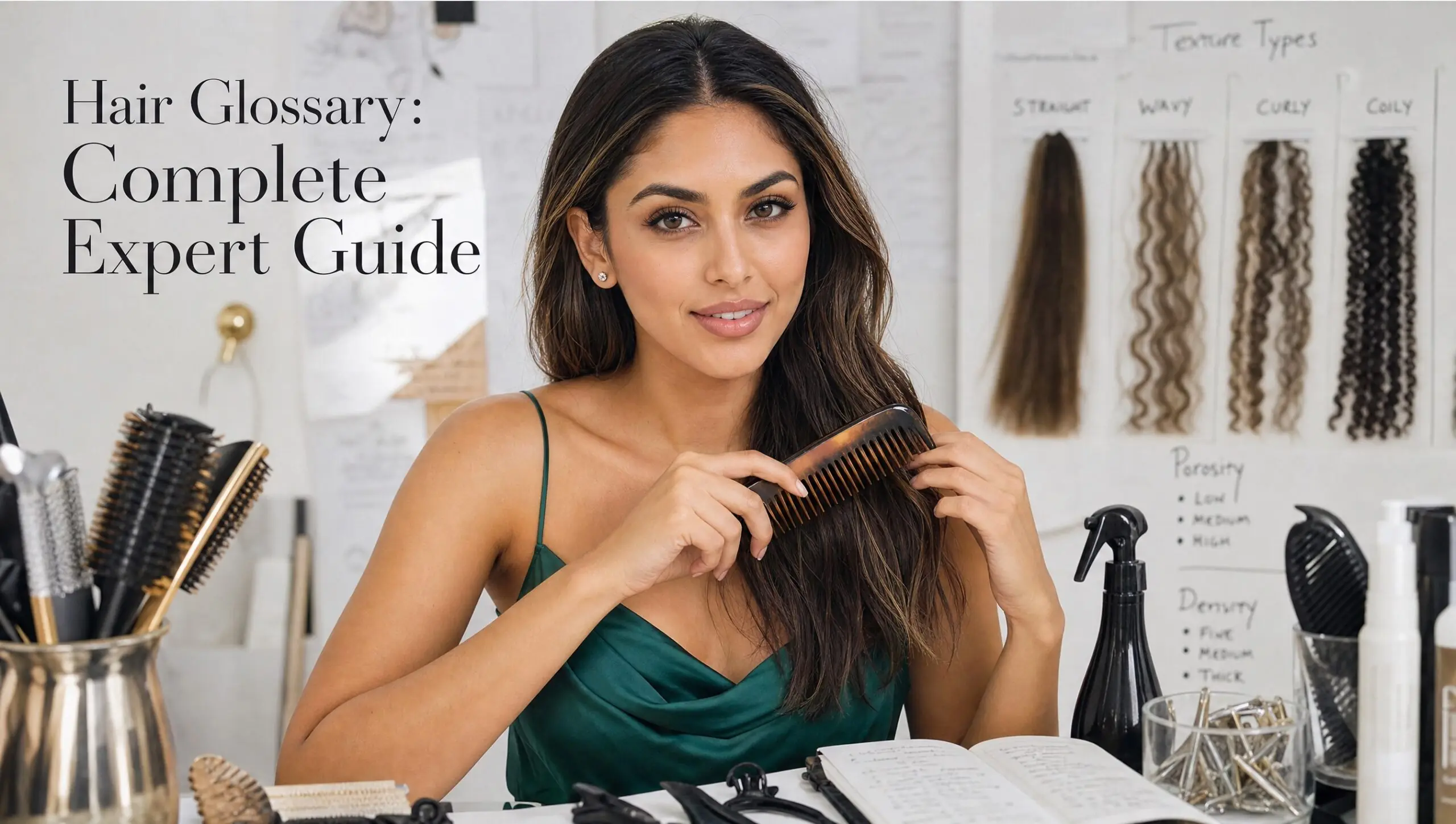
The most widely used hair classification system divides hair into four main types, each with subtypes labelled A, B, and C. Hairstylist Andre Walker developed this system, and the natural hair community has refined it further over the decades.
Type 1 hair is straight. It has no natural curl pattern. The hair lies flat from root to tip. Type 1A is very fine and limp with almost no body. Type 1B has more volume and slight bends. Type 1C is thick, resistant to styling, and tends to hold styles poorly without product. Straight hair gets oily faster than other types because sebum travels down the shaft without any curl bends to slow it.
Type 2 hair is wavy. It forms an S-shaped pattern when dry. Type 2A waves are loose and easy to straighten. Type 2B waves are more defined and prone to frizz. Type 2C hair has strong waves that behave like loose curls and resist smoothing. Wavy hair sits between straight and curly in terms of moisture needs.
Type 3 hair is curly. It forms definite, springy curls ranging from loose loops in Type 3A to tight corkscrews in Type 3C. Curly hair is more prone to dryness than straight hair because the curl bends make it harder for scalp oils to coat the entire strand from root to end.
Type 4 hair is coily. It has very tight curls or zigzag patterns. Type 4A coils are tight but defined. Type 4B hair has a sharper zigzag pattern with less definition. Type 4C hair has the tightest coils and the highest shrinkage rate, sometimes appearing up to 75 percent shorter than its actual stretched length. Coily hair is naturally the driest hair type and requires consistent moisture input and gentle handling to thrive.
Hair Porosity: The Key to Product Absorption
Hair porosity describes how easily your hair absorbs and retains moisture. It is determined by the condition of the hair’s cuticle layer, the outer protective shell made of overlapping scales, similar to roof shingles.
Low porosity hair has cuticles that lie flat and are tightly packed against each other. Moisture struggles to enter the shaft. Products tend to sit on top of the hair rather than absorbing it. People with low-porosity hair often notice product buildup and slow-drying strands. Gentle heat from a steamer or warm towel helps open the cuticle temporarily and allows moisture in. Lightweight, water-based products work best.
Medium porosity hair has a slightly raised cuticle that allows moisture in and holds it reasonably well. This is considered the ideal state. Products absorb easily, colour processes more evenly, and the hair holds styles with less effort. Regular maintenance keeps medium-porosity hair performing well.
High porosity hair has a raised or damaged cuticle layer. Moisture enters quickly but escapes just as fast, leaving hair feeling dry within hours of conditioning. High porosity often results from chemical processing, excessive heat, or genetics. Sealing with heavier oils and butters after moisturising helps lock in hydration. Cold water rinses after washing help press the cuticle down.
You can test your porosity with the float test. Drop a clean, product-free strand of hair into a glass of room-temperature water. Low porosity hair floats at the surface. Medium-porosity hair sinks slowly to the middle. High-porosity hair sinks quickly to the bottom.
Hair Density, Strand Thickness, and Elasticity
Hair density refers to the number of individual strands sitting on your scalp. Low-density hair has a visible scalp even without parting. High-density hair feels thick and full. Density affects how much product you need and which hairstyles work best, but it does not indicate health or damage.
Strand thickness is a separate measurement from density. Fine strands are narrow in diameter. They are delicate, prone to breakage, and weighed down easily by heavy products. They suit lightweight serums and foams rather than rich butters. Medium strands are average in diameter and respond well to most products and treatments. Coarse strands have the largest diameter. They are generally stronger but can resist colour and chemical treatments, often requiring longer processing times.
Elasticity describes how far a wet strand stretches before it snaps. Healthy hair stretches slightly when wet and returns to its original length without breaking. Low elasticity signals a protein deficiency or severe internal damage. The strand breaks immediately without any give. Good elasticity is one of the clearest signs of well-nourished, structurally sound hair.
Essential Hair Care Techniques Every Woman Should Know
Cleansing Methods: Shampoo, Co-Wash, and Clarifying
Shampooing uses surfactants to lift oil, dirt, and product buildup from the scalp and hair. The frequency of washing depends on hair type and scalp activity. Straight and fine hair types often need washing every one to three days because oil builds up quickly on smooth strands. Coily and curly hair types can go one to two weeks between washes without excessive buildup.
Co-washing means washing hair with conditioner only, skipping shampoo entirely. Conditioners contain mild cleansing agents that remove light buildup without stripping natural oils. Co-washing works best for Type 3 and Type 4 hair, which tends to be drier and more fragile when its natural oils are removed frequently. It is not ideal for fine or straight hair, which may feel limp and greasy without regular shampooing.
Clarifying shampoos contain stronger surfactants designed to remove heavy product build-up, mineral deposits from hard water, and excess oil that regular shampoos leave behind. Use them once or twice a month, not as a daily wash. Overuse strips the hair and scalp of beneficial natural oils and can leave hair feeling dry and brittle.
Low-poo shampoos are a middle-ground option. They contain sulphate-free or mild surfactants and cleanse gently. They work well for wavy and curly hair types that need more cleaning than co-washing provides but still want to preserve natural oils and curl definition.
Pre-Poo, Deep Conditioning, and Leave-In Conditioning
Pre-poo stands for pre-shampoo treatment. It is applied to dry hair before washing. The goal is to coat the strands with oil or conditioner before shampoo strips them. Coconut oil is the most popular pre-poo because its lauric acid structure allows it to penetrate the hair shaft and significantly reduce protein loss during washing. A 2003 study in the Journal of Cosmetic Science confirmed that coconut oil reduces protein loss in both damaged and undamaged hair when used as a pre-wash treatment. Pre-poo is especially valuable for type 3 and type 4 hair, which experiences significant water absorption and shaft swelling when wet, a process called hygral fatigue.
Deep conditioning applies a rich, penetrating conditioner to the hair for an extended time, usually 15 to 45 minutes. Deep conditioners contain higher concentrations of moisturising agents, proteins, or both compared to rinse-out conditioners. Heat from a processing cap or hooded dryer helps the conditioner penetrate the cuticle. Deep conditioning should happen at least once a week for high porosity, chemically treated, or very dry hair. Monthly deep conditioning is sufficient for healthy, low-maintenance hair types.
Leave-in conditioner is applied after washing and left in without rinsing. It provides ongoing moisture throughout the day, helps detangle, and forms the base of most multi-step styling routines for curly and coily hair. Lightweight spray leave-ins are suitable for fine and wavy hair. Thicker cream leave-ins suit coily and high-porosity hair.
Detangling Techniques That Prevent Breakage
Detangling removes knots and tangles from the hair. The method matters enormously. Aggressive or dry detangling causes significant breakage, especially in curly and coily hair types.
Finger detangling uses your fingers to gently separate knots before introducing a tool. It is the gentlest method available and allows you to feel resistance and adjust pressure before the hair snaps. It is especially recommended for Type 4 hair, where a comb applied too aggressively can break large sections at once.
Wide-tooth combs work through wet, conditioner-coated hair with far less friction than fine-tooth combs. Always detangle from the ends upward toward the root. Starting at the root and dragging a comb downward forces knots to compound and tear the strand.
Detangling brushes such as the Tangle Teezer or Denman brush have flexible bristles that flex through wet curly hair with less trauma than traditional paddle brushes. They are not suitable for dry or Type 4C hair without first saturating the hair with conditioner or water.
Heat Styling Tools and How to Use Them Safely
Flat Irons and Curling Irons: What You Need to Know
A flat iron, also called a straightening iron, presses the hair between two heated plates to create a smooth, straight finish. Plate material affects heat distribution and results. Ceramic plates distribute heat evenly and reduce hot spots that cause localised burning. Titanium plates heat up faster and maintain a consistent temperature across the entire plate, making them effective for thick or resistant coarse hair. Tourmaline plates emit negative ions that smooth the cuticle layer and reduce static and frizz during styling.
Temperature settings are critical for protecting hair from damage. Fine hair should never exceed 300 degrees Fahrenheit. Medium hair can handle 300 to 380 degrees. Coarse or very thick hair may require 380 to 410 degrees. Using temperatures higher than necessary causes cumulative thermal damage, which shows up as split ends, breakage, dullness, and permanent loss of curl pattern in wavy and curly hair.
Curling irons and curling wands create curls and waves. Barrel size determines the result. A half-inch barrel produces tight ringlets. A one-inch barrel creates classic, defined curls. A one-and-a-half-inch barrel makes loose, soft waves. Wands wrap hair freely around the barrel without a clamp, producing smoother results without the kink marks that clamp-style irons can leave.
Hair Dryers and Diffusers: Drying Without Damage
A hair dryer blows heated air over the hair to evaporate water. Ionic dryers emit negative ions that break down water molecules into smaller droplets for faster drying and reduced frizz. They are especially useful for thick, dense hair. Standard dryers emit positive ions, which can increase static and cause frizz in fine and porous hair types.
The concentrator nozzle attaches to the dryer and focuses airflow into a narrow stream. Use it during blowouts to smooth the hair while directing the airflow downward along the shaft. Pointing airflow from root to tip keeps the cuticle scales lying flat, which increases shine and reduces frizz in the finished style.
A diffuser is a wide, bowl-shaped attachment with prongs or finger-like projections. It disperses air gently and evenly around the hair without disturbing the natural curl clumps. Diffusing is the preferred drying method for Type 2, Type 3, and Type 4 hair because it enhances curl definition and reduces frizz compared to direct high-velocity airflow. Use medium heat and medium speed for best results. High heat with high speed breaks up curl clumps and causes frizz.
The cool shot button blasts room-temperature air to set a finished style. Using it at the end of a blowout or diffusing session closes the cuticle, increases shine, and extends how long the style holds before frizzing.
Heat Protectants: A Non-Negotiable Step Before Every Tool
Heat protectants create a barrier between the heat source and the hair shaft. Most work by coating the strands with film-forming ingredients that distribute strands more evenly across the strand rather than allowing them to concentrate in one spot and cause burning.
Common heat protectant ingredients include dimethicone and cyclomethicone. These silicones coat the strand and provide the primary thermal barrier. Some formulas include hydrolysed proteins that strengthen the hair during the styling process. Argan oil is a popular natural option. It withstands moderate heat up to around 420 degrees Fahrenheit and adds shine while protecting the cuticle.
Heat protectants are available as sprays, creams, and serums. Sprays suit fine hair because they apply lightly without weighing strands down. Creams and serums suit thicker, coarser hair that needs heavier coverage. Apply to damp or dry hair before styling, depending on the product instructions. Apply to every section that will contact a heated tool. Skipping this step, even for a quick touch-up, causes cumulative damage that compounds over weeks and months.
Hair Glossary: Decoding Ingredients on Product Labels
Sulfates, Silicones, and Parabens Explained
Sulphates are anionic surfactants that create lather and remove dirt and oil from the hair and scalp. Sodium lauryl sulphate (SLS) is the most common and the harshest. It strips natural oils aggressively, which causes dryness and scalp irritation in sensitive individuals. Sodium laureth sulphate (SLES) is a slightly gentler version. Sulphate-free formulas use milder surfactants such as cocamidopropyl betaine or sodium cocoyl isethionate, which cleanse without stripping the hair of its natural lipid layer.
Silicones are synthetic polymers that coat the hair shaft. They add slip, shine, and smoothness. Water-soluble silicones such as dimethicone copolyol rinse out easily with regular shampoo. Non-water-soluble silicones such as dimethicone require a sulphate-containing shampoo to fully remove. When non-water-soluble silicones build up on the strand, they block moisture from getting into the cuticle, which makes the hair drier over time, especially in high porosity and curl-prone hair types.
Parabens are preservatives, including methylparaben and propylparaben, that extend product shelf life by preventing bacterial and mould growth. Consumer concern around their potential hormonal activity has pushed many brands to adopt alternatives like phenoxyethanol or sodium benzoate. The debate continues in research communities, but paraben-free formulations are now standard across most major hair care lines.
Proteins: Keratin, Biotin, and Hydrolyzed Varieties
Hair is composed primarily of a protein called keratin. Approximately 95 percent of each hair strand is made up of keratin chains linked together by disulphide and hydrogen bonds. Chemical processes, heat, and mechanical friction break these bonds, causing weakness, frizz, and breakage. Keratin treatments and many conditioning products add keratin back to the hair to fill gaps in damaged strands, reinforce the shaft, and reduce frizz and porosity.
Biotin is a B vitamin (B7) frequently associated with hair and nail strength. In topical products, biotin coats the strand and adds temporary thickness to individual strands. Its most significant impact on hair comes from addressing a biotin deficiency through dietary supplements, which can cause noticeable thinning. Topical biotin in shampoo does not penetrate the follicle and therefore cannot influence hair growth at its source. Healthy individuals without a deficiency are unlikely to see dramatic results from biotin supplementation.
Hydrolysed proteins are large protein molecules broken into smaller fragments through chemical or enzymatic processes. The smaller the fragment, the deeper it can penetrate into the hair shaft. Hydrolysed keratin, hydrolysed silk, and hydrolysed wheat protein are the most common examples found in conditioners and treatments. They strengthen weak spots and reduce breakage from within the strand. Overusing protein treatments without sufficient moisture leads to protein overload, making hair feel stiff, brittle, and prone to snapping with minimal force.
Natural Oils, Butters, and Humectants
Natural oils serve different functions depending on their molecular weight and fatty acid composition. Lightweight oils such as argan oil, grapeseed oil, and jojoba oil absorb into or along the hair shaft easily and add shine without heaviness. They suit fine and medium hair types. Heavier oils such as castor oil coat the shaft and act as sealants rather than penetrators. They work best layered over a water-based moisturiser.
Coconut oil is unique in hair oils. Its lauric acid structure allows genuine penetration into the hair cortex rather than sitting on the surface. Multiple peer-reviewed studies have shown it reduces protein loss during washing more effectively than most other oils tested. It works best for medium- and high-porosity hair. Low porosity hair may find coconut oil sits on top and contributes to buildup rather than providing moisture.
Humectants attract and bind water molecules from the surrounding environment to the hair shaft. Glycerin, aloe vera, and panthenol (provitamin B5) are the most common. They help hair retain moisture and stay hydrated between wash days. In very dry climates or low-humidity conditions, humectants can pull moisture out of the hair shaft itself rather than from the air, causing increased dryness. Layering an oil or butter over humectant-rich products seals moisture in and prevents this effect.
Shea butter and mango butter are thick emollients that coat the hair and scalp with a protective, occlusive layer. They slow moisture evaporation and add softness. They are most effective for Type 3 and Type 4 hair, which needs heavier sealants to maintain hydration. Fine or straight hair types should avoid butters on the hair shaft, as they can cause greasiness and weigh strands flat.
Professional Hair Treatments Decoded
Keratin Treatments, Smoothing Services, and Japanese Straightening
Keratin treatments are in-salon smoothing services that infuse the hair with keratin protein. A stylist applies a formula to clean, dry hair, then flat-irons it at high heat to bond the keratin to the cuticle. Results last eight to twelve weeks depending on hair type and how often it is washed. The hair becomes smoother, frizz-free, and faster to style at home.
Brazilian blowouts are a specific type of keratin treatment with a different formulation. They typically allow washing sooner after the service than traditional keratin treatments. Some earlier formulations contained formaldehyde at levels that raised occupational health concerns for salon workers. Most reputable brands now offer formaldehyde-free versions that use alternative bonding agents to achieve similar results.
Japanese straightening, also called thermal reconditioning or rebonding, is a permanent straightening process. It uses chemicals to break the hair’s natural disulphide bonds and heat to reform them in a straight configuration. The results are permanent in the treated hair until new growth appears at the root. It cannot be reversed, and applying it to already chemically processed or bleached hair carries a high risk of severe damage and breakage.
Bond-Building Treatments: Olaplex, K18, and How They Work
Olaplex is a patented bond-building system first introduced in 2014. Its active ingredient, bis-aminopropyl diglycol dimaleate, identifies and reconnects broken disulphide bonds within the hair’s cortex. Disulphide bonds are the structural links that hold the hair’s keratin protein chains together. Bleaching and colouring processes break these bonds as a side effect of lightening, causing weakness, elasticity loss, and increased porosity.
Unlike conditioning treatments that coat the exterior of the hair, Olaplex works from the inside out. It can be added to bleach or colour formulas during processing to minimise damage in real time. It is also used as a standalone treatment before or after chemical services. Several competing bond-building technologies have launched since 2014, including K18, Wellaplex, and Redken’s pH-Bonder. Each uses a different mechanism but shares the core goal of repairing internal hair structure.
K18 is a notable newer entrant. It uses a biomimetic peptide that mimics the natural keratin chain structure to reconnect broken bonds within the cortex. It works in as little as four minutes without heat activation. Unlike Olaplex, which is rinsed out, K18 is left in the hair as a treatment. It has gained rapid popularity in professional salons as an add-on service and as a consumer at-home product.
Color Treatments: Key Terms You Will Hear at the Salon
Highlights are sections of hair lightened with bleach or high-lift colour to create contrast against the natural or base colour. Traditional foil highlights isolate specific sections precisely. Balayage is a freehand lightening technique where colour is painted directly onto the hair surface in sweeping strokes without foils. The result is softer and more natural-looking, with a gentler grow-out line compared to foil highlights.
Ombré is a gradient technique where hair transitions from a darker shade at the roots to a lighter shade at the ends. Toning follows lightening services to neutralise unwanted warm tones. Bleached hair typically pulls orange or yellow, depending on its natural pigment level. Toners deposit complementary pigments to cancel these tones. Purple pigment neutralises yellow. Blue pigment neutralises orange. Most toners are semi-permanent and fade gradually over four to eight weeks.
Gloss treatments add shine and subtle tone without lifting the hair’s natural colour. They deposit a clear or tinted coating over the cuticle and last three to five weeks. A clear gloss adds shine and smoothness to any hair type. A tinted gloss can refresh faded colour or enhance natural tone without committing to a full colour service.
Scalp Health and Hair Growth Terminology
The Four Phases of the Hair Growth Cycle
Every hair follicle operates on a continuous growth cycle with four distinct phases. The anagen phase is the active growth phase. Each strand spends two to seven years in anagen, growing at approximately half an inch per month. Genetics determine the length of this phase and therefore set your maximum potential hair length. Around 85 to 90 percent of your hair is in the anagen phase at any given time.
The catagen phase is a brief transitional phase that lasts two to three weeks. Growth stops and the follicle begins to shrink and detach from its blood supply. The telogen phase is the resting phase, lasting about three months. The hair strand remains anchored in the follicle but does not grow. Approximately 10 to 15 percent of your hair is in telogen at any time.
The exogen phase is the shedding phase, where the resting strand releases from the follicle to make room for new anagen growth. Losing 50 to 100 hairs per day is entirely normal. Telogen effluvium occurs when a physical stressor, illness, hormonal change, or severe nutritional deficiency pushes an abnormally large number of follicles into telogen simultaneously. Noticeable shedding typically appears two to four months after the triggering event and usually resolves once the cause is addressed.
Common Scalp Conditions and Their Names
Dandruff, clinically termed seborrhoeic dermatitis, produces white or yellowish flakes on the scalp and hair. It results from an overgrowth of a yeast-like fungus called Malassezia, which is present on all scalps but becomes problematic when it grows in excess. Medicated shampoos containing zinc pyrithione, ketoconazole, or selenium sulphide are effective first-line treatments used regularly to control symptoms.
Dry scalp is distinct from dandruff. Dry scalp produces smaller, lighter flakes and results from dehydration or over-washing rather than fungal overgrowth. The scalp often feels tight and itchy. Reducing shampoo frequency and using hydrating scalp oils or serums addresses dry scalp effectively.
Scalp psoriasis produces thick, silvery, adherent scales and results from an autoimmune response that dramatically accelerates skin cell turnover on the scalp. It requires targeted medical treatment and should be assessed by a dermatologist. Traction alopecia is hair loss caused by chronic tension on the hairline and follicles from tight styling. It affects the temples and edges most commonly and can become permanent if tension continues long-term without rest.
Scalp Treatments, Serums, and Hair Growth Actives
Scalp serums are leave-on treatments applied directly to the scalp to address specific concerns. Minoxidil is the most clinically validated topical treatment for androgenic alopecia in women. It is available over the counter at 2 percent or 5 percent concentrations. It works by widening blood vessels around follicles and extending the anagen growth phase, resulting in thicker, longer strands over time. Results typically appear after four to six months of consistent use.
Peptide serums use short amino acid chains to signal follicles to support hair retention and growth. Caffeine serums have received interest for their potential to block dihydrotestosterone (DHT), a hormone linked to follicle miniaturisation in patterned hair loss. Research is promising but limited, and caffeine is not yet established as a standalone treatment for significant hair loss.
Rosemary oil has attracted significant attention as a natural alternative. A study published in Skinmed found that rosemary oil performed comparably to 2 percent minoxidil in promoting hair growth over a six-month period. It is thought to work by improving microcirculation in the scalp. Diluted in a carrier oil and massaged into the scalp several times a week, it is a low-risk, accessible option for those seeking natural support.
Styling Products, Cutting Terms, and Finishing Vocabulary
Hold Levels, Gels, Creams, and Mousses
Styling products are categorised by their hold level: light, medium, firm, and maximum. Light-hold products add texture and soft definition without stiffness or crunch. They suit straight and wavy hair for everyday wear. Firm and maximum hold products lock a style in place and resist humidity throughout the day. They are the choice for structured updos, sleek buns, or defined curls that must last from morning to evening.
Gel is a water-based product that provides firm hold and curl definition. In the curly hair community, gel is applied generously over soaking-wet hair and left to dry into a firm cast over each curl. Once fully dry, the cast is scrunched and broken to reveal soft, defined, frizz-free curls underneath. This is called the “gel cast” method. Look for gel formulas that include moisturising ingredients such as aloe vera alongside the hold polymers to prevent the drying effect that alcohols in some gels can cause.
Hair mousse is a foam-based product that adds volume and definition with a lighter feel than gel or cream. It is particularly effective for fine wavy hair that gel or cream would flatten. Curl cream is a heavier, moisturising styler that defines curls without crunch. It suits Type 3 curls well. Custards are thick, gel-cream hybrids used widely in Type 4 coily hair routines for maximum moisture, definition, and hold in one step.
Salon Cutting Techniques: A Quick Reference
A blunt cut creates a straight, clean line at the ends. All the hair is cut to a single length. This cut works well for fine hair because the blunt edge creates the visual impression of thickness and fullness at the ends.
Layers remove weight and add movement by cutting sections of hair at different lengths. Face-framing layers soften the look around the face. Long layers maintain length while preventing flatness at the crown. Layers can be inappropriate for very thin or fine hair, which can look even less dense when layered.
A dusting trims only the very tips of the hair, removing less than a quarter inch. It eliminates split ends without detectable length loss. A deva cut is a curl-specific technique performed on dry, unstyled hair. Each curl is cut individually to respect and enhance the natural pattern, rather than cutting all hair to one length when wet. A wet cut can result in uneven lengths once curls shrink and spring back to their natural shape.
Thinning shears have one serrated blade and are used to remove bulk from thick hair without reducing overall length. They should be used sparingly on curly or coily hair because they can create uneven sections within curl clumps, leading to frizz and disrupted definition.
Finishing Products: Serums, Oils, and Hairspray
Hair serum is a silicone-based liquid applied to dry or damp hair to smooth frizz, add shine, and control flyaways. Apply it only to the mid-lengths and ends. Using it near the scalp creates a greasy appearance. A small amount, roughly the size of a pea for fine hair or two peas for thicker hair, is sufficient. Rubbing it between palms before applying ensures even distribution.
Finishing hair oil adds polish to styled hair and seals dry ends. Argan oil is the most widely recommended finishing oil for its lightweight texture, high vitamin E and fatty acid content, and strong shine-enhancing properties. It suits all hair types when used sparingly. Marula oil is another lightweight option with excellent absorption and a silky feel. Both can be applied to damp hair before diffusing or to dry hair as a final polish.
Hairspray holds a finished style in place. Flexible-hold hairsprays allow movement and are brushable after drying. Firm-hold varieties lock a style rigidly and resist humidity. Most hairsprays contain polymers that coat the strand in a thin, setting film. Overuse of hairspray creates buildup that makes hair feel stiff and dull. A clarifying shampoo used once or twice a month removes accumulated hairspray residue effectively.
Frequently Asked Questions
What is the difference between hair type and hair texture?
‘Hair type’ refers to the curl pattern of the hair, classified on the Type 1 through Type 4 scale. Hair texture refers to the diameter of each individual strand, described as fine, medium, or coarse. You can have type 4 coily hair with fine-diameter strands or type 1 straight hair with coarse-diameter strands. Both factors determine which products and techniques work for you. Fine strands are easily weighed down and benefit from lightweight liquid formulas. Coarse strands resist absorption and work better with richer, heavier products. Understanding both gives you a far more accurate framework for building your routine than the type alone.
What does it mean when a shampoo is labelled ‘sulphate-free’?
A sulphate-free shampoo replaces harsh cleansing agents like sodium lauryl sulphate with gentler surfactants. The result is a milder cleanse that removes dirt and light buildup without stripping the hair’s natural oils. This is particularly beneficial for colour-treated hair, curly and coily hair types, and people with sensitive or reactive scalps. One trade-off is that sulphate-free formulas do not remove heavy silicone buildup as effectively as traditional shampoos. If you use products containing non-water-soluble silicones regularly, incorporate a clarifying shampoo into your routine once or twice a month to prevent accumulation.
How do I know if my hair needs more moisture or more protein?
Wet a single strand and stretch it gently. Healthy hair stretches slightly, roughly 30 percent of its length, and then returns to its original shape. If it stretches far before breaking, your hair has too much moisture relative to protein. Add a protein-rich treatment and scale back deep moisturising conditioners temporarily. If the strand snaps immediately with almost no stretch, your hair needs moisture urgently and is over-proteinated. Add deep moisturising treatments and avoid additional protein until elasticity improves. If your hair feels gummy or mushy when wet, this also signals too much moisture and insufficient protein. Adjust over several wash days and observe how the hair responds before making further changes.
Can heat-damaged hair be repaired?
Heat damage permanently alters the internal disulphide bond structure of the affected strands. When high heat permanently straightens a naturally curly or wavy pattern, no topical product can restore that pattern to the same strand. However, bond-building treatments like Olaplex and K18 can meaningfully improve the strength, elasticity, and overall feel of heat-damaged hair by reconnecting broken bonds that remain repairable. Deep conditioning and protein treatments support the structural integrity of what remains. For long-term recovery, most stylists recommend gradually trimming the damaged sections while protecting new growth from further heat exposure. Using heat tools at the correct temperature and applying a quality heat protectant consistently prevents ongoing damage from accumulating.
What is traction alopecia, and how is it prevented?
Traction alopecia is hair loss caused by repeated tension applied to the hairline, temples, and edges. It develops gradually from wearing consistently tight hairstyles, including braids, weaves, high ponytails, buns, and tight cornrows. The follicles experience chronic stress and eventually become damaged or destroyed in the affected area. Early signs include soreness, small bumps, and thinning or missing hair along the hairline. Prevention requires varying hairstyles regularly, avoiding styles that feel tight or painful, keeping protective styles loose enough to move freely, and giving the hairline rest periods between styles. Caught early, traction alopecia is often reversible. Chronic long-term tension can cause permanent follicle damage that does not respond to regrowth treatments.
Conclusion
Understanding the language of hair care transforms every product you buy and every service you book. You now have the vocabulary to read labels critically, choose the right tools, and build a routine that genuinely matches your hair type, porosity, and goals. The most important takeaways from this guide are these: identify your hair type and porosity first, because they determine which ingredients and methods will actually work for your strands. Balance moisture and protein consistently to keep hair strong, elastic, and resistant to breakage. Protect your hair from heat with appropriate temperatures, quality tools, and a heat protectant applied every single time without exception. Give your scalp the same attention as your lengths and ends, because strong hair growth begins at a healthy follicle. Trim regularly so that split ends do not travel up the shaft and undermine the length you have worked to grow.
Your next steps are straightforward. Start by testing your porosity with the float test at home. Audit your current products for silicone type and sulphate content. Book a consultation with a stylist who specialises in your hair type. Introduce one new treatment or technique at a time so you can accurately assess what is and is not working. When you speak the language of hair care fluently, every decision becomes simpler, more confident, and far more effective.
RELATED ARTICLES:
How to Achieve Perfect, Voluminous Hair: A Comprehensive Guide
MOB WIFE HAIR: HOW TO GET THE VOLUMINOUS, LIVED-IN LOOK EVERYONE’S OBSESSING OVER
Glass Hair in 2026: The Products and Techniques for a Frizz-Free, Mirror-Like Finish That Lasts
Trim Split Ends Regularly for Healthier, Stronger Hair: The Exact Schedule That Works
5 Hair Mistakes While Sleeping
About The Author

COMMENTS