
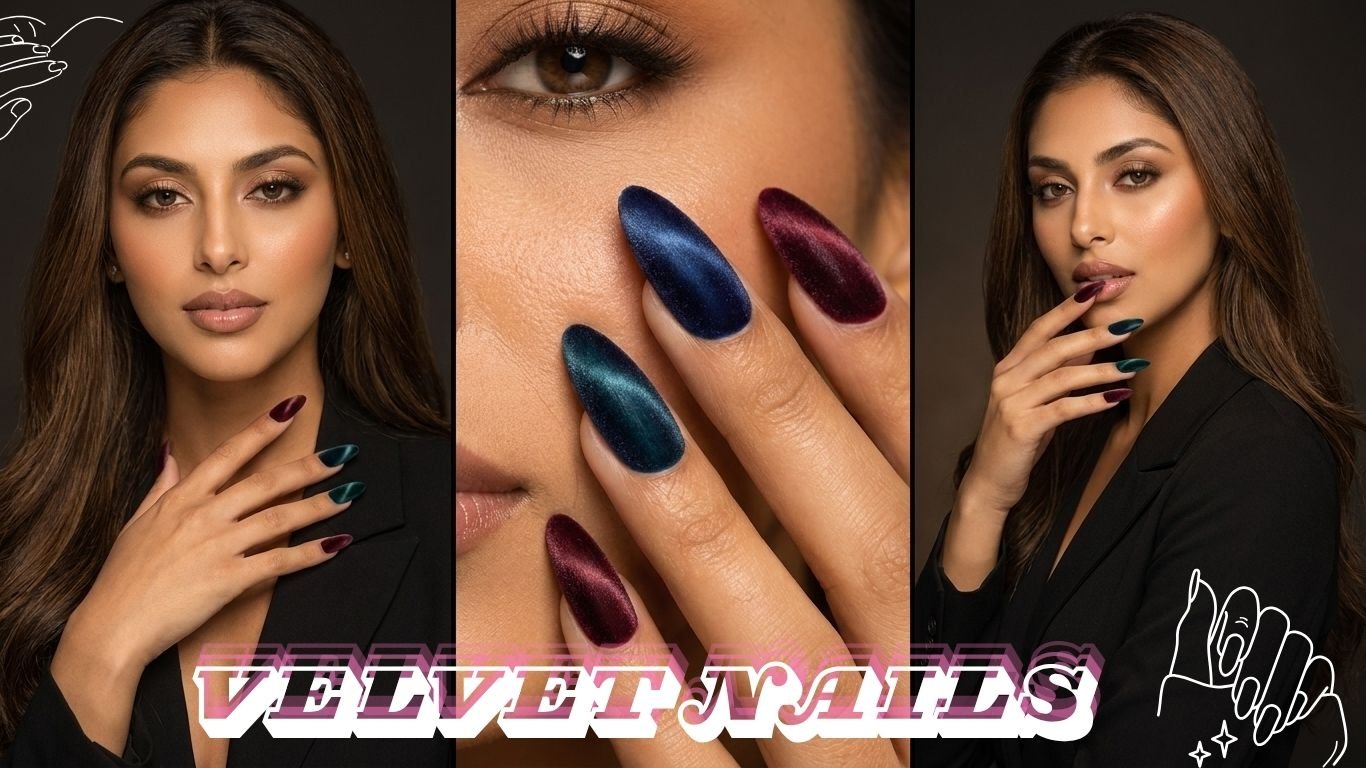
Velvet nails are the magnetic cat-eye manicure that turned the 2026 nail conversation on its head, trading the high-shine chrome obsession of the last
Velvet nails are the magnetic cat-eye manicure that turned the 2026 nail conversation on its head, trading the high-shine chrome obsession of the last three years for a softer, fabric-like finish that actually moves with the light. The look uses iron-flake gel polish and a small magnet to pull a ribbon of shimmer across the nail, mimicking the way crushed velvet catches a lamp. This guide breaks down what the finish actually is, why it spiked on Pinterest and runway boards in early 2026, who the shade family flatters, how to do it at home without ruining the effect, what salons charge, the mistakes that turn the finish flat, and the six questions readers keep asking before they book the appointment.
This guide was reviewed by the BeautynFacts editorial team. Last updated: June 2026.
What Velvet Nails Actually Are (and Why They’re Trending in 2026)
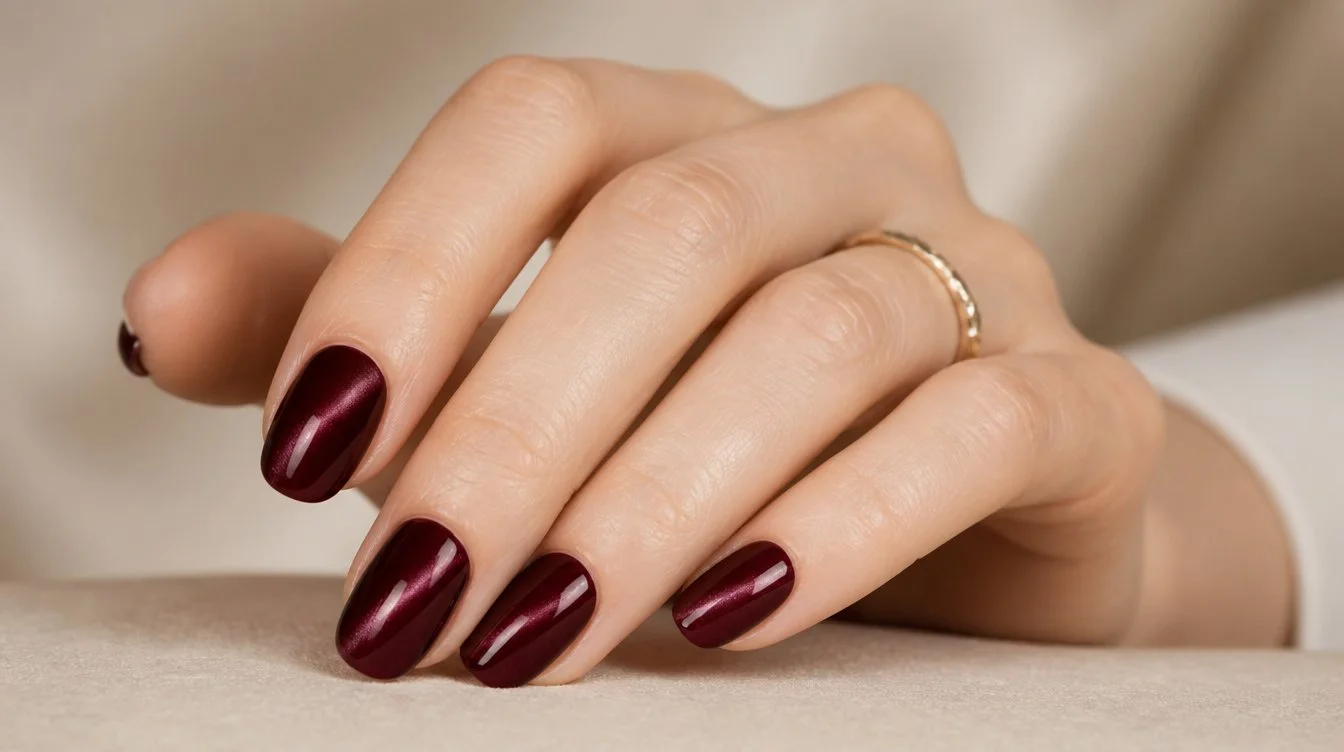
Velvet nails are a gel manicure built on a magnetic polish loaded with tiny iron-flake particles. While the gel layer is still wet, a small handheld magnet sits a few millimetres above the nail and pulls those flakes toward one edge before the lamp cures them in place. The result is a directional shimmer that pools like a brushstroke through crushed velvet or raw silk, not the flat mirror you get with chrome powder. The body of the colour stays rich and saturated, the highlight rides on top like a ribbon, and the whole finish reads matte-adjacent until light hits the angle. That contrast between deep bass and floating sheen is the entire point of the look.
The trend caught fire because it solved a fatigue problem. Chrome had been the dominant gel finish since 2023, and it was starting to look generic on every grid. Velvet nails kept the high-end nail-art feel without the harsh reflection; they photographed beautifully in low light and worked on short almond, soft square, and long coffin shapes equally well. Spring 2026 runways at Khaite, Tory Burch, and a handful of Seoul shows put the finish on models in deep burgundy and espresso, and within two weeks the Pinterest search graph for the term doubled.
The Numbers Behind the Velvet Nails Boom
Pinterest’s spring 2026 trend report flagged “velvet manicure” as one of its three fastest-rising beauty searches of the season, climbing roughly five times its winter baseline. TikTok hashtags around the magnetic cat-eye finish crossed the billion-view mark by April, with the bulk of the engagement landing on shade-comparison videos and at-home tutorials. Salon menus that added a velvet upcharge in January reported the option being booked in roughly one of every four gel appointments by March, which is a faster menu adoption curve than Chrome saw in its first quarter back in 2023.
Editorial coverage followed the social signal. By February, Vogue, Allure, and Harper’s Bazaar had all run dedicated explainers on the finish, and bridal magazines started featuring deep-jewel velvet as an alternative to the classic glossy red. The look also benefited from the broader “quiet luxury” mood in beauty, which favours textured neutrals and gemstone tones over loud neons and graphic art. Velvet sits naturally in that lane, which is why it has moved past the trend cycle phase faster than aura nails or jelly nails did.
Who Velvet Nails Flatter (and Who Should Adapt the Look)
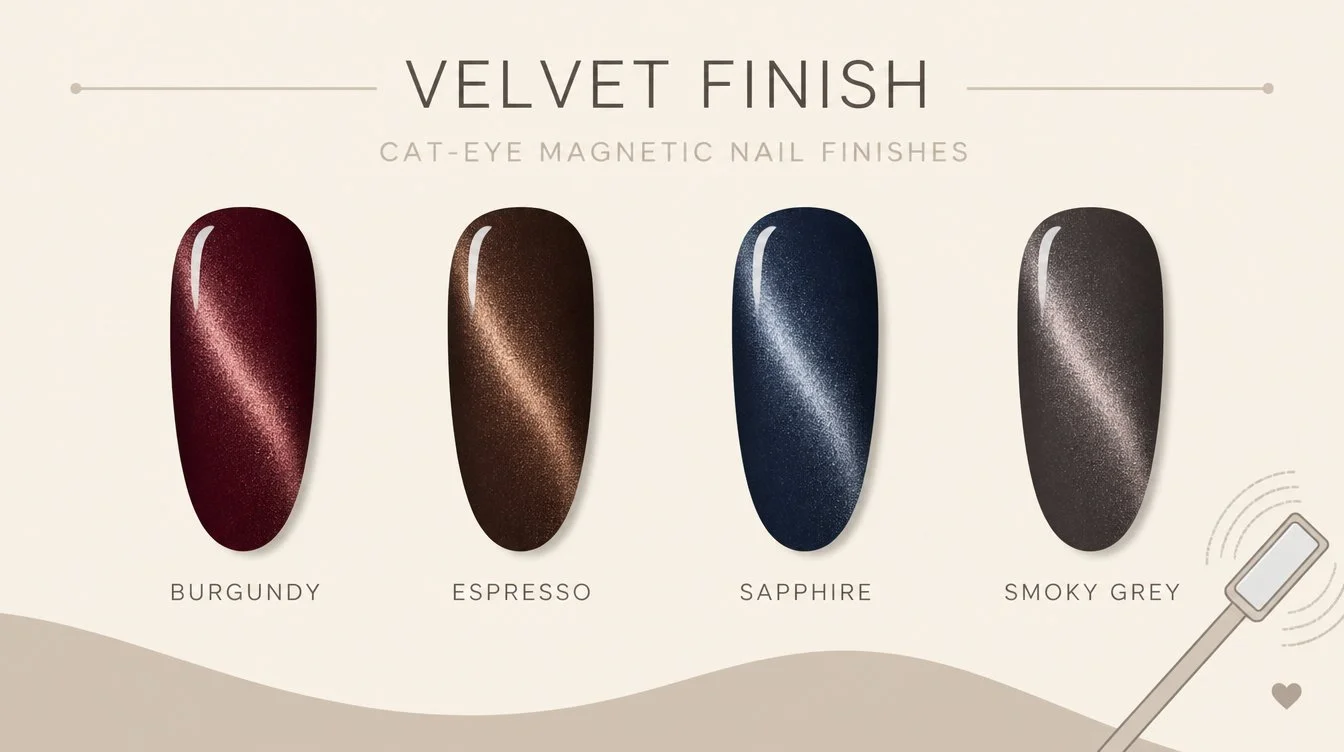
The shade family does most of the work here, and the good news is that the velvet finish flatters a wider undertone range than chrome does. Deep burgundy and espresso brown read beautifully on medium-to-deep skin tones with warm or neutral undertones because the soft sheen catches the same warmth in the skin and bounces it back as a glow rather than a glare. Sapphire and smoky grey velvet works strongly on cool undertones across the depth range since the cool base anchors the look, and the sheen reads as silver rather than gold.
For very fair, cool-toned skin, a full-coverage espresso can swallow the hand visually, so a softer plum velvet or a dove-grey velvet keeps the contrast gentle. For very deep skin, burgundy and emerald velvet sit gorgeously, while a true black velvet can feel heavy and is better as an accent nail rather than ten across the board. Nail shape also matters. Velvet nails look most luxe on medium-length almond, soft square, and short coffin shapes because those silhouettes give the shimmer ribbon room to travel. On very short, rounded natural nails the cat-eye effect compresses and can look more like a smudge than a sheen, so a slightly longer free edge of even two millimetres helps the finish breathe.
How to Get Velvet Nails at Home: Step by Step
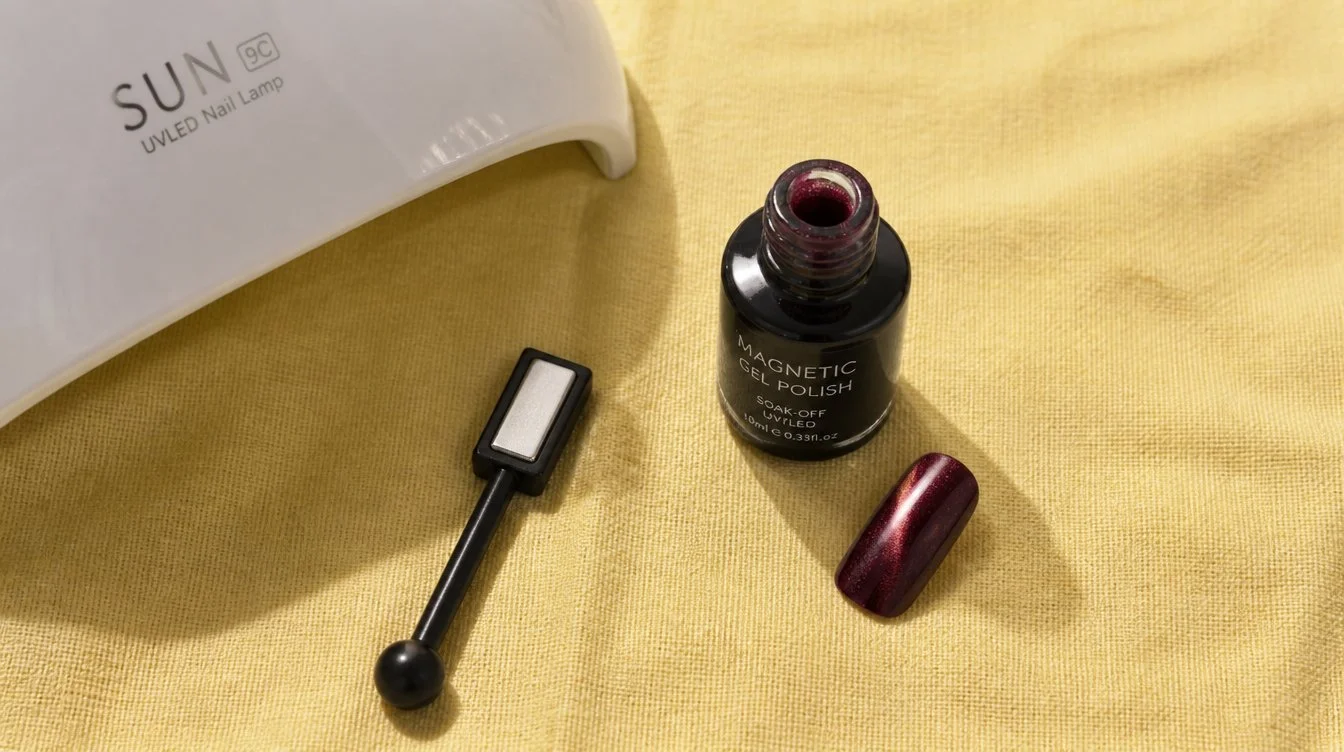
The at-home version is entirely doable if you already own a UV or LED lamp. You need magnetic gel polish (the bottle usually says “cat-eye” or “magnetic”), a base coat, a no-wipe top coat, and the small bar magnet that ships with most of these polishes or sells separately for under five dollars. Skip any step here and the finish goes flat.
- Prep the nail. Push back cuticles, lightly buff the surface to break the shine, and wipe with a lint-free pad and alcohol. Magnetic gel needs a clean, slightly textured base or the iron flakes will not sit evenly.
- Apply a thin base coat and cure for the time on the bottle, usually 30 to 60 seconds in an LED lamp. A thick base coat is the most common reason the magnet effect fails.
- Paint the first thin coat of magnetic gel. Cure fully. This layer is just for colour depth, not the effect.
- Paint the second, slightly thicker coat. Do NOT cook yet.
- While that coat is wet, hold the magnet two to three millimetres above the nail at the angle you want the shimmer to land. Hold steady for ten to fifteen seconds. Most people angle it diagonally across the nail for a classic cat-eye band or vertically down the centre for a spine effect.
- Without moving the nail, slide it into the lamp and cure it with the magnet pulled away just before the light comes on. A cure for the full bottle of time?
- Repeat the wet-coat-plus-magnet step on each nail one at a time. Do not try to magnetise multiple nails at once, or the wet polish will pool.
- Finish with a no-wipe top coat and a final cure. Wipe the cuticle area with cuticle oil to soften the edge.
The Salon / Pro Version
A pro technician will give you a cleaner cat-eye band because they control the magnet angle with practised hands and can hold it at the exact distance the gel brand calls for. They will also build the base in thinner coats than most home users, which lets the iron flakes lie flatter and produces a sharper highlight. Salons that have been doing chrome for years are usually the fastest at adopting velvet, since the prep is nearly identical.
Expect to pay the standard gel manicure base price plus an upcharge for the magnetic finish. In most Indian metros, that offers the full service between roughly INR 1,500 and INR 3,500 depending on the salon tier, with high-end studios charging more. In the US, the same service usually runs USD 55 to USD 95 for a full set on natural nails and USD 85 to USD 150 if you are adding extensions or builder gel for length. Bridal and editorial appointments price higher and often bundle a cuticle treatment and nail art accents.
Common Velvet Nails Variations to Try in 2026
Burgundy velvet is the default that started the trend and still photographs best in low-light dinner-table conditions. It works year-round but peaks in autumn and winter when the deep red reads as warm jewellery on the hand.
Espresso brown velvet is the quiet luxury favourite. The brown base reads almost neutral from a distance, and the shimmer ribbon only reveals itself when the light moves, which is exactly the kind of subtle finish that fits the broader minimalist mood of 2026.
Sapphire and emerald velvet are the saturated jewel options. They photograph dramatically and are popular for evening events, bridal mehendi looks, and party season. The cool base flatters silver rings and white-gold jewellery.
Smoky grey velvet is the modern alternative to a classic nude. It reads as a sophisticated neutral while still giving you the textured finish, and it sits well with office dress codes that would never tolerate burgundy.
Cherry-cola velvet is the late-spring twist, a brown-red hybrid that splits the difference between burgundy and espresso. It has been the breakout shade on Pinterest boards labelled “old money manicure” since March.
What to Avoid: Mistakes That Kill the Look
A thick gel layer is the biggest killer of the cat-eye effect. The magnet can only pull the iron flakes through a certain depth of polish, so a thick coat traps half of them in the base, and the highlight reads muddy. Fix: two thin coats, not one thick one.
Curing before you apply the magnet defeats the entire technique. Once the gel sets, the flakes are locked in random positions. Fix: apply the second coat, magnetise, then cure.
Moving the magnet during the hold blurs the highlight. Even a small wobble smudges the ribbon. Fix: rest your elbow on the table and hold for the full ten to fifteen seconds.
Using a magnet that is too far from the nail produces a weak, washed-out shimmer. Fix: keep it at roughly two to three millimetres, not five. Some bottle caps have a built-in magnet on top to help you gauge the distance.
Skipping a no-wipe top coat dulls the finish within a day. Fix: always seal with a glossy no-wipe top coat designed for gel.
Overfiling the surface during prep removes too much of the natural nail and weakens the bond. Fix: a light buff is enough to break the shine, not a full grind.
Products That Actually Work for Velvet Nails
Look for a gel polish bottle that lists “cat-eye”, “magnetic”, or “9D effect” on the label. The pigment load should be high enough that the colour reads opaque in two coats, and the iron-flake density should be visible when you swirl the bottle. A weak magnetic polish looks like glitter in suspension; a strong one looks almost metallic when you tilt it.
Your magnet matters more than people assume. A flat bar magnet gives you the classic horizontal cat-eye band. A double-ended magnet (one flat side, one curved) lets you switch between band and spine effects without buying two tools. Stronger neodymium magnets pull the flakes faster, which helps if your gel cures quickly under a powerful LED lamp.
For the lamp itself, a 48-watt or 54-watt dual-source LED-plus-UV lamp is the sweet spot for home users. It cures gel evenly without flash-curing the polish before the magnet has done its work. Cheaper 36-watt lamps work, but you need to extend the cure time. Pair everything with a high-shine no-wipe top coat, since matte top coats kill the velvet effect entirely and a wipe top coat removes the inhibition layer that protects the shimmer.
Velvet Nails vs Chrome Nails: How to Choose
Chrome and velvet often get lumped together because both rely on metallic-looking particles, but they produce very different finishes. Chrome is a powder rubbed over a cured black or coloured gel base, and it produces a hard mirror reflection that catches every overhead light. The finish is flat and even and reads as polished metal. Velvet is a one-bottle magnetic gel, and the finish is directional and soft, with a single highlight ribbon riding through a deeper base colour.
Choose chrome if you want maximum impact in bright light, plan to photograph the nails head-on, or like the futuristic edge. Choose velvet nails if you want a softer, more wearable finish that reads luxe in restaurant lighting, holds up better under natural daylight, and pairs with quiet-luxury outfits rather than statement looks. Velvet also tends to age more gracefully on the nail because as it grows out, the regrowth line is less obvious than the hard edge a chrome finish leaves behind.
How Long Velvet Nails Last on Nails
As a gel finish, velvet nails wear roughly two to three weeks before the first lift shows at the cuticle or free edge. The shimmer itself does not fade because the iron flakes are sealed under the top coat and protected from oxygen and water. What kills the look first is regrowth, which becomes visible at the cuticle around day ten if you have fast-growing nails.
Compared with chrome, velvet hides chips and small dings slightly better because the directional shimmer draws the eye to the highlight rather than the damage. Compared with regular gel, velvet wears about the same. Top coat reapplication at day seven extends the high-shine finish by another week, and a cuticle-oil routine twice daily slows the lift at the base.
How Long the Velvet Nails Trend Will Stay Relevant
Velvet is more likely to hold than fade. Looking at the trajectory of Chrome (which has dominated for three full years) and Glazed Doughnut (which held the top spot for roughly eighteen months), Velvet has the same combination of low technical barrier for salons, photographable results, and wide shade flexibility that lets a finish settle into the permanent menu rather than spike and crash. The Pinterest search graph for the term flattened upward in late spring rather than dropping, which is the signal trend forecasters watch for staying power.
The honest forecast: expect Velvet to remain a default gel option through 2026 and into 2027, with the dominant shade rotating from burgundy in winter to espresso and smoky grey through spring, sapphire and emerald in summer, and back to burgundy and cherry cola for autumn. The technique will get absorbed into the broader nail-art lexicon the same way chrome did, layered under French tips, mixed with rhinestone accents, and used as a base for negative-space art.
Frequently Asked Questions About Velvet Nails
What are velvet nails, and how are they different from chrome nails?
Velvet nails are a gel manicure that uses a magnetic polish loaded with iron-flake particles. A small magnet pulls those flakes into a directional ribbon of shimmer before the gel cures, creating a soft, fabric-like sheen that looks like crushed velvet. Chrome nails use a different process: a fine metallic powder is rubbed over a cured gel base to produce a hard mirror reflection. The short version is velvet reads soft and directional; chrome reads flat and reflective. Both last roughly two to three weeks as gel manicures.
Can I get velvet nails at home without a magnet?
No, the magnet is what creates the cat-eye effect. Without it, the iron flakes in the polish stay randomly distributed, and the finish just looks like a slightly shimmery gel, not the directional velvet sheen. The good news is that most magnetic gel polishes ship with a small bar magnet included, and a standalone magnet costs under five dollars from any nail supply site. Any flat magnet strong enough to pick up a paperclip from two centimetres away will work, but a purpose-built nail magnet gives you the cleanest result.
How long do velvet nails last?
A velvet gel manicure lasts roughly two to three weeks on most nails, which is the standard wear time for any gel finish. The shimmer itself does not fade because the iron flakes sit sealed under a top coat. What ends the look first is regrowth at the cuticle, which becomes visible around day ten if your nails grow quickly. To stretch wear, reapply a no-wipe top coat at day seven and oil the cuticles twice a day. Soak-off removal at a salon prevents the damage that picking causes.
What colours work best for velvet nails in 2026?
The five shades doing the heaviest lifting in 2026 are burgundy, espresso brown, sapphire, emerald, and smoky grey. Burgundy is the year-round default and reads luxe in any light. Espresso is the quiet luxury favourite for office and minimalist wardrobes. Sapphire and emerald are the saturated jewel tones for evening, bridal, and party looks. Smoky grey is the modern neutral that works as a sophisticated alternative to nude. Cherry-cola, a brown-red hybrid, is the breakout shade of late spring and the one trending hardest on Pinterest right now.
Are velvet nails safe for natural nails?
Velvet nails are no more damaging than any other gel manicure when applied and removed correctly. The risks are the same as with standard gel: over-buffing during prep can thin the nail plate; peeling the gel off rather than soaking it removes layers of natural nail; and skipping cuticle care leads to dryness. The magnetic polish itself uses the same cured-gel chemistry as any other coloured gel and does not contain anything more aggressive. Book proper soak-off removal at a salon, oil cuticles daily, and take a one-week break between sets if you wear gel continuously.
How much do velvet nails cost at a salon?
In Indian metros, a full velvet gel manicure typically costs between INR 1,500 and INR 3,500 depending on the salon tier, with high-end studios charging more for extensions or nail art. In the US, the same service usually runs USD 55 to USD 95 for a full set on natural nails and USD 85 to USD 150 if you are adding builder gel or extensions for length. The magnetic finish is almost always charged as an upcharge of roughly USD 10 to USD 20 over the standard gel base price, since it takes a few extra minutes per nail.
Related Articles
- Glazed Donut Nails: The 2026 Pearlescent Manicure
- Aura Nail Art: The Soft Airbrushed Manicure Trend
- Rich Girl Manicure: The Quiet-Luxury Nail Look
About The Author

COMMENTS