






The 2026 Skin Streaming Routine: A Smarter Minimal Skincare System That Actually WorksSkin streaming routine is the antidote to a bathroom shelf crowd
The 2026 Skin Streaming Routine: A Smarter Minimal Skincare System That Actually Works
Skin streaming routine is the antidote to a bathroom shelf crowded with 12 serums you never finish. This 2026 skin streaming routine strips your regimen back to a few multitasking formulas that calm your barrier, save money, and still deliver visible results.
If you’ve ever looked at your shelf and thought, “Why do I own 12 serums… and my skin still feels irritated?” you’re not alone. In 2026, the biggest skincare flex isn’t owning more products; it’s getting better results with fewer steps. That’s exactly what a skin streaming routine is designed to do: streamline your routine to the essentials, protect your skin barrier, and use actives more intelligently so your skin can actually tolerate them.
Here’s the thesis: consistency beats complexity. When you cut out the “maybe” products and keep only what your skin needs daily, you reduce irritation, save time, and make progress easier to track.
In practice, people don’t fail skincare because they’re lazy. They fail because the routine is too complicated to repeat, especially when travel, weather, stress, and busy schedules hit. This guide will help you build a skin-streaming routine that’s beginner-friendly, advanced-ready, and climate-adaptive, plus we’ll streamline hair, makeup, lips, and nails for a complete “minimal but polished” beauty system.
“The best routine is the one you can repeat daily without irritating your skin.”
What Is a Skin-Streaming Routine, and Why Is It Everywhere in 2026?
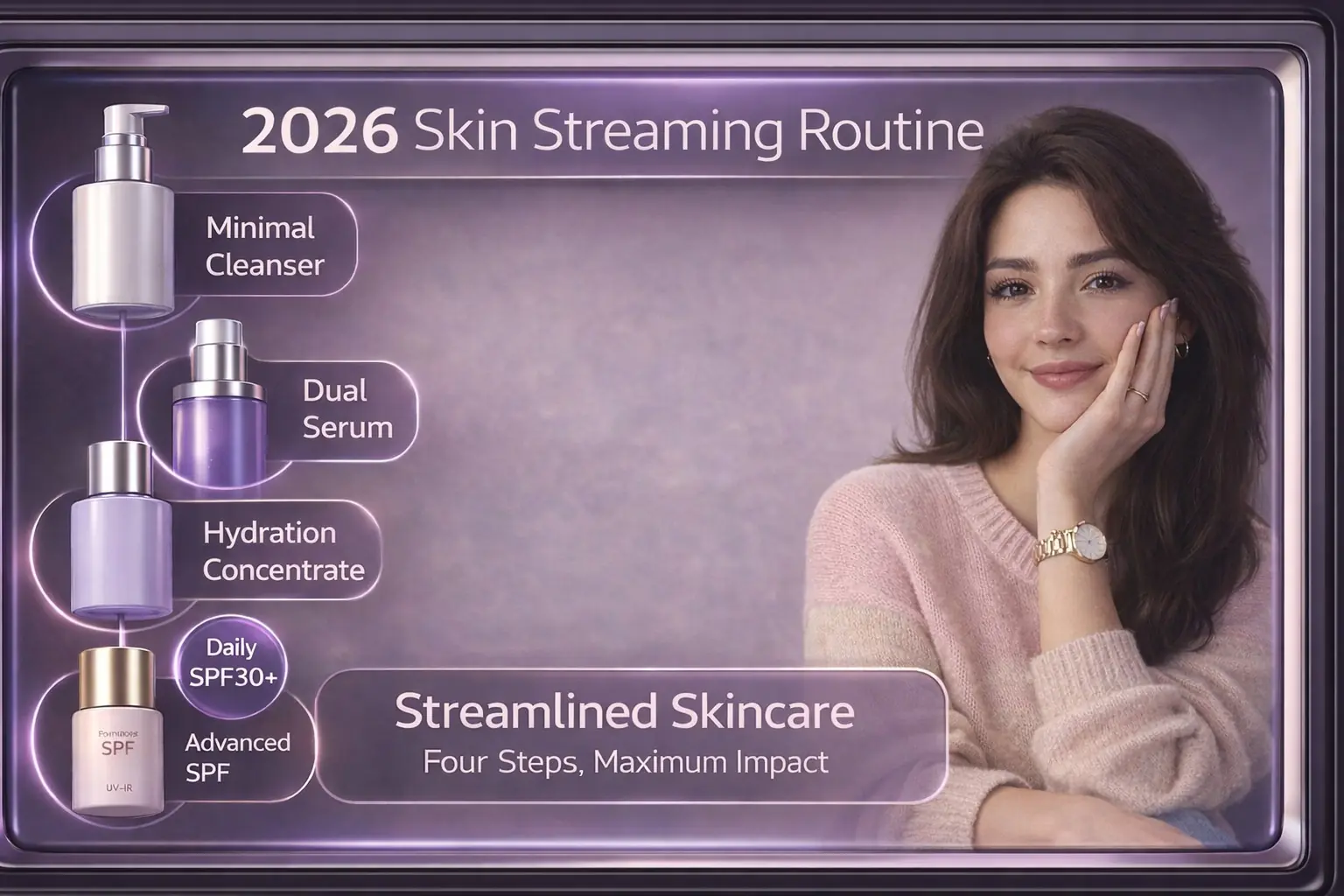
A skin-streaming routine means reducing skincare to a tight, curated set of steps using fewer, smarter products that cover multiple needs rather than layering a long list of single-purpose formulas.
What it is:
Published · Updated
- Not “skincare fasting” (doing nothing)
- Not “all-natural only”
- There is no universally applicable routine.
Skin steaming vs. skin flooding vs. 10-step routines
Skin flooding focuses on layering hydration (often hyaluronic acid-heavy) in multiple steps, useful in certain dehydrated phases but easy to overdo if you’re acne-prone or already irritated.
10-step routines can work for some people, but many end up with barrier damage from too many actives or frequent exfoliation (especially when trends go viral).
Quick Takeaway (for scanners):
Skin streaming = fewer steps + better consistency + stronger barrier + smarter actives.
Skin streaming is a response to over-complicated routines and irritation from overuse.
“Most irritation isn’t ‘mysterious sensitivity’; it’s too many products too often.”
The 2026 Shift: From “More Products” to “More Resilience”
The 2026 trend layer is simple: barrier resilience is the new glow. That’s why you’re seeing the rise of skinimalism and streamlined routines in mainstream beauty coverage.
Here’s what’s driving it:
- Beauty burnout: People are tired of 45-minute routines and product fatigue.
- Smarter multitaskers: Better formulation science means one product can hydrate + brighten + support the barrier.
- Higher environmental stress: UV, pollution, and climate extremes make “protect and repair” more important than ever.
- New essentials go mainstream: hypochlorous acid sprays for calm, portable SPF for reapplication, and simplified retinoid strategies.
If your skin stings with “gentle” moisturiser, don’t add more soothing products. Subtract triggers first.
“A routine should fit your life, not the other way around.”
Skin Barrier 101: The Science That Makes Skin Streaming Work
Think of your skin barrier like a brick wall:
- The “bricks” are skin cells.
- The “mortar” is a mix of lipids (ceramides, cholesterol, and fatty acids).
When the mortar gets stripped by over-cleansing, harsh exfoliation, or too many actives, water escapes, irritants get in, and you end up with the following:
- Tightness that feels “dry”
- Redness, burning, or stinging
- Sudden acne flare-ups or rough texture
This is why skin streaming works so well: fewer steps means fewer chances to disrupt that wall.
The sensitization cycle (why “more actives” backfires)
A common pattern:
- Breakout or dullness appears
- You add more acids, more retinoids, more masks.
- Barrier breaks → inflammation rises
- Skin gets worse → you panic-buy more products
If your skin is reactive, the fastest path to glow is often barrier repair + consistent SPF, not stronger actives.
Core barrier-support ingredients (minimal but powerful):
- Ceramides
- Glycerin
- Petrolatum (at night for very dry skin)
- Panthenol
- Niacinamide (if tolerated)
“Barrier strength is the foundation; actives are the decoration.”
The STREAM Framework: Build Your Skin Streaming Routine in 10 Minutes
Here’s the method I use to “audit” routines quickly:
S Set your goal (pick 1 primary and 1 secondary)
Examples:
- Primary: acne control | Secondary: dark spots
- Primary: hydration | Secondary: fine lines
- Primary: glow | Secondary: texture
T-Trim to the Core³
Your Core 3 is
- Cleanse (gentle, not stripping)
- Treat (one focused active)
- Protect (sunscreen in the morning)
Reduce friction (make it easy)
If your routine isn’t easy, you won’t do it.
- Put products where you’ll use them.
- Choose textures you enjoy.
- Avoid 8-step layering
Evaluate compatibility
Do not stack multiple strong actives daily in a minimal routine.
- Retinoid + exfoliating acid + strong vitamin C = often too much
A Add one “booster” only if truly needed
Boosters are optional:
- Azelaic acid
- Niacinamide
- Barrier serum
- Spot treatment
Maintain for 28 days before changing
Skin needs time. Changing every week prevents progress.
A perfect skin-streaming routine is boringly consistent.
“Your routine should be simple enough that you can do it half-asleep.”
Your AM skin-streaming routine is tailored according to your skin type.
Your morning routine should do two things:
- Support the barrier
- Defend against UV and pollution
AM Core Steps (everyone)
- Gentle cleanse (or rinse)
- Treat (optional, based on goal)
- Moisturize (as needed)
- Sunscreen (non-negotiable)
Now customise:
Oily / acne-prone (AM)
- Cleanser: gentle gel
- Treat: niacinamide or azelaic acid (if tolerated)
- Moisturizer: lightweight gel-cream
- SPF: fluid or gel SPF
Example: If you’re oily, skip heavy occlusives in the morning. Your “glow” should come from hydration + SPF, not grease.
Dry/dehydrated (AM)
- Cleanser: creamy or milky
- Treat: hydrating serum (glycerin-based) or mild vitamin C derivative
- Moisturizer: ceramide-rich
- SPF: moisturizing SPF cream
Sensitive / redness-prone (AM)
- Cleanser: ultra-gentle (or just water)
- Treat: minimal, maybe none for 2 weeks
- Moisturizer: fragrance-free barrier cream
- SPF: mineral or hybrid if tolerated
Combination/normal (AM)
- Cleanse lightly
- Treat: vitamin C (if tolerated)
- Moisturize lightly
- SPF daily
Featured snippet-friendly answer:
AM skin-streaming routine = cleanse (or rinse); one treatment max; moisturise if needed; and sunscreen every day.
“Most anti-ageing is just daily sun protection done consistently.”
Your PM Skin Streaming Routine (Including Retinal vs. Retinol)
Night is for repair + targeted treatment. In 2026, a lot of routines succeed with a “two-night rhythm”:
The beginner-friendly two-night rhythm
- Night A: Treatment night (retinoid OR exfoliant)
- Night B: Recovery night (barrier repair only)
This keeps things minimal and dramatically lowers irritation risk.
Retinal vs retinol in a skin-streaming routine
Retinal (retinaldehyde) is often positioned as a “next-gen” retinoid that converts to retinoic acid in fewer steps than retinol. Some clinical and editorial dermatology sources discuss it as faster-acting and effective while still being tolerable when introduced correctly.
Clinical example data: A 2025 cosmetics journal study of an anhydrous 0.1% retinal formula reported high user satisfaction (e.g., 81% reporting improved appearance) with improvements in photoaging signs and tolerability.
How to choose (minimal decision rule):
- Choose retinol if you’re very sensitive or new and want gentler progression.
- Choose retinal if you want stronger results in fewer steps and can commit to slow introduction.
PM skin streaming template
- Cleanse
- Treatment (retinoid OR azelaic acid OR exfoliant – pick one category)
- Moisturize (barrier cream)
- Optional: occlusive on dry zones (only if needed)
Comparison table: Minimal retinoid options (streaming-friendly)
OptionBest forSpeed to Results Irritation risk: minimal-routine fit. Retinol beginners, sensitive medium Retinal-experienced beginners: texture/pigmentation faster, medium excellent (with recovery nights) Prescription retinoids for severe acne/photoaging are the fastest, highest possible, but needs guidance
“Retinoids work best when your barrier can tolerate them. Start slower than you think.”
Skin Streaming Routine for Top Concerns (Dark Spots, Acne, Texture, Anti-Aging)
This section is where minimal routines become powerful because you stop “stacking everything” and start aiming.
1) Hyperpigmentation + glow strategy
Minimal “brightening stack” (choose one primary):
- Vitamin C (AM) or
- Azelaic acid (AM/PM) or
- Retinoid (PM)
Support:
- Daily SPF (the real pigment prevention tool)
Consistent sunscreen use helps prevent dark spot recurrence and slows visible aging.
If you’re treating dark spots, do not judge progress week-to-week. Measure at 8-12 weeks.
2) Acne + inflammation strategy (streamlined)
A minimal acne routine is about the following:
- Reducing inflammation
- Keeping pores clear
- Protecting the barrier
A 2026-friendly add-on is hypochlorous acid (HOCl) for calming irritated, reactive, or acne-flaring skin, especially after workouts, masks, or over-exfoliation.
Simple acne PM options (pick one):
- Retinoid nights + recovery nights
- Salicylic acid 2x/week + recovery nights
- Azelaic acid daily if tolerated
3) Fine lines + firmness strategy
Minimal anti-ageing is
- SPF daily
- Retinoid at night (slow build)
- Barrier support so you can stay consistent
Real-world example (case-style):
A 34-year-old with “dullness + texture” drops 9 products and keeps cleanser + moisturiser + SPF + retinol twice weekly. After 6 weeks: less stinging, smoother texture, makeup sits better, and there are fewer flare-ups.
“If your routine causes redness, you’re not ‘purging’; you’re inflaming.”
Skin Streaming + Skin Cycling (Advanced, Low-Irritation Progress)
If skin streaming is “minimal steps”, skin cycling is “minimal irritation through rotation”.
Skin cycling generally means rotating actives (like exfoliating acids and retinoids) with recovery nights focused on hydration and barrier repair, often to reduce irritation from daily actives.
When cycling helps
- You get dry, flaky, or stinging from daily retinoids
- You want exfoliation benefits without barrier damage.
- Your skin is acne-prone but reactive
A streaming-friendly 4-night cycle (minimal version)
- Night 1: Exfoliation (AHA or BHA)
- Night 2: Retinoid (retinol/retinal)
- Night 3: Recovery (barrier only)
- Night 4: Recovery (barrier only)
Repeat.
Cycling is not about doing more; it’s about doing activities less often but more consistently.
Warning signs you’re doing too much
- Burning on application
- Peeling that doesn’t stop
- New widespread redness
- Breakouts that worsen after 4–6 weeks
“The best schedule is the one your skin can tolerate for months.”
Climate-Adaptive Skin Streaming (Humidity, Pollution, High UV, Travel)
In 2026, “one routine year-round” is outdated for many people because climate and environment change your skin’s behaviour. Climate-adaptive beauty and climate-responsive skincare are increasingly discussed as a major direction in product development and consumer routines.
Hot/humid climates: keep it light and clean.
- Lighter moisturizer textures
- Non-comedogenic SPF
- Rinse sweat promptly
- Avoid heavy occlusives in AM
Cold/dry climates: protect the barrier
- Cream cleanser
- Barrier moisturizer (ceramides)
- Occlusive on dry zones at night
Urban/pollution exposure: defend + repair
- Antioxidants (vitamin C if tolerated)
- Gentle cleansing at night
- Consistent SPF
SPF gels vs. sticks vs. serums (reapplication in real life)
Global suncare trend reporting highlights portable, hygienic reapplication formats and cosmetic hybrids (tints/primers with SPF) as growing areas, especially for reapplying over makeup.
Simple rule:
- SPF gel/fluid = best daily base for oily climates
- SPF serum is a good option for individuals with dry to normal skin who dislike heavy sunscreen.
- SPF stick = best for quick reapplication (but apply enough and evenly)
If you use a stick, do multiple passes and don’t miss the hairline, sides of the face, and nose bridge.
“Your sunscreen is only as effective as your reapplication habits.”
Streamlined Beauty Beyond Skin: Hair, Makeup, Lips, and Nails (Minimal Works Here Too)
Skin streaming pairs perfectly with the wider 2026 beauty vibe: effortless, polished, and breathable.
Hair routine: a frizz control routine that ensures frizz-free curly hair.
A minimal hair routine can be the following:
- Cleanse: scalp-focused shampoo
- Condition: mid-lengths to ends
- Style: one leave-in (for frizz control) + one optional sealant oil
Split ends trimming schedule: If you heat-style often, trim every 8–12 weeks; if minimal heat, 12–16 weeks works for many.
Makeup tips (including makeup for glasses)
Minimal makeup that looks great with glasses:
- Light base (or SPF tint)
- Concealer only where needed
- Curl lashes + mascara (smudge-resistant)
- Soft brow definition
- Cream blush for “alive” skin
Lip oils vs. lip gloss and anti-ageing lip care
- Lip oil provides conditioning, has a lighter shine, and is great for daily use.
- Lip gloss: high shine, sometimes stickier, great for events
Anti-ageing lip care basics:
- SPF on lips in the day (lip SPF)
- Balm at night
- Avoid licking lips (worsens dryness)
Stronger, healthier nails + manicure/pedicure basics
Minimal nail routine:
- Cuticle oil 3–4x/week
- Gentle filing (one direction)
- Hand cream nightly
- Gloves for cleaning chores
Minimal beauty isn’t “doing nothing”. It’s doing the few things that compound.
“A minimal routine looks premium when your basics are high quality.”
Common Mistakes + Troubleshooting (Why Minimal Routines Fail)
Most “skin streaming doesn’t work” stories come down to a few predictable mistakes.
Mistake 1: Swapping products too fast
If you change 3 things at once, you’ll never know what helped.
Fix: Change one variable every 2-4 weeks.
Mistake 2: Mixing incompatible actives
Common irritation combos:
- Strong exfoliant and retinoid on the same night
- Multiple acids daily
- Overusing “tingly” products
Fix: Separate activities using recovery nights (streaming + cycling).
Mistake 3: Confusing purging with irritation
Purging is typically limited to areas you normally break out in and usually stabilises.
Irritation is burning, redness, and worsening sensitivity.
Fix: Pause actives, repair the barrier, and reintroduce slowly.
Troubleshooting map (fast)
- Dry/flaky: reduce exfoliation, add barrier moisturizer, consider occlusive at night
- New breakouts: check heavy products, hair products touching face, and sunscreen compatibility
- For stinging, temporarily remove fragrance and active ingredients, and simplify your routine to include only cleansing, moisturising, and SPF.
“When in doubt, return to your basics for a period of 7 days.”
The 30-Day Skin Streaming Reset Plan (With Tracking)
If you want this to actually stick, treat it like a reset, not a makeover.
Week 1: The Baseline (calm first)
AM: cleanse/rinse → moisturizer → SPF
PM: cleanse → moisturizer
That’s it.
Week 2: Add one treatment (choose based on goal).
- Acne: azelaic acid or salicylic acid (limited frequency)
- Glow/pigment: vitamin C (AM) or azelaic acid
- Anti-aging/texture: retinoid (PM, 2 nights/week)
Week 3: Build rhythm (treatment + recovery)
- 2 treatment nights
- 5 recovery nights (or 1 exfoliation + 1 retinoid + recovery)
Week 4: Optimize (only if stable)
- Increase treatment frequency slightly if no irritation
- Consider one booster (only if needed)
Tracking (simple but powerful):
- Weekly photo in the same lighting
- A 1/10 score for comfort (tightness, sting)
- breakouts, sleep, stress, cycle
CTA: Save this guide and commit to the 30-day reset before buying anything new. Your skin will tell you what it truly needs.
FAQ
Q1: What is a skin-streaming routine?
A1: A simplified routine using only essentials to cleanse, treat (one active), moisturise, and protect without excessive layering.
Q2: Is skin streaming good for acne?
A2: Yes, when it prioritises gentle cleansing, barrier support, and a single acne treatment used consistently.
Q3: Skin streaming vs. skin flooding: what’s the difference?
A3: Streaming minimises steps, flooding layers with hydration products. Flooding can help dehydration, but streaming is better for consistency and irritation control.
Q4: Can I use a retinal or retinol in a skin-streaming routine?
A4: Yes, use one retinoid on treatment nights and add recovery nights to reduce dryness and irritation.
Q5: How long until I see results?
A5: Many people notice comfort improvements in 1–2 weeks, but visible texture/pigment changes often take 6–12 weeks.
RELATED ARTICLES:
Skincare-infused makeup: Why your 2026 foundation should double as a serum
5 Skincare Trends to Watch Out for in 2026
Climate-Adaptive Skincare: Build a Weather-Proof Skin Care Routine
Skin Streaming 2.0: The Skin Care Blueprint for Faster Results, Stronger Barrier, and Less Clutter
2025 Skincare Revolution: Morning & Evening Routine to Achieve Flawless Skin
About The Author

COMMENTS