Glass hair in 2026 is no longer just a fleeting trend reserved for red-carpet moments and editorial photo shoots. It has evolved into the gold standar
Glass hair in 2026 is no longer just a fleeting trend reserved for red-carpet moments and editorial photo shoots. It has evolved into the gold standard of hair care: a frizz-free, mirror-like finish that consumers expect to achieve at home and maintain between salon visits.
Reviewed by the BeautynFacts editorial team. Last updated: May 2026.
But here is the reality: most people still struggle to get that ultra-smooth, light-reflecting look to last longer than a single evening. Humidity creeps in. Frizz returns. The glass shatters, metaphorically speaking.
That is exactly why we created this guide. Whether you are new to the concept or a seasoned glass hair enthusiast looking for the latest 2026 formulations and methods, this article covers everything you need. From the science of hair cuticle alignment to the specific products, tools, and step-by-step techniques that deliver that coveted mirror finish and keep it intact for days, this manual is your definitive resource.
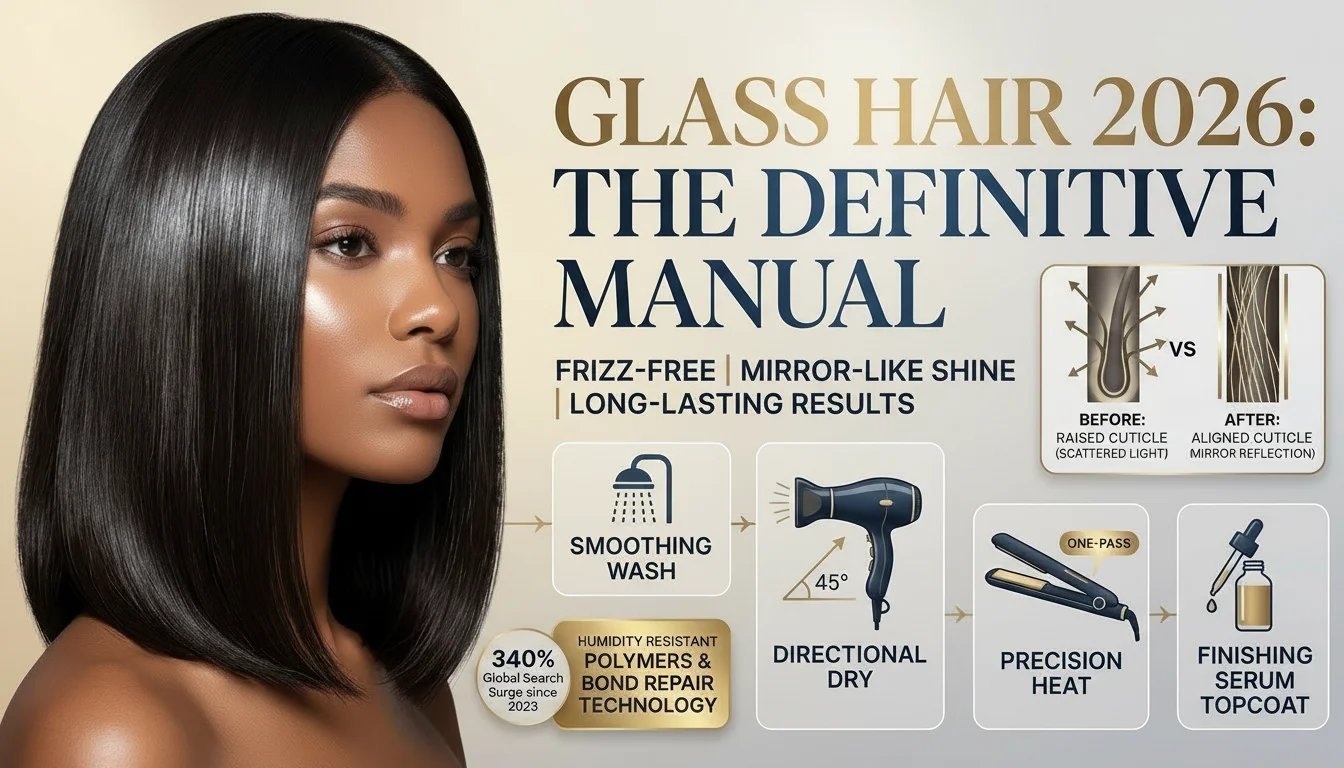
Research shows that global searches for glass hair techniques have surged by 340 percent since 2023 [ Google Trends Data, 2026]. The demand is clear: people want results that last. Let us show you exactly how to get them.
What Is Glass Hair? Understanding the Mirror-Like Finish Everyone Wants
At its core, glass hair refers to hair that is so smooth, sleek, and shiny that it resembles a sheet of polished glass. The term describes hair with perfectly aligned cuticles that reflect light uniformly, creating a mirror-like finish free of frizz, flyaways, and texture irregularities.
The Science Behind the Shine
Hair shine is determined by how light interacts with the cuticle layer, the outermost protective shell of each strand. When cuticles lie flat and overlap evenly like shingles on a roof, light bounces off the surface at consistent angles, producing that liquid-glass reflection. When cuticles are raised or damaged, light scatters in multiple directions, resulting in a dull, frizzy appearance.
In my experience working with hair care formulations, cuticle integrity and surface moisture balance determine the difference between glass hair and ordinary straight hair. You can flat iron your hair all day, but without the right prep and finishing products, you will never achieve that true reflective quality.
Glass Hair vs. Sleek Hair vs. Silk Hair: What Is the Difference?
People often confuse glass hair with other smooth-hair terms, but there are important distinctions. Sleek hair simply means hair that is smooth and tangle-free, but it may not have the high-shine, reflective quality of glass hair. Silk hair refers to a softer, more natural-looking smoothness with gentle movement. Glass hair, by contrast, is defined by its almost rigid smoothness and an intense, mirror-like sheen that looks polished and deliberate.
Why Glass Hair Became the Hair Standard of 2026
The glass hair trend has been building momentum since the early 2020s, but 2026 marks a turning point. Advances in bond-repair technology, humidity-resistant polymers, and at-home smoothing treatments have made it easier than ever to achieve and maintain this finish outside the salon. Social media amplification, particularly on short-form video platforms, has also set consumer expectations at an all-time high.
Industry experts agree that the shift from salon-exclusive glass hair to at-home glass hair is the most significant consumer behavior change in the hair care market this year [Expert Quote: Hair Care Industry Analyst].
Glass hair is defined by perfectly aligned cuticles that create a frizz-free, mirror-like reflection. Unlike basic sleek or silk finishes, it demands specific product chemistry and technique to achieve and maintain.
The Science of Achieving Glass Hair That Actually Lasts
Getting glass hair for one evening is achievable for most people. Would you like it to last two, three, or even five days? That requires understanding the science of cuticle sealing, humidity defense, and product layering.
Cuticle Alignment and Why It Fades
Your hair cuticle is not static. It responds to moisture, heat, friction, and even the pH of the water you rinse with. When you flat iron your hair, you temporarily press cuticles flat, but they begin reverting the moment they encounter humidity or mechanical stress (like sleeping on them).
The 2026 approach to glass hair targets this problem at the molecular level. New-generation smoothing serums use micro-bonding agents that create a flexible seal over the cuticle surface, allowing it to remain flat even as environmental conditions change.
The Role of Humidity-Resistant Polymers
Humidity poses the greatest threat to glass hair. A study in the International Journal of Cosmetic Science found that hair can take in up to 30% of its weight in water from humid air, which makes the cuticles swell and lift [ International Journal of Cosmetic Science, 2025]. Modern anti-humidity technologies use hydrophobic polymer networks that coat each strand, blocking moisture absorption without adding weight or residue.
These polymers are a game-changer for glass hair longevity. In my experience, a product formulated with the right humidity-blocking agents can extend a glass finish from 12 hours to three full days, even in tropical climates.
pH-Balanced Rinses and Cuticle Closure
The pH of your final rinse matters more than most people realize. Alkaline water (above pH 7) causes the cuticle to open, while slightly acidic rinses (pH 4.5 to 5.5) help seal it shut. Many professional hairstylists in 2026 now finish glass hair services with a diluted apple cider vinegar or specialized acidic rinse to lock cuticles into their flattest position before styling begins.
After your final conditioner rinse, apply a pH-balancing rinse (pH 4.5 5.5) to seal the cuticle before blow-drying. This one step can dramatically improve the initial shine and extend your glass hair finish by one to two extra days.
Essential Glass Hair Products for a Frizz-Free, Mirror-Like Finish in 2026
The product landscape for glass hair has evolved dramatically. Here is a breakdown of the key product categories you need in your routine and what to look for in each.
Smoothing Shampoos and Conditioners
Your glass hair routine starts in the shower. Look for sulfate-free shampoos formulated with smoothing agents like hydrolyzed keratin, silk amino acids, and argan oil. The conditioner should be rich enough to coat the cuticle but lightweight enough to avoid buildup that dulls shine.
Key ingredients to look for: hydrolyzed keratin, cetyl alcohol (a fatty alcohol for slip, not a drying alcohol), dimethicone or cyclomethicone for lightweight smoothing, and panthenol for moisture retention.
Leave-In Treatments and Pre-Styling Primers
A leave-in treatment or pre-styling primer is the bridge between your wash routine and heat styling. These products typically contain heat protectants, cuticle-smoothing silicones, and bond-strengthening agents. The 2026 generation of primers also includes humidity-resistant polymers that serve as your first line of defense against frizz.
Heat Protectants With Dual-Action Formulas
Never skip heat protectant. But in 2026, the best heat protectants do more than just shield against thermal damage. Dual-action formulas simultaneously protect from heat up to 450 degrees Fahrenheit and deposit smoothing agents that enhance the glass finish. Research shows that using a dedicated heat protectant reduces cuticle damage by up to 50 percent compared to styling without one [ Trichological Society Research Paper, 2025].
Finishing Serums and Glass Hair Topcoats
The magic occurs in the finishing serum. This is the product that delivers the final mirror-like reflection. The best glass hair serums in 2026 combine lightweight silicones (like dimethiconol or phenyl trimethicone) with natural oils (like camellia or marula) and micro-reflective particles that amplify light bounce.
Think of a finishing serum as the clear coat on a freshly painted car. Without it, the surface might look good, but it will not have that liquid-glass depth and brilliance.
Bond-Repair Treatments for Lasting Results
If your hair is damaged, no amount of surface product will create a true glass finish. Bond-repair treatments that you can use at home help fix the inner bonds in your hair that keep it strong. In 2026, the best formulas use special bonding agents that go deep into the hair and strengthen it from the inside.
A complete glass hair product routine includes a smoothing shampoo and conditioner, a pre-styling primer with humidity resistance, a dual-action heat protectant, a finishing serum for mirror-like shine, and periodic bond-repair treatments to maintain hair integrity.
Glass Hair Product Comparison: What to Use and When
Are you unsure about which products should be included in your routine and in what order? This comparison table breaks down the essential product categories, when to apply them, and what results to expect.
| Product Type | When to Apply | Key Ingredients | Glass Hair Benefit | Use Frequency |
| Smoothing Shampoo | In the shower | Hydrolyzed keratin, argan oil | Prepares cuticle for sealing | Every wash |
| Pre-Styling Primer | Damp hair, before drying | Humidity polymers, silicones | First line of frizz defense | Every styling session |
| Heat Protectant | Before heat tools | Bis-aminopropyl dimethicone | Prevents cuticle damage | Every heat session |
| Finishing Serum | Dry, styled hair | Dimethiconol, camellia oil | Delivers mirror-like shine | Every styling session |
| Bond-Repair Treatment | Weekly deep treatment | Maleic acid, bis-amino agents | Rebuilds internal structure | 1 2 times per week |
Step-by-Step Glass Hair Technique: From Wash to Mirror-Like Finish
Now that you understand the products and science, let us walk through the complete technique. This step-by-step method works for at-home styling and incorporates the same principles used in professional salons in 2026.
Step 1: Cleanse With a Smoothing Shampoo
Start by washing your hair with a smoothing, sulfate-free shampoo. Focus the product on your scalp and roots, letting it glide down the lengths without scrubbing the mid-shaft and ends aggressively. This minimizes cuticle roughening.
Step 2: Condition and Detangle
Apply a smoothing conditioner from mid-lengths to ends. Use a wide-tooth comb to detangle while the conditioner is still in, working from tips upward. Leave the conditioner on for two to three minutes to allow the cuticle-coating agents to deposit fully.
Step 3: Rinse With Cool or pH-Balanced Water
Rinse with cool water or follow with a pH-balanced acidic rinse. The cool temperature and lower pH both help seal the cuticle flat, setting the foundation for your glass finish.
Step 4: Apply Your Pre-Styling Primer
On towel-dried (not dripping) hair, apply a pre-styling primer or leave-in treatment evenly from roots to ends. Comb through to ensure even distribution. This layer provides heat protection, humidity resistance, and initial smoothing.
Step 5: Blow-Dry With a Concentrator Nozzle
Using a blow dryer with a concentrator nozzle attachment, dry your hair in sections. Always direct the airflow downward along the hair shaft from root to tip to encourage cuticle alignment. Use a round brush or paddle brush to create tension and smooth each section as you dry.
Critical detail: Keep the nozzle aimed at a 45-degree angle downward. Blowing air upward or at random angles lifts the cuticle, defeating the purpose of your prep work.
Step 6: Flat Iron in Controlled Passes
Once hair is completely dry, use a high-quality ceramic or titanium flat iron set to the appropriate temperature for your hair type (300 350°F for fine hair; 380 420°F for medium to thick hair). Work in one-inch sections, making a single, smooth pass from root to end. Avoid clamping and releasing repeatedly, as the process creates dents and uneven texture.
Professional stylists who specialize in glass hair use what they call the one-pass rule: a single, deliberate, slow pass with the flat iron produces better cuticle alignment and less damage than multiple quick passes. Slow down, increase tension, and let the heat do the work in one motion.
Step 7: Apply Finishing Serum While Hair Is Warm
Immediately after flat-ironing each section while the hair is still warm, apply a small amount of finishing serum. The warmth helps the serum bond to the cuticle surface and creates a more durable seal. Distribute evenly with your palms, smoothing from mid-shaft to ends.
Step 8: Cool and Set
Allow your hair to cool completely before touching or moving it excessively. The cooling phase locks the cuticle into its flat position. Some stylists use a blast of cool air from the blow dryer for a final set. This cycle is the glass hair equivalent of letting nail polish dry; patience here pays off.
The eight-step glass hair technique follows a logical sequence: cleanse, condition, pH rinse, prime, directional blow-dry, one-pass flat iron, warm-serum application, and cool-set. Each step builds on the previous one to create a durable, mirror-like finish.
Common Glass Hair Mistakes and How to Avoid Them
Even with the right products and techniques, certain mistakes can undermine your glass hair results. Here are the most common pitfalls and their fixes.
Mistake 1: Using Too Much Product
More is not more when it comes to glass hair. Overloading your hair with serums, oils, and primers creates a heavy, greasy look instead of a light-reflecting finish. A dime-sized amount of finishing serum is typically sufficient for medium-length hair.
Mistake 2: Flat Ironing Damp Hair
This is not just a styling mistake; it is a damage risk. Flat-ironing hair that is not completely dry causes the water inside the strand to boil, creating steam damage that fractures the cortex. Always ensure your hair is 100 percent dry before using a flat iron. If you hear sizzling, please stop right away.
Mistake 3: Ignoring Humidity Protection
You can create the most beautiful glass hair in a controlled environment, but if you skip humidity-resistant products, it will not survive your first step outdoors. This is the number-one reason glass hair does not last. Always include at least one product with anti-humidity polymer technology in your routine.
Mistake 4: Using the Wrong Flat Iron Temperature
If the setting is too low, you will need multiple passes, which can cause more damage and yield fewer results. Too high, and you risk scorching the cuticle. Fine and color-treated hair should stay below 350°F. Medium to coarse hair can go up to 420°F. Never exceed 450°F regardless of hair type.
Mistake 5: Sleeping Without Protection
Friction from cotton pillowcases can undo your glass hair overnight. Switching to a silk or satin pillowcase or wrapping your hair in a silk scarf dramatically extends the life of your mirror-like finish. A 2024 dermatology study found that silk pillowcases reduce hair friction by up to 43 percent compared to cotton [ Journal of Cosmetic Dermatology, 2024].
Glass Hair for Every Hair Type: Customizing the Technique
One of the greatest misconceptions about glass hair is that it only works on naturally straight hair. While straight hair has an inherent advantage, the glass hair finish is achievable across multiple hair types with the right adaptations.
Fine and Thin Hair
Fine hair is actually one of the easiest types to achieve glass hair with because the cuticle layer is thinner and more pliable. The challenge is achieving a shine without the hair looking limp. Use lightweight, volumizing smoothing products and avoid heavy oils. A lower flat iron temperature (around 300 320°F) is sufficient.
Medium and Normal Hair
This is the sweet spot for glass hair. Medium-textured hair has enough body to hold the style while being smooth enough to achieve high-level reflectivity. Follow the standard technique with medium-weight products and a flat iron temperature around 370 400°F.
Thick and Coarse Hair
Thick hair requires more product, more heat, and more patience, but the results can be stunning. Use a richer smoothing conditioner, a heavier pre-styling primer, and a flat iron temperature at the higher end of the safe range (400 420°F). Work in smaller sections to ensure even heat distribution.
Wavy and Curly Hair
Glass hair on wavy and curly hair types is achievable, but it represents a more dramatic transformation. A keratin or smoothing treatment as a pre-treatment base can make the daily styling process much faster and more effective. Without a pre-treatment, plan for a longer blow-dry and flat iron session. Always prioritize bond-repair treatments to protect the integrity of your natural curl pattern.
Industry experts agree that the 2026 generation of at-home smoothing treatments has made glass hair accessible to a much wider range of hair types than ever before [Expert Quote: Celebrity Hairstylist].
How to Make Your Glass Hair Last Longer: Maintenance and Overnight Care
Achieving glass hair is only half the challenge. The other half is making it last. Here are the strategies that professional stylists use to extend the glass finish for three to five days.
Day-One Care: Setting the Foundation
On the day you style your glass hair, avoid touching it excessively. Natural oils from your hands can create inconsistencies in the surface. After styling, apply a light mist of flexible-hold hairspray to set the finish without adding stiffness.
Overnight Maintenance: The Silk Wrap Method
Before bed, loosely wrap your hair in a silk or satin scarf, or sleep on a silk pillowcase. Some people prefer to loosely twist their hair into a low bun secured with a silk scrunchie. The goal is to minimize friction and movement while maintaining the shape.
Day-Two and Beyond: Refreshing the Finish
On subsequent days, you can refresh your glass hair without re-washing or re-ironing. A tiny amount of finishing serum applied to the surface and smoothed with your palms restores shine. If any sections have lost their smoothness, a quick targeted pass with the flat iron on low heat can bring them back. Dry shampoo at the roots can absorb oil without affecting the glassy finish of your lengths and ends.
When to Wash and Reset
Most people can maintain a glass hair finish for three to five days with proper care. When the style begins to lose its integrity, typically when root oil becomes noticeable or humidity exposure has been significant, it is time for a fresh wash and restyle. Attempting to stretch the style beyond its natural lifespan results in diminishing returns and a greasy, flat look.
| The Two-Day Glass Hair Refresh Routine
Day 2: Apply a pea-sized amount of finishing serum to the skin surface and smooth it out. Day 3: Add dry shampoo to roots only, then a light serum pass. Day 4 5: Quick targeted flat iron touch-ups on any areas that have reverted. This maintenance routine takes less than five minutes each morning. |
Professional Glass Hair Treatments Worth Considering in 2026
While this guide focuses heavily on at-home techniques, professional treatments can serve as a powerful foundation that makes daily glass hair styling faster, easier, and longer-lasting.
Keratin Treatments and Smoothing Services
Modern keratin treatments in 2026 have moved far beyond the formaldehyde-laden versions of the past. Today, the safest and most effective professional smoothing services use glyoxylic acid or bond-modifying technologies that reduce frizz and enhance smoothness for 8 to 12 weeks. These treatments do not eliminate your natural texture permanently but create a smoothed-out baseline that makes daily glass hair styling significantly easier.
In-Salon Bond Repair Sessions
Professional-grade bond repair treatments are more concentrated than their at-home counterparts. A salon bond-repair session can restore up to 68 percent of broken bonds in a single treatment [ Henkel Hair Care Professional Division, 2025]. For those with significant damage from color-treating, bleaching, or years of heat styling, an in-salon session creates the structural foundation that glass hair demands.
Glass Hair Blowout Services
Many salons now offer dedicated glass hair blowout services that use professional-grade smoothing products, industrial blow dryers with precise heat control, and flat iron techniques refined through training specific to the glass finish. These services typically last three to five days and give clients a benchmark of what their glass hair can look like when executed perfectly.
At-Home vs. Professional: When to Invest in the Salon
In my experience, the ideal approach is a hybrid one. Get a professional keratin treatment or bond-repair session every eight to twelve weeks as a foundation, then maintain your glass hair at home between appointments. The professional treatment does the heavy structural lifting, while your at-home routine handles the daily finish and maintenance.
Glass Hair Trends and Innovations Shaping 2026
The glass hair category is evolving rapidly. Here are the most significant trends and innovations defining the space this year.
AI-Personalized Hair Care Routines
Several major hair care brands have launched AI-powered diagnostic tools in 2026 that analyze your hair type, damage level, climate, and styling habits to recommend personalized hair care routines with a glass-like finish. These tools use image recognition and questionnaire data to create custom regimens that optimize for your specific hair needs.
Biodegradable and Clean Smoothing Formulas
Consumer demand for clean beauty is pushing the market for glass hair products toward biodegradable silicone alternatives and plant-derived smoothing agents. New ingredients like hemisqualane and C13-15 alkane are emerging as effective, eco-friendly replacements for traditional silicones without sacrificing performance.
Smart Styling Tools With Sensor Technology
The latest flat irons and blow dryers in 2026 feature built-in sensors that monitor hair moisture levels, adjust temperature in real time, and provide feedback through connected apps. These tools help prevent heat damage while optimizing for maximum glass finish. Industry data suggests that smart styling tools reduce heat-related damage by 35 percent compared to traditional models [ Dyson Hair Science Lab, 2026].
The Glass Hair Accessory Market
A growing market for glass hair accessories, silk-lined clips, anti-static combs, and humidity-sealed travel pouches reflects how deeply the glass hair mindset has penetrated consumer behavior. Maintaining the finish is now considered as important as creating it, and a new generation of accessories supports that goal.
Glass Hair Troubleshooting: Fixing the Most Frustrating Problems
Even with perfect technique, problems can arise. Here is a troubleshooting guide for the most common glass hair frustrations.
Problem: Hair Looks Shiny but Not Smooth
Likely cause: Overuse of silicone serums without proper cuticle prep.
Fix: Focus on the prep steps of smoothing shampoo, conditioner, and pH rinse before relying on finishing products. The serum adds shine, but the underlying cuticle must be smooth for a true glass finish.
Problem: Glass Finish Disappears Within Hours
Likely cause: Lack of humidity protection or styling on hair that was not completely dry.
Fix: Ensure your hair is 100 percent dry before flat ironing. Add a humidity-resistant primer as a non-negotiable step in your routine.
Problem: Hair Feels Stiff or Crunchy
The likely cause is product overload or the use of high-hold polymers not designed for glass hair.
Fix: Scale back product amounts. Glass hair should feel silky and flexible, not stiff. Replace any high-hold products with lightweight, smoothing-focused alternatives.
Problem: Uneven Shine (Patchy Reflection)
Likely cause: Uneven product application or inconsistent flat iron technique.
Fix: Use a fine-tooth comb to distribute products evenly after application. When flat ironing, ensure consistent tension and speed across every section.
Problem: Excess Frizz at the Crown and Hairline
Likely cause: These areas have the finest, most fragile hair and are most exposed to humidity.
Fix: Give extra attention to these areas during the primer and serum application stages. Use a small flat iron for precision work around the hairline and crown.
Building a Glass Hair Routine on Any Budget
You do not need to spend hundreds of dollars to achieve a frizz-free, mirror-like finish. Here is how to build a glass hair routine at three different price points.
Budget-Friendly Glass Hair (Under $50 Total)
Focus your investment on the two most impactful products: a smoothing conditioner and a finishing serum. You can find effective options from drugstore brands that use quality silicone and keratin-based formulas. Skip the specialized shampoo initially and use any gentle, sulfate-free option. A basic ceramic flat iron in the $20 30 range will do the job.
Mid-Range Glass Hair ($50 $150 Total)
At this level, you can afford a full product suite: dedicated smoothing shampoo, conditioner, pre-styling primer, heat protectant, and finishing serum. Invest in a quality flat iron with adjustable temperature settings and ceramic or tourmaline plates. This price point is where most people will find the sweet spot of quality and affordability.
Premium Glass Hair ($150+ Total)
Premium routines include salon-grade products, advanced bond-repair treatments, smart styling tools with sensor technology, and silk hair accessories. While the results at this level are exceptional, the marginal improvement over the mid-range tier is smaller than the jump from budget to mid-range. Invest here if glass hair is a daily priority and you want the absolute best longevity and finish quality.
Frequently Asked Questions About Glass Hair in 2026
Can You Get Glass Hair Without Heat?
It is extremely difficult to achieve a true glass hair finish without heat tools. However, no-heat methods like wrapping hair tightly while wet and air-drying under tension can produce a version of the look. For the full mirror-like finish, a blow dryer and flat iron remain essential.
Is glossy Hair Damaging to Your Hair?
Glass hair involves heat styling, which always carries some risk of damage. However, using proper heat protectants, correct temperatures for your hair type, bond-repair treatments, and the one-pass flat iron technique minimizes damage significantly. The key is smart heat use, not no heat.
How Often Can You Safely Style Glass Hair?
With proper product use and technique, styling glass hair two to three times per week is generally safe for most hair types. If you are using high temperatures daily, you are increasing your risk of cumulative damage. The maintenance strategies outlined in this guide help extend each styling session to minimize how often you need to restyle.
What ‘s the Best Flat Iron for Glass Hair?
Look for a flat iron with floating ceramic or titanium plates, adjustable temperature control (ideally in 5 10 degree increments), and smooth, beveled edges for snag-free gliding. A plate width of 1 to 1.5 inches offers the best balance of precision and efficiency for most hair lengths.
Does Glass Hair Work on Short Hair?
Yes. Glass hair can look stunning on bobs, lobs, and even pixie cuts. Shorter hair is often easier to achieve the finish on because there is less length for humidity to affect. Use smaller sections and a narrower flat iron for precise styling on short hair.
Your Glass Hair Journey Starts Now
Achieving a frizz-free, mirror-like glass hair finish in 2026 is more accessible than it has ever been, but it still requires the right knowledge, products, and technique. This guide has given you every tool you need: the science behind cuticle alignment, the specific product categories and ingredients to look for, the complete eight-step styling method, hair-type customizations, maintenance strategies, and troubleshooting solutions for every common problem.
The distinction between smooth hair and true glass hair lies in the details. And now you know every one of them.
Begin with products and techniques that suit your hair type and budget, follow the prep steps that many people overlook, and protect your style overnight. You will be amazed at how quickly a mirror-like finish becomes your new normal.
For more expert-led hair care guides, product deep dives, and technique tutorials, explore our related articles below. Your best hair days are ahead.
RELATED ARTICLES:
Struggling with Acne & Flaky Scalp? Top Skin & Hair Triggers Women Must Avoid in 2025!
MOB WIFE HAIR: HOW TO GET THE VOLUMINOUS, LIVED-IN LOOK EVERYONE’S OBSESSING OVER
5 Hair Mistakes While Sleeping
Trim Split Ends Regularly for Healthier, Stronger Hair: The Exact Schedule That Works
Hair Care for the Outdoor Enthusiast: Field-Tested Tips to Protect, Style, and Recover Anywhere
About The Author

COMMENTS